
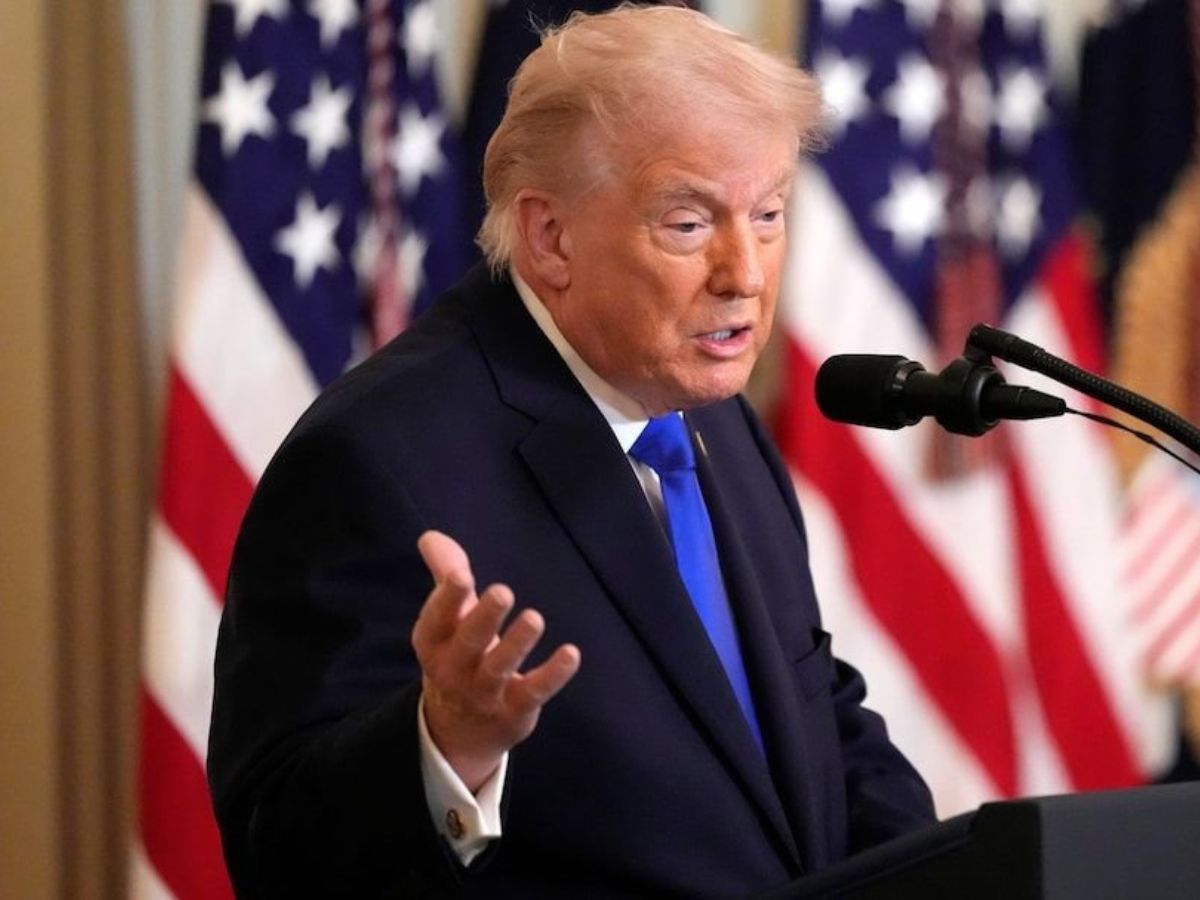
By the second week of the United States war with Iran, a striking gap has opened between battlefield reality and political rhetoric. President Donald Trump continues to insist that the campaign will end “very soon” and has suggested that the operation is already close to completion. Yet the war itself tells a more complicated story.
The uncertainty surrounding the war’s trajectory is also reflected in the president’s own shifting timeline.
When the conflict began, Trump suggested the campaign could conclude quickly, describing the operation as a short strike designed to cripple Iran’s military infrastructure and carry out a decapitation exercise.
Within days, however, the tone changed. Administration officials indicated that there were no fixed time limits on the operation and warned that the conflict could continue as long as necessary to achieve its objectives.
Now, as the war enters its second week, Trump has again returned to the language of a rapid end, saying the conflict will be over “very soon.”
Such oscillation in timelines is not merely rhetorical inconsistency. It reflects the difficulty of reconciling early expectations with battlefield reality.
Iran’s ability to continue launching missiles and threatening regional infrastructure has complicated the prospect of a quick military conclusion. At the same time, reports have emerged that Washington has quietly explored diplomatic channels through intermediaries to gauge the possibility of a ceasefire. Even if formal negotiations have not begun, the existence of such contacts suggests that political exit options are being examined alongside the ongoing military campaign.
The central fact is simple. Iran is still fighting.
Missiles and drones continue to be launched across the region. Gulf infrastructure remains under threat. Nearly two weeks into sustained air strikes, Iran’s retaliatory capability has not disappeared. In modern American air campaigns the first operational objective is to suppress the enemy’s ability to strike back. If that capability persists well into the second week, the conflict has already moved beyond the quick-strike timeline that was initially implied.
This makes the contrast with the rhetoric that preceded the war even more striking.
In the weeks before the conflict began, Washington signaled overwhelming military readiness.
Beginning in late January the United States launched what officials described as the largest military buildup in the Middle East since the 2003 invasion of Iraq, deploying multiple carrier strike groups, stealth aircraft and large numbers of fighter jets across bases in Israel, Jordan and the Gulf.
The buildup included two aircraft carrier groups led by the USS Gerald R. Ford and USS Abraham Lincoln, along with F-22 and F-35 fighter deployments and extensive tanker aircraft to sustain long-range strike operations.
The message was unmistakable. Washington intended to demonstrate overwhelming military power and signal that Iran could be defeated quickly if war broke out.
When the strikes finally began on 28 February under what became known as Operation Epic Fury, early statements reinforced the expectation of a short campaign. Officials suggested the military phase could last roughly four to five weeks, with rapid destruction of Iranian command structures and missile infrastructure.
But the battlefield has not followed that script.
Iran continues to demonstrate an ability to launch missiles and drones, threaten regional shipping routes and disrupt energy infrastructure. That persistence reflects a strategic choice Tehran made long before this war began.
Instead of building a conventional army capable of defeating the United States in open battle, Iran invested heavily in survivability. Missile forces are dispersed and launchers are mobile. Command networks are redundant with many facilities buried deep underground in hardened tunnel complexes. The entire architecture is designed to ensure that even after heavy bombing Iran retains the capacity to impose costs.
Signs of adjustment are also visible in the military posture of the United States itself.
Reports indicate that Washington is considering redeploying air defense systems and other military assets from bases in South Korea to reinforce its posture in the Middle East.
Such moves are not routine. The Korean peninsula is one of the United States’ most sensitive strategic theaters because of the constant threat from North Korea. When assets begin shifting away from East Asia toward the Gulf, it suggests that the demands of the Iran conflict are greater than initially anticipated and that the Pentagon is adjusting its force distribution to sustain operations.
The economic consequences of that resilience are already being felt far beyond the battlefield.
Energy markets reacted immediately when the war began. Oil prices surged above $100 per barrel for the first time in years as the conflict disrupted shipping through the Strait of Hormuz, a narrow passage through which roughly one fifth of the world’s oil normally flows.
The shock has quickly reached American consumers. National gasoline prices have jumped roughly 17 percent since the war began, averaging around $3.48 per gallon, with some states experiencing even sharper increases.
In California the impact has been especially dramatic. Average prices there have climbed above $5 per gallon, with some stations charging more than $8 amid supply disruptions and regional taxes.
Diesel prices, which affect trucking, agriculture and supply chains, have risen even faster. Economists warn that sustained high oil prices could push inflation higher and begin affecting food and transportation costs across the American economy.
That creates a new dimension of pressure for the White House. Wars abroad rarely remain purely military events. They quickly become economic and political events at home.
A recent Reuters-Ipsos poll shows that only about 29 percent of Americans approve of the strikes on Iran, and most expect gasoline prices to continue rising as the conflict continues.
In the United States, fuel prices have long been one of the most politically sensitive economic indicators. When they rise sharply, the effect is immediate and visible. Every driver sees it at the pump.
This is where the strategic dilemma begins to take shape.
If Iran continues to demonstrate the ability to launch missiles and destabilize regional energy markets, Washington faces a narrowing set of choices.
Trump could escalate the war further, expanding strikes against hardened infrastructure and potentially widening the conflict. It could seek a negotiated end through intermediaries. Or it could redefine its objectives and declare the mission accomplished.
History shows that the third option is often chosen in limited wars.
In the 1991 Gulf War the United States and its allies launched a massive campaign to expel Iraqi forces from Kuwait. Once that objective was achieved the coalition stopped short of overthrowing Saddam Hussein and declared victory. The broader political transformation of Iraq was left unresolved.
A similar pattern emerged during NATO’s 1999 air war against Yugoslavia. After seventy-eight days of bombing, Serbian forces withdrew from Kosovo. NATO declared the operation successful even though the regime in Belgrade remained in place.
Even the early phase of the Afghanistan war followed this logic. The immediate objective was framed as dismantling al-Qaeda’s sanctuary and removing the Taliban regime that hosted it. Once those goals were achieved within months, the operation was presented as a success despite the much longer conflict that followed.
These examples illustrate a recurring pattern of American warfare. When decisive victory becomes costly or uncertain, the government in power adjust the definition of success rather than escalate indefinitely.
The emerging dilemma in the Iran war resembles that pattern. If Iran continues to demonstrate the ability to launch missiles and disrupt regional energy flows, the United States must decide whether to expand the conflict or limit it. Expanding the war would mean deeper strikes against hardened missile networks and potentially a wider regional confrontation including losses to its allies in Gulf. Limiting it would require defining a point at which Washington can say its objectives have been met.
None of this guarantees that the war will end quickly. Iran may continue attempting to impose costs across the region, and further escalation cannot be ruled out. But the second week of the conflict reveals a clearer strategic reality than the dramatic opening days.
The war that was publicly framed as a short campaign has become a contest between military pressure, economic disruption and political endurance.
If that balance continues, Washington may eventually conclude that it has achieved enough to stop. And when that moment arrives, history suggests the outcome will likely be presented in familiar terms: the objective was achieved, deterrence restored, and the mission complete.




