
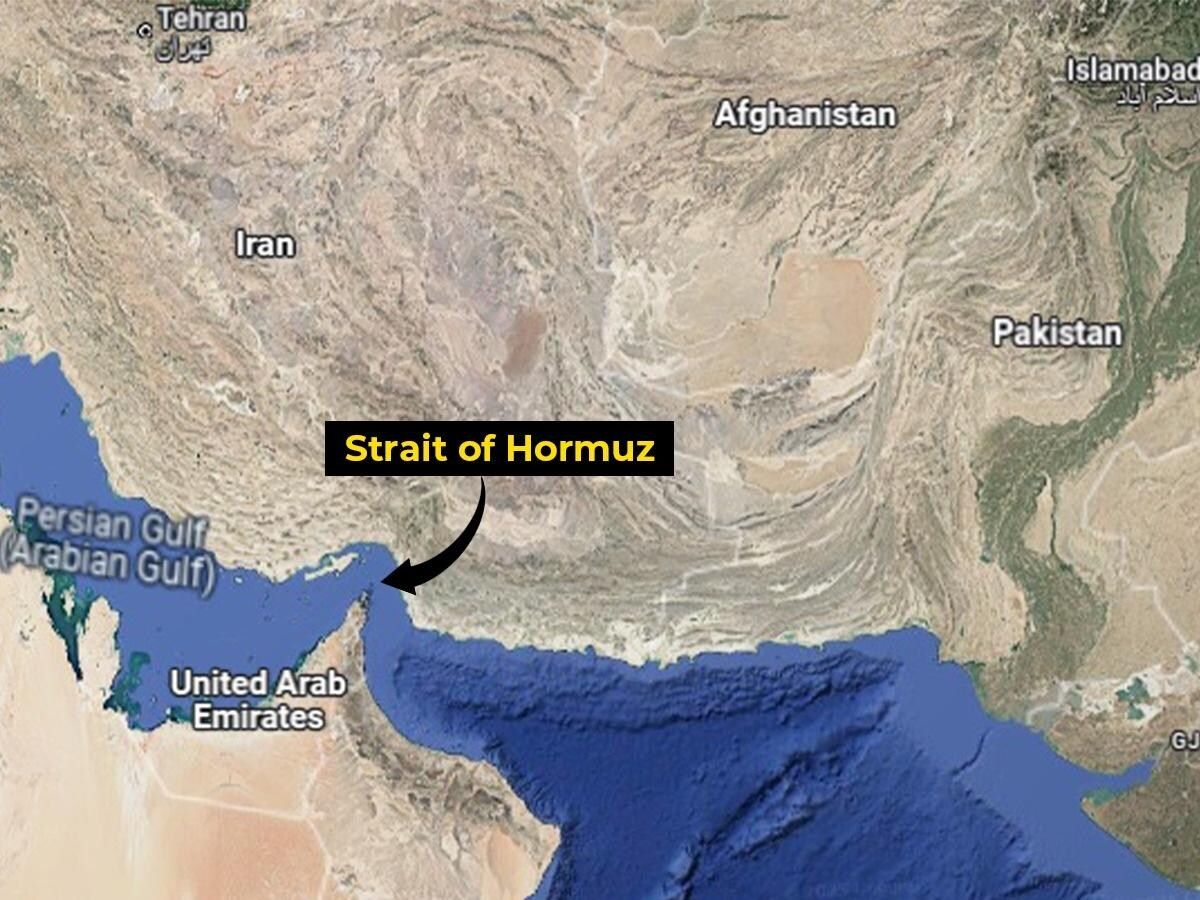
Tensions in the Middle East have sharply escalated after US and Israeli strikes on Iranian targets triggered retaliatory actions from Tehran. As missile exchanges intensify across the region, global markets have turned their focus to one critical chokepoint: the Strait of Hormuz. Iranian officials have hinted at restricting or even closing the waterway, raising fears of a severe disruption to global oil and gas supplies.
Energy traders, shipping companies and governments are closely monitoring the situation. Even without a formal closure, reports of heightened military activity, vessel warnings and tanker delays have already rattled oil markets. Analysts warn that any prolonged disruption in the Strait of Hormuz could send crude prices surging and trigger wider economic shocks worldwide.
Iran-Israel War: Where is the Strait of Hormuz?
The Strait of Hormuz sits between Iran on one side and Oman and the United Arab Emirates on the other. It connects the Persian Gulf to the Gulf of Oman and the Arabian Sea, serving as the only sea passage for most Gulf oil exports.
At its narrowest point, the strait measures about 33 kilometres wide, while the designated shipping lanes are only about 3 kilometres wide in each direction. This narrow passage makes it highly vulnerable during times of military tension.
Despite its size, the strait handles some of the world’s largest oil tankers. Gulf producers depend on it to transport crude oil and liquefied natural gas (LNG) to international markets.
Iran-Israel War: How Much Oil & Gas Passes Through the Strait of Hormuz?
The Strait of Hormuz carries a significant share of global energy supplies. In 2024, around 20 million barrels of oil per day passed through the waterway. That volume represents roughly 20–30 per cent of the world’s seaborne oil trade.
Major producers, including Saudi Arabia, Iraq, Iran, Kuwait, Qatar and the UAE, ship their crude through this route. The Strait also plays a key role in LNG trade. About one-fifth of global LNG shipments, largely from Qatar, move through this corridor.
Energy analysts stress that even short-term disruptions could tighten global supply and push oil prices higher almost immediately.
Iran-Israel War: Where Does All the Oil Go?
Most of the oil and gas flowing through the Strait of Hormuz heads to Asia. In 2024, around 84 per cent of crude shipments moving through the strait went to Asian markets. Countries like China, India, Japan and South Korea depend heavily on Gulf energy imports.
These economies rely on stable oil supplies to power industries, transport networks and electricity generation. A sudden supply shock would raise fuel prices, increase production costs and slow economic growth.
The strait also supports imports into Gulf countries such as Kuwait and the UAE, which receive shipments from the United States and West Africa.
Iran-Israel War: How Would the Strait of Hormuz’s Closure Impact Oil Prices?
Although Iran has not officially closed the Strait, recent developments have intensified concerns. Vessels crossing the waterway reportedly received warnings via very high frequency (VHF) transmissions stating that “no ship is allowed to pass the Strait of Hormuz”. However, officials clarified that Iran has not formally announced a shutdown.
Shipping data indicates that many oil tankers have anchored in Gulf waters rather than transit the strait. Reports suggest that at least 150 tankers, including crude and LNG carriers, have paused movement due to security concerns.
Muyu Xu, senior crude oil analyst at Kpler, said: “The Strait of Hormuz is critical to the global energy market, as roughly 30 per cent of the world’s seaborne crude oil transits the waterway. In addition, nearly 20 per cent of global jet fuel and about 16 per cent of gasoline and naphtha flows also pass through the Strait.”
He added, “On Sunday, an oil tanker was struck off the coast of Oman just hours ago, signalling a clear escalation of the conflict and a shift in targets from purely military facilities to energy assets.”
Ali Vaez, director of the Iran project at the International Crisis Group, said, “Closure of the Strait of Hormuz would disrupt roughly a fifth of globally traded oil overnight – and prices wouldn’t just spike, they would gap violently upward on fear alone.”
Iran-Israel War: How Would the Oil Market in India Be Affected?
India is one of the world’s largest crude oil importers, and it depends heavily on supplies from the Middle East. Nearly 60–65 per cent of India’s crude oil imports come from Gulf countries such as Iraq, Saudi Arabia, the UAE and Kuwait — most of which ship their oil through the Strait of Hormuz.
If tensions disrupt traffic through the strait or push global crude prices higher, India would immediately feel the impact. Higher international crude prices would raise India’s import bill, weaken the rupee and widen the current account deficit.
Oil marketing companies could face pressure to increase petrol, diesel and LPG prices if crude stays elevated for a sustained period. Even if the government temporarily absorbs some of the shock through tax cuts or subsidies, prolonged high prices would strain public finances.
A spike in oil prices would also push up transportation costs, food prices and manufacturing expenses, adding to inflation. This could make it harder for the Reserve Bank of India to cut interest rates.
Iran-Israel War: What Does it Mean for the Global Economy?
A sustained spike in oil prices would affect far more than fuel costs. Higher crude prices typically drive up transportation, manufacturing and food costs, increasing global inflation.
Hamad Hussain, a climate and commodities economist at Capital Economics, said, “If crude oil prices were to rise to $100 per barrel and remain at those levels for a while, that could add 0.6-0.7 per cent to global inflation.”
He added, “This could slow the pace of monetary easing by major central banks, particularly in emerging markets, where policymakers tend to be more sensitive to swings in commodity prices.”
Economists warn that fragile economies could face renewed pressure if oil prices remain elevated for an extended period. Financial markets could also react sharply to any confirmed disruption in Hormuz shipping.
For now, the strait remains technically open. However, continued military escalation between the US, Israel and Iran keeps global energy markets on edge. Even the threat of closure alone has proven powerful enough to shake oil prices and raise fears of broader economic instability.




