
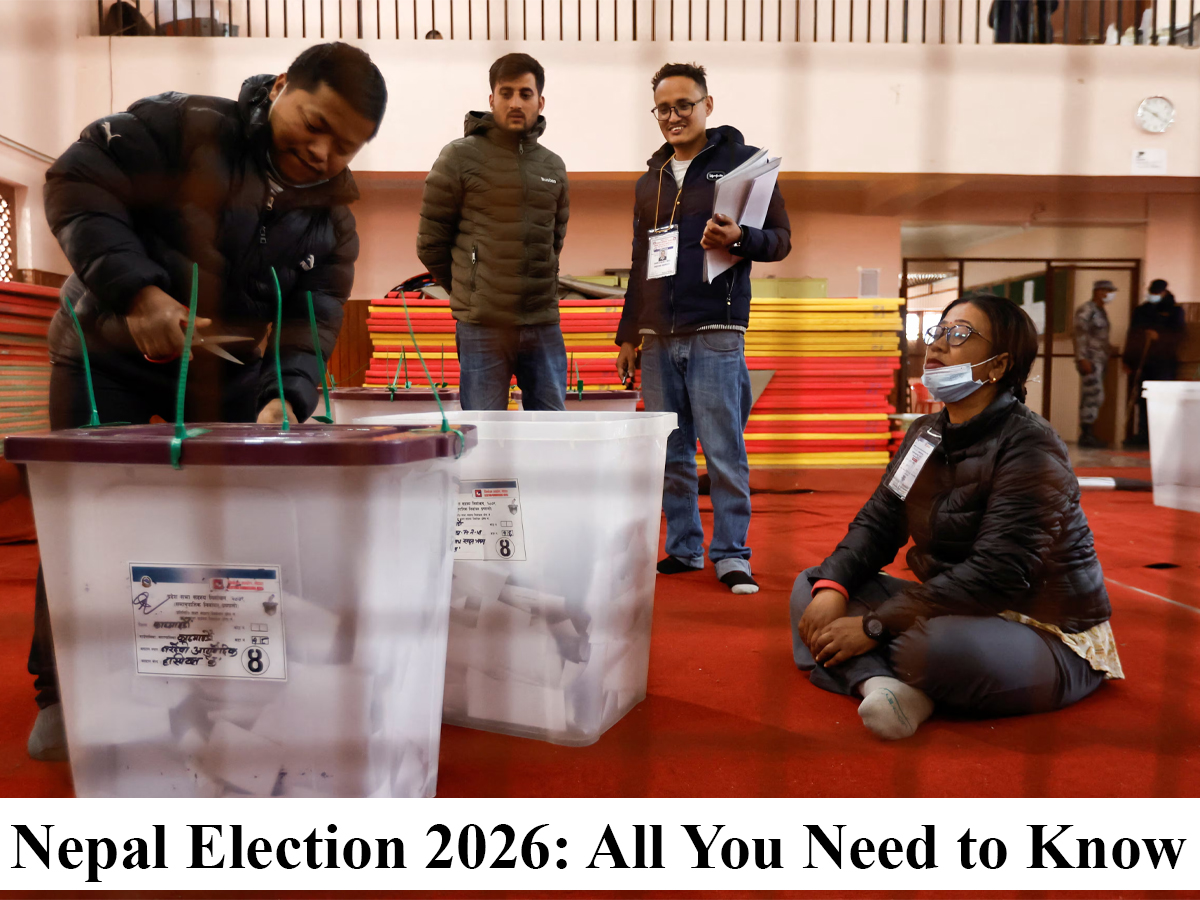
As Nepal votes on March 5, 2026, the nation stands at a major political crossroads. This election marks the first national vote since violent, youth-led protests last year forced the resignation of then-Prime Minister KP Sharma Oli and set the stage for big political change. The polls will determine the next government of the Himalayan republic and reflect how voters respond to calls for reform, economic opportunities, and accountability after months of unrest.
Below is a complete, easy-to-understand guide covering what the Nepal election is about, when and how voting happens, who is running, the main issues driving the vote, and how results will be counted and announced.
Nepal Election 2026: When are the Nepalis Voting?
Nepal’s nationwide election for the House of Representatives, the lower house of parliament, takes place on Thursday, March 5, 2026. This is the first election after the Gen-Z protest, which happened in Nepal on 8th September 2025, and witnessed an aggressive protest.
Nepal Election 2026: What is the time for Nepal Election Voting?
Polling stations for the election will be open at 07:00 (GMT) and are scheduled to close at 17:00 (GMT), although in some areas voters are allowed to cast their ballots later to ensure everyone gets to vote. Nepal is 15 minutes ahead of India.
Nepal Election 2026: Who Can Vote in Nepal Election 2026?
Nearly 19 million Nepalis are eligible to vote, including around 800,000 first-time voters, many of them young adults who have been active in political debates since the protests.
Nepal Election 2026: When will the result come?
Nepal’s Election Commission has said it plans to announce the outcomes of the 165 first-past-the-post seats within 24 hours after ballot boxes are gathered from across the country, a process that itself usually takes at least a full day.
Acting Chief Election Commissioner Ram Prasad Bhandari informed local media that counting votes under the proportional representation system, which decides the allocation of 110 seats, may require an additional two to three days.
If the commission manages to stick to this timeline, it would mark a significant change from the country’s experience with election result announcements.
During Nepal’s previous general election in 2022, authorities took more than two weeks to publish the complete and final results.
Nepal Election 2026: Who are the Major Parties in Nepal Election?
Nepal is divided into seven provinces which named, Koshi, Madhesh, Bagmati, Gandaki, Lumbini, Karnali, and Sudurpaschim are the seven provinces. The key political parties contesting the election include the RSP, Congress, UML, NCP, RPP, PSP-N, Janamat, UNP, along with several other smaller parties.
Nepal Election 2026: Who Are the Main Contenders?
Nepal’s elections feature candidates from across the political spectrum, from veteran leaders to fresh faces inspired by recent protests.
Veteran Politicians
KP Sharma Oli: Former prime minister and leader of the Communist Party (UML), seeking a comeback despite controversy over his last term.
Gagan Thapa: Leader of the old-established Nepali Congress, focused on corruption reform and job creation.
Rising New Leaders
One of the most discussed figures in this election is Balendra “Balen” Shah, a former rapper and civil engineer who became a popular mayor of Kathmandu and now heads a reformist movement appealing to young and urban voters.
Shah and his party are campaigning on promises of economic reform, transparency, and bridge-building between Nepal’s traditional political establishment and voters who want change.
Nepal Election 2026: What is Nepal’s Mixed Electoral System?
Nepal uses a mixed system combining direct and proportional voting, designed to balance local constituency representation with broader party strength.
First Past the Post (FPTP)
- 165 seats in the lower house are decided by direct voting.
- In each constituency, the candidate with the most votes wins a seat.
Proportional Representation (PR)
- 110 seats are filled based on party vote share nationwide.
- Voters cast a separate ballot for a party list.
- This system aims to ensure smaller parties and diverse voices gain representation.
Why are there two systems in Nepal Election?
Combining FPTP and PR helps prevent domination by a single party and encourages coalition governments. It also reflects Nepal’s social diversity and makes sure smaller groups and voices have a chance to be heard in parliament.
Nepal Election 2026: Why This Election Matters?
This vote comes after a turbulent year. In September 2025, large protests led largely by young people erupted over corruption, economic stagnation, and public anger at political elites. Security forces cracked down, leading to widespread unrest and loss of life, and ultimately the resignation of the prime minister.
An interim government led by former chief justice Sushila Karki took over with a promise to restore stability and hold elections within six months. Polls on March 5 are the fulfillment of that pledge and are seen as a crucial test of Nepal’s democracy.
What are the Key Reasons to Vote in the Nepal Election?
- It will replace the interim government and establish a fully elected legislature.
- It tests the appeal of new, younger political figures against traditional party leaders.
- Nepal’s next government will guide the country’s economic direction, anti-corruption efforts, and foreign policy, especially ties with neighbouring powers.
Nepal Election 2026: What Are the Main Issues Driving the Vote?
Corruption
Nepalis are deeply concerned with political corruption, and this issue played a central role in the Gen Z uprising that led to these elections.
Jobs and Economy
High unemployment, especially among young people, is pushing voters to demand economic opportunity and better governance.
Foreign Relations
As Nepal negotiates its position between neighbouring giants India and China, foreign policy will be a key topic, especially trade, investment, and border management.
Climate and Local Concerns
For communities like the Sherpa in the Everest region, environmental issues and climate change are rising priorities as well.
Nepal Election 2026: What Security and Conduct Plans Are in Place
Authorities have briefed voters on code-of-conduct rules, and security teams are deployed nationwide to ensure a peaceful process. Some local areas have seen concerns about violations of election rules, but officials are stepping up monitoring efforts.
Home officials have also confirmed comprehensive security measures to protect voters’ rights and guard against disruptions on election day.




