
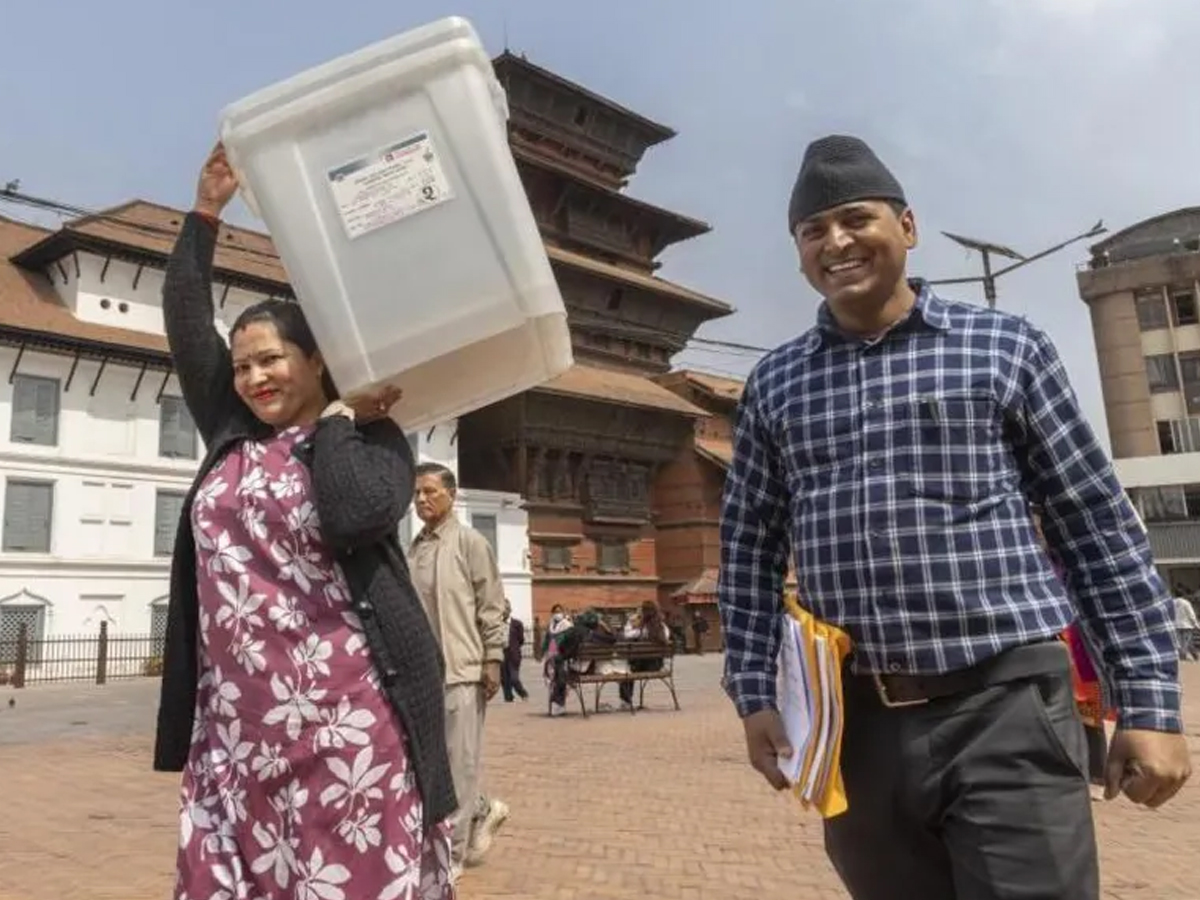
Nepal is holding a crucial parliamentary election today as millions of citizens head to polling stations across the Himalayan nation to choose a new government. The vote marks the first national election since last year’s mass protests led largely by young people, which forced the resignation of the government led by KP Sharma Oli.
Around 19 million voters out of Nepal’s population of about 30 million are eligible to participate in the election. They will elect members of the 275-seat House of Representatives, which will determine the country’s next prime minister and government.
The election has attracted intense political competition, with dozens of parties and thousands of candidates seeking representation in parliament.
Nepal Election 2026: How Many Seats Are in Nepal’s Parliament?
Nepal’s lower house, the House of Representatives, has 275 members. The seats are filled through a combination of two voting systems designed to balance local representation with proportional party strength.
A total of 3,406 candidates are contesting for 165 seats that are decided through direct voting. Another 3,135 candidates are competing for the remaining 110 seats under the proportional representation system.
According to the country’s Election Commission, 65 political parties are participating in the nationwide contest. To facilitate voting across the country, authorities have set up 10,967 polling booths and 23,112 polling centres.
Voting began at 7 AM Nepali time and will continue until 5 PM.
Election Day in Nepal: Nepal Election Candidates and Main Political Parties
Several major political parties and leaders are competing in this election, each hoping to form the next government.
The Communist Party of Nepal–Unified Marxist Leninist (CPN-UML), led by former prime minister KP Sharma Oli, is attempting a political comeback after losing power during last year’s protests.
Meanwhile, the Rastriya Swatantra Party (RSP) has emerged as a strong challenger by highlighting issues raised during the youth-led demonstrations. The party is led by Ravi Lamichhane, with prominent figure Balendra Shah playing a key role in its campaign.
The Nepali Congress has also tried to attract younger voters with reformist leadership. The party has projected Gagan Thapa as its prime ministerial candidate.
The RSP has put forward former Kathmandu mayor Balen Shah, 35, as its candidate for prime minister. Meanwhile, CPN-UML has once again projected 75-year-old Oli for the top post.
Another traditional political force in the election is the Communist Party led by Pushpa Kamal Dahal, widely known as Prachanda.
How Nepal’s Voting System Works: FPTP and Proportional Representation
Nepal uses a mixed electoral system that combines the First Past the Post (FPTP) method with proportional representation.
First Past the Post (FPTP)
Under the FPTP system, 165 seats in parliament are decided through direct elections. The country is divided into constituencies, and voters choose individual candidates. The candidate who receives the highest number of votes wins the seat.
Proportional Representation (PR)
The remaining 110 seats are allocated through proportional representation. In this system, voters cast their ballot for a political party instead of an individual candidate.
Seats are then distributed among parties according to the total number of votes each party receives nationwide.
Nepal Election 2026: Why Nepal Uses Two Voting Systems
The mixed system aims to ensure both local representation and fair participation of smaller political parties. By combining direct and proportional voting, Nepal hopes to prevent a single party from dominating parliament.
Nepal Election 2026: When Will Nepal Election Results Be Declared?
Vote counting will begin soon after polling stations close and ballot boxes are transported to counting centres. However, the final results may take several days.
Officiating Chief Election Commissioner Ram Prasad Bhandari told local reporters that counting results for the 165 directly elected seats could be completed within 24 hours after the ballot boxes arrive at counting centres.
However, the proportional representation results could take an additional two to three days to finalize.
Nepal’s challenging geography is one of the main reasons for the delay. Many polling stations are located in remote mountainous areas where transporting ballot boxes can be difficult.
In some regions, election officials must carry ballot boxes by hand down steep mountain trails. In others, helicopters are required to transport them.
Another factor that may slow down the process is the presence of party representatives at counting centres. These representatives sometimes raise objections about vote validity or counting procedures, which can extend the tallying process.
In the last parliamentary election held in 2022, authorities took more than two weeks to officially announce the final results.
With political tensions still fresh after last year’s protests, the outcome of this election will play a major role in shaping Nepal’s political future and determining who will lead the country in the coming years.




