
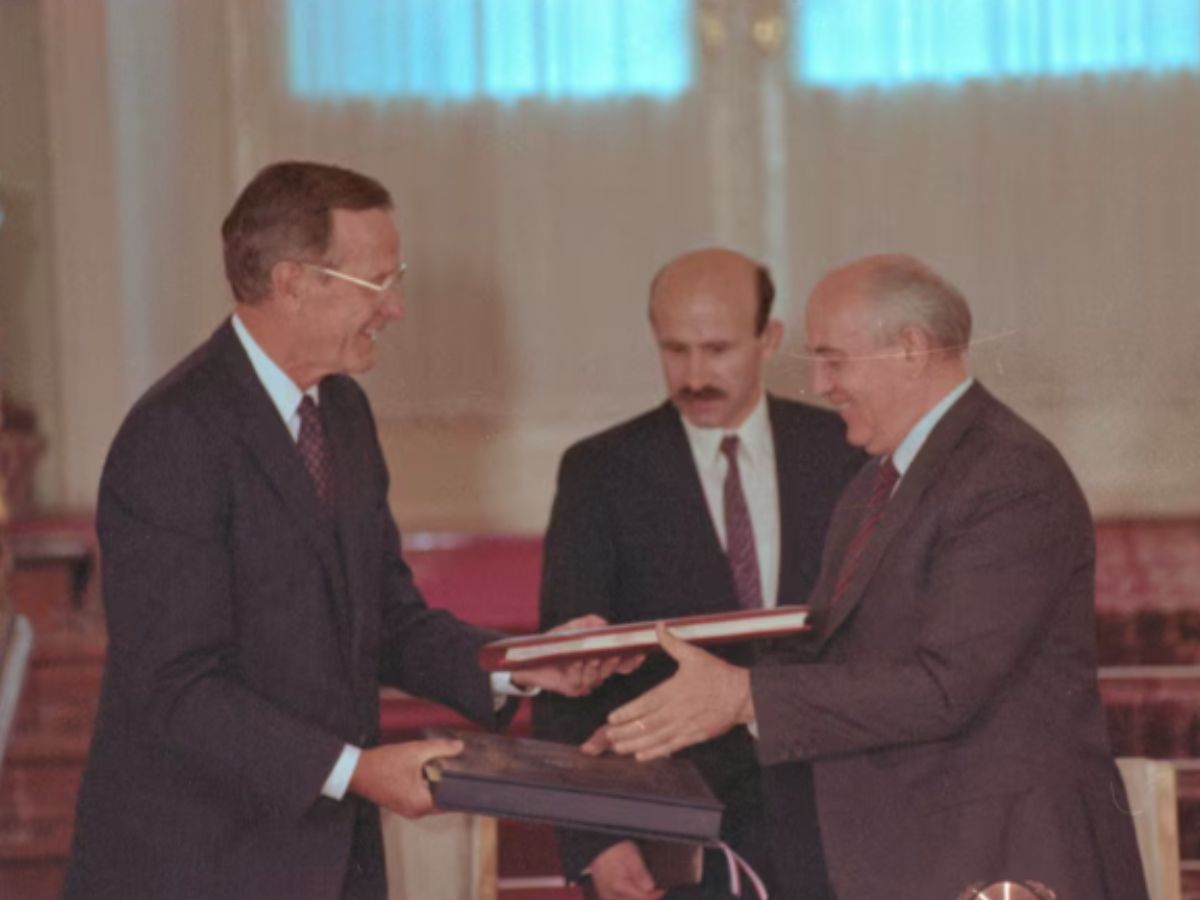
Even during the Cold War, when the United States and Russia are bitter rivals, both sides agreed on one important thing they needed rules to stop their nuclear weapons race from getting out of control.
From 1969 until after the Soviet Union collapsed in 1991, Washington and Moscow signed several arms-control agreements. These treaties created a stable system that limited how many nuclear weapons each side could keep.
Now that long-standing system is in danger. The New START treaty the last remaining nuclear arms agreement between the U.S. and Russia will expire on February 5, just weeks from now. What happens after that remains unclear because the two countries have not held talks about a replacement, mainly due to the war in Ukraine.
Putin’s proposal to extend New START
In September, Russian President Vladimir Putin suggested that both countries should keep following the New START limits for another 12 months. The treaty caps each side’s deployed nuclear warheads at 1,550.
So far, U.S. President Donald Trump has not officially responded. Western security experts are divided on whether the United States should accept Putin’s offer.
Supporters say a short extension would give both sides more time to negotiate a long-term deal and show that they still support nuclear arms control.
Critics, however, warn it could help Russia. Moscow is developing new weapons that are not covered by New START, such as the Burevestnik cruise missile and the Poseidon nuclear torpedo.
Former U.S. defence official Greg Weaver wrote in a paper for the Atlantic Council that Russia has also refused since 2023 to allow inspections that would prove it is still obeying the treaty.
Weaver added that accepting Putin’s plan would also send a wrong signal to China. It would suggest that the U.S. will not expand its nuclear forces even as China rapidly increases its own arsenal.
"This signal would likely undermine the prospects for bringing China to the arms control negotiating table, indicating to China that US forces will remain limited regardless of what China does."
Nuclear balance between the U.S., Russia, and China
According to the Federation of American Scientists, Russia has about 5,459 nuclear warheads and the United States has 5,177. Together, they control nearly 87% of the world’s nuclear weapons.
China is far behind in numbers but is growing fast. It now has around 600 warheads, and the U.S. Pentagon estimates it could exceed 1,000 by 2030.
Trump has said he wants to pursue "denuclearisation" talks with both Russia and China. But Beijing has rejected this idea, calling it "unreasonable and unrealistic" because its arsenal is much smaller than those of the U.S. and Russia.
Russia has further complicated matters by saying that the nuclear weapons of Britain and France both NATO members should also be part of any future talks. Those countries have refused.
Why a new global nuclear treaty is difficult
Nikolai Sokov, a former Russian arms negotiator, said trying to create a new international nuclear agreement under current conditions is extremely difficult. He called it "almost a dead end. It will take forever."
Sokov said one option could be a new U.S.–Russia treaty that allows flexible limits to reflect China’s growing nuclear force. But even that would take years.
Reducing the risk of nuclear war
Sokov believes the most urgent step right now is not a new treaty, but reducing the risk of a nuclear accident. Currently, only the U.S. and Russia have a 24-hour emergency hotline for nuclear crises. Europe does not. "No European capital, not even the NATO headquarters, can actually communicate with Moscow. There is no dedicated line," Sokov said.
He stressed that building trust and communication should come first. "If parties at the same time also begin negotiations on arms control, that would be great. But you need to understand that the next treaty will be very, very complex... It will take time. So the number one priority is risk reduction and confidence building."