
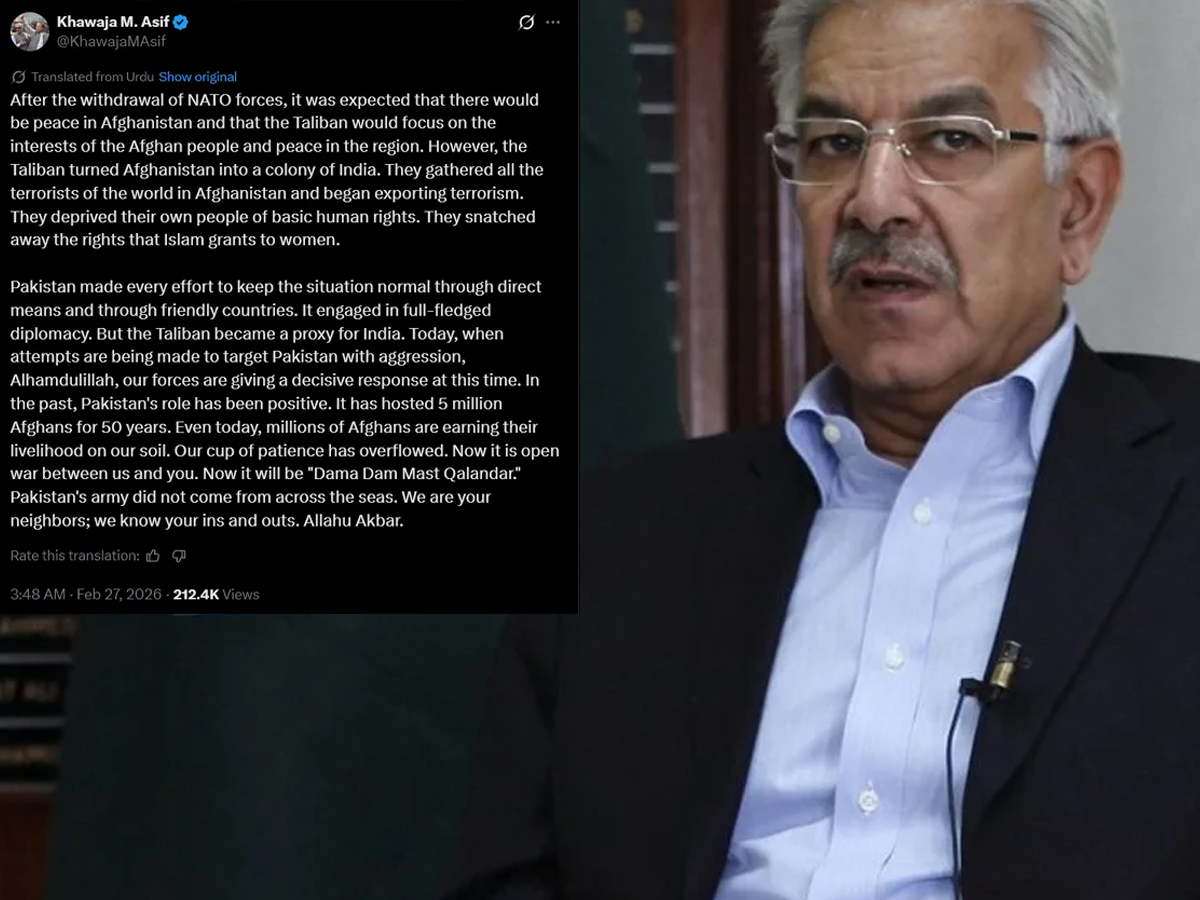
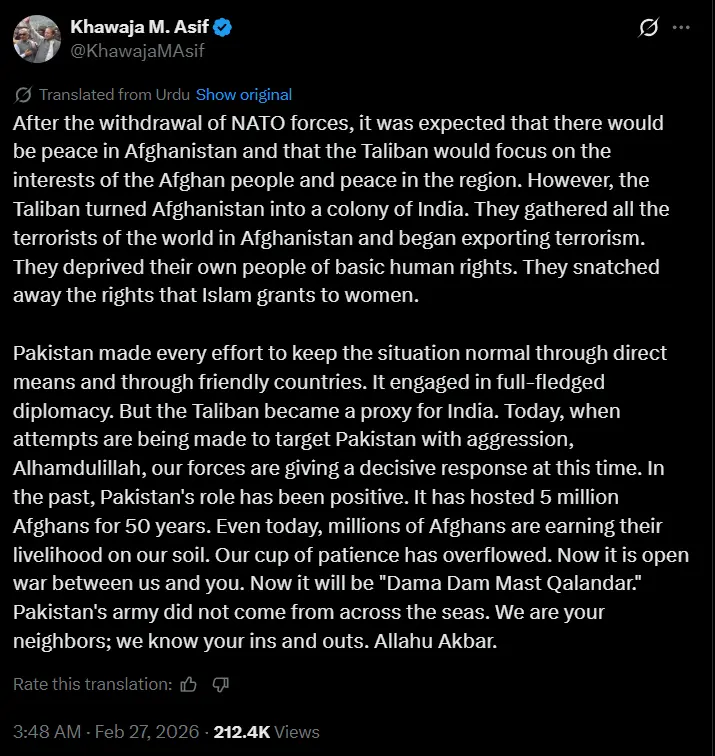
Pakistan Afghanistan War: News: Pakistan’s military has dramatically escalated hostilities with Afghanistan’s Taliban-led administration, declaring an “open war” after intensified cross-border fighting that has shaken regional stability. Defence Minister Khawaja Asif took to X, saying the crisis had reached a breaking point. “Our patience has reached its limit. Now it is open war between you and us,” he wrote, framing the confrontation as a direct challenge from Kabul.
Pakistan’s decision came amid reports of loud explosions, aircraft activity over Kabul, and airstrikes in Kandahar and Paktia provinces early Friday. Afghan officials claim these strikes were unleashed following their own military’s retaliatory offensive along the disputed Durand Line, but Islamabad insists its actions were in direct response to what it calls unprovoked attacks by Afghan forces.
Pakistan-Afghanistan War: What Khawaja Asif Said About Afghanistan’s Government?
In his post, Khawaja Asif sharply criticised the Taliban rulers. He said that after the Nato withdrawal, Pakistan had hoped for peace and stability in Afghanistan. Instead, he claimed the Taliban had turned the country into “a colony of India,” suggesting Kabul had shifted regional dynamics and security threats unfavorably.
Asif also accused the Taliban of denying basic human rights to their own people and of failing to take effective action against militant groups operating from Afghan territory. He pointed to Islamabad’s repeated efforts to keep relations normal — through direct dialogue and involving friendly nations — but added that attacks against Pakistan compelled a stronger response.
Pakistan-Afghanistan War: Cross-Border Fighting Along the Durand Line
The severity of the conflict has surged following months of tension along the Pakistan-Afghanistan border, known as the Durand Line. Both sides have traded accusations of aggression and denial of responsibility for civilian casualties. Afghanistan’s Taliban government claimed its forces had launched “wide-ranging retaliatory operations” in regions like Kandahar and Helmand after Pakistan’s latest strikes, claiming dozens of Pakistani soldiers were killed and some captured during the clashes.
Pakistan’s information ministry countered by saying Afghan forces opened “unprovoked fire” in Khyber Pakhtunkhwa province, prompting Islamabad’s “immediate and effective” military response. Both nations have reported military success and rejected opposing casualty figures, deepening mistrust.
Pakistan-Afghanistan War: Airstrikes Hit Major Afghan Cities
Explosions and aircraft activity were reported in Kabul and other Afghan cities as Pakistan’s air force hit targets inside Afghan borders. Afghanistan’s Taliban spokesman acknowledged the strikes and defended his forces’ counter-attacks. These airstrikes mark one of the most serious escalations of violence in years between the two neighbours and signal that the conflict is now extending beyond frontier skirmishes into direct aerial engagement.
Pakistan-Afghanistan War: Broader Strain and Failed Mediation Efforts
The latest outbreak follows months of strained relations with border crossings largely closed since the October clashes that claimed dozens of lives on both sides. Diplomatic mediation efforts from countries including Qatar and Turkey have so far failed to hold. Pakistan has consistently accused the Taliban of harbouring militant groups like Tehrik-i-Taliban Pakistan (TTP) and Islamic State Khorasan Province fighters — claims the Taliban repeatedly denies.
Before this escalation, Pakistani air strikes in provinces such as Nangarhar and Paktika had already drawn international concern after the United Nations reported at least 13 civilian deaths. Those strikes added to the volatility of the border and helped set the stage for the recent full-blown confrontation.
With the militaries of both countries now directly engaged, regional observers fear a wider instability that could impact neighbouring nations. For now, diplomatic channels remain strained, and both Islamabad and Kabul are digging in for what could become one of the most serious regional conflicts in South Asia in recent years.




