Rhetoric on fighter exports clashes with production limits, attrition, and supply dependencies.
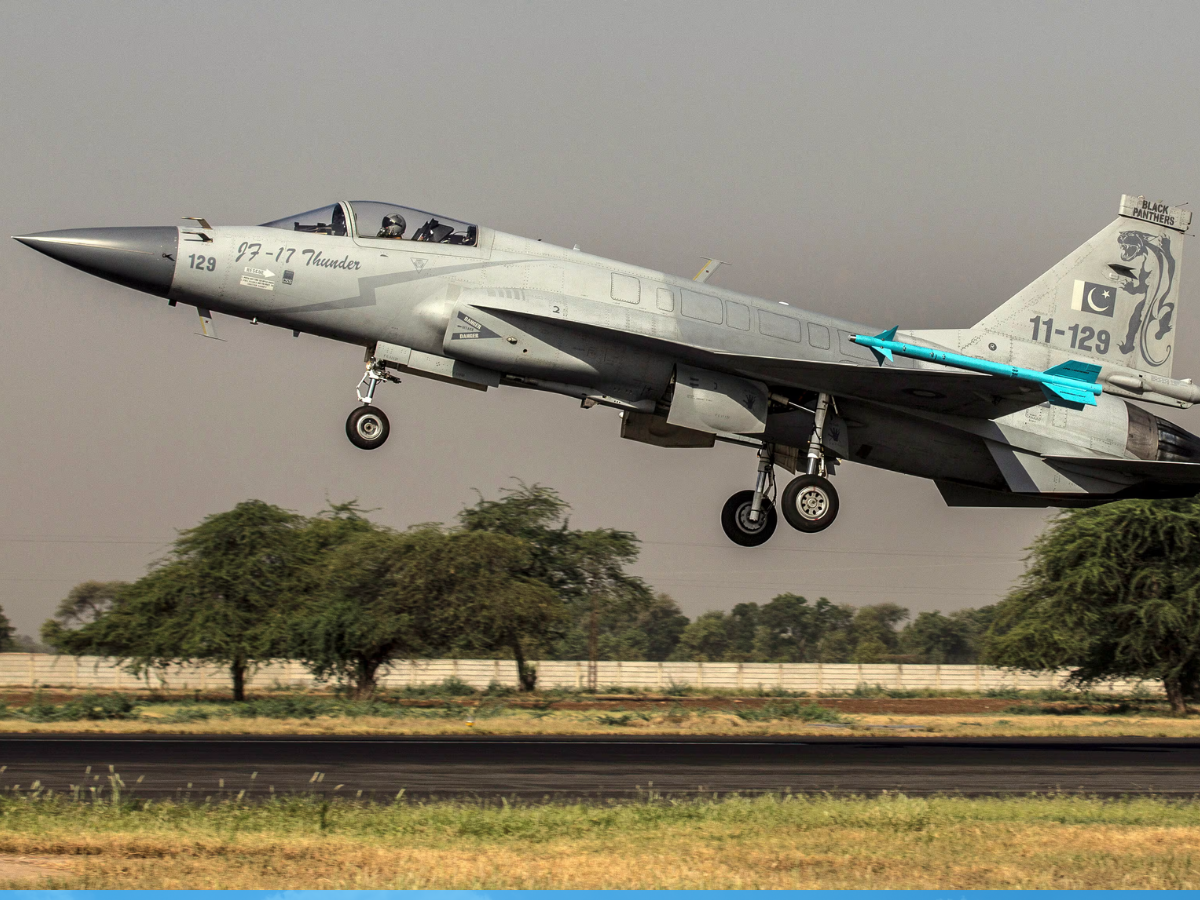
A JF17 Thunder fighter jet of the Pakistan Air Force takes off from Mushaf base in Sargodha north Pakistan (Photo: Reuters)
NEW DELHI: Pakistan’s recent claims of rising international demand for its JF-17 fighter aircraft sit uneasily with the programme’s demonstrated manufacturing record, which continues to show modest output sustained primarily to meet domestic requirements rather than to enable mass exports at scale.
Despite a surge in official rhetoric following the May 2025 aerial confrontation with India, the industrial reality at Pakistan Aeronautical Complex (PAC) Kamra remains that of a bottlenecked production ecosystem, exposing a persistent gap between marketing narratives and executable capacity.
Since the JF-17 entered serial production in the late 2000s, Pakistan has produced and inducted approximately 175-185 aircraft in total, a figure that includes all units supplied to foreign customers. Spread across roughly seventeen years, this equates to an average production rate of about eleven aircraft per year, underscoring the programme’s steady but low-volume character.
While current industrial assessments from early 2026 indicate a calibrated increase in output to roughly 16-18 aircraft annually at PAC Kamra, this tempo remains inadequate to simultaneously support domestic recapitalisation and large-scale international deliveries. This constraint persists even as sections of the international media amplify narratives of surging demand for the aircraft and inflate Pakistan’s ability to meet such expectations.
Chinese aerospace analysts have sought to frame this mismatch as a “sweet problem,” arguing that rising demand could justify further Chinese capital infusion into the programme. However, there is no visible evidence of the structural changes necessary to support such a surge, including the establishment of multiple parallel final assembly lines, expanded subsystem integration capacity, or increased flight test and certification throughput.
Historically, the bulk of PAC’s JF-17 production has been absorbed by the Pakistan Air Force (PAF) itself. Eight operational squadrons, together with training and evaluation units, account for roughly 155-160 aircraft, leaving little headroom for exports without directly impacting domestic force levels.
The weakness in the export narrative becomes most apparent when assessed against the PAF’s own internal force-structure doctrine. The service mandates a minimum strength of 25 combat squadrons to maintain what it describes as a “defensive boxer” posture and to preserve force parity with its principal regional adversary, India.
To meet this requirement, the PAF must overcome a looming “replacement wall” of more than 250 legacy aircraft, specifically the Mirage III/V and F-7P/PG fleets, which are approaching or have reached airframe exhaustion. Even at a sustained peak production rate of eighteen aircraft per year, Pakistan would require nearly fourteen years of uninterrupted output merely to satisfy its own domestic replacement policy.
This industrial strain is further compounded by significant fleet attrition over the past decade.
During this period, the PAF has lost approximately 35 or more combat-capable aircraft to a combination of non-combat accidents and the May 2025 conflict, codenamed Operation Sindoor. At least 20-22 aircraft have been lost in accidents alone, including six confirmed JF-17 crashes since the type’s induction. Several incidents, including a June 2024 crash, were specifically attributed to failures associated with the RD-93 engine.
Verified reporting from early 2026 further confirms that Pakistan lost approximately 12-13 aircraft during the four-day Operation Sindoor conflict. These losses included advanced fighters downed in Beyond Visual Range engagements, as well as multiple airframes destroyed on the ground during precision strikes at Bholari and Nur Khan airbases.
Until recently, confirmed JF-17 exports were limited to sixteen aircraft delivered to Myanmar and three supplied to Nigeria. This changed in November 2025, when Azerbaijan officially inducted its first batch of five JF-17 Block III aircraft, unveiled during the country’s Victory Day parade. The induction followed a landmark $1.6 billion umbrella agreement signed in June 2025 for up to forty aircraft.
Even so, this contract alone represents an export backlog that would take Pakistan more than two years to fulfill even if it diverted 100 per cent of its current annual production to exports and effectively sidelined the needs of its own air force.
Meanwhile, reports of formal inquiries from Iraq, Bangladesh, and Indonesia in early 2026, along with expressions of “interest” from Saudi Arabia and Libya, remain largely aspirational. In the Saudi case, discussions are reportedly focused on converting roughly $2 billion in outstanding loans into military hardware rather than proceeding through a conventional commercial procurement process.
Structurally, the JF-17 programme remains dependent on external suppliers for critical components, most notably the Russian Klimov RD-93 engine and advanced Chinese avionics, which together account for an estimated 42 per cent of the aircraft’s production value.
Although Russia is reported to have proceeded with deliveries of the RD-93MA variant in late 2025, Pakistan does not exercise sovereign control over these upstream supply chains. This lack of control leaves any large-scale export commitment exposed to external geopolitical pressures, sanctions risk, and logistical disruption.
In effect, Pakistan has demonstrated competence as a steady, low-volume producer and assembler of the JF-17, capable of meeting domestic fleet requirements over time and fulfilling small export orders on extended timelines. What it has not yet demonstrated is the industrial depth or resilience required to sustain simultaneous, large-export commitments at the scale suggested by recent official statements.
Until production rates rise materially and are reflected in delivered aircraft rather than press releases and promotional claims, Pakistan’s JF-17 export narrative remains, in practical terms, a marketing campaign unsupported by its execution record.
