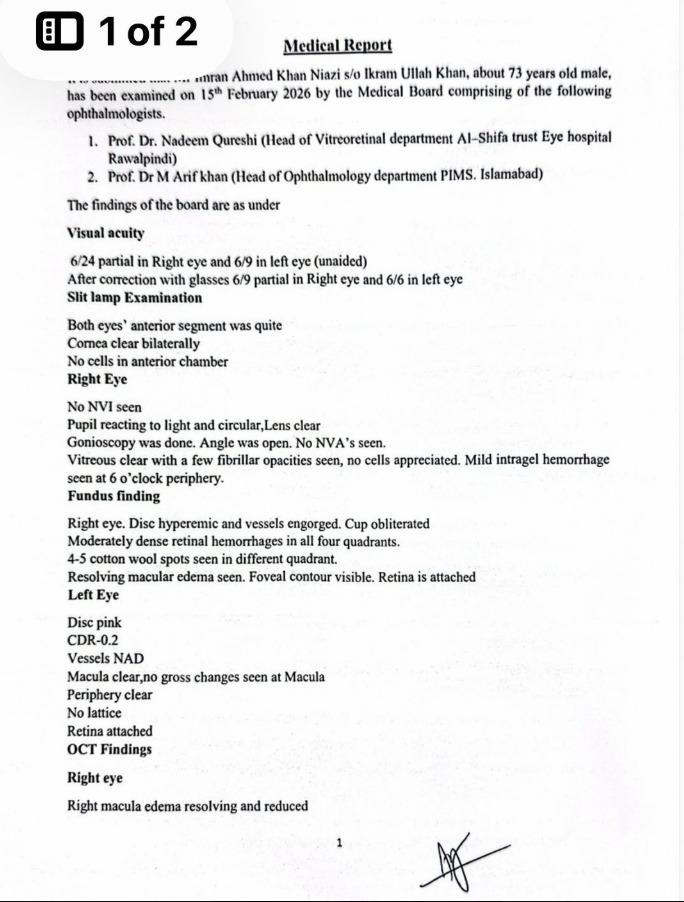
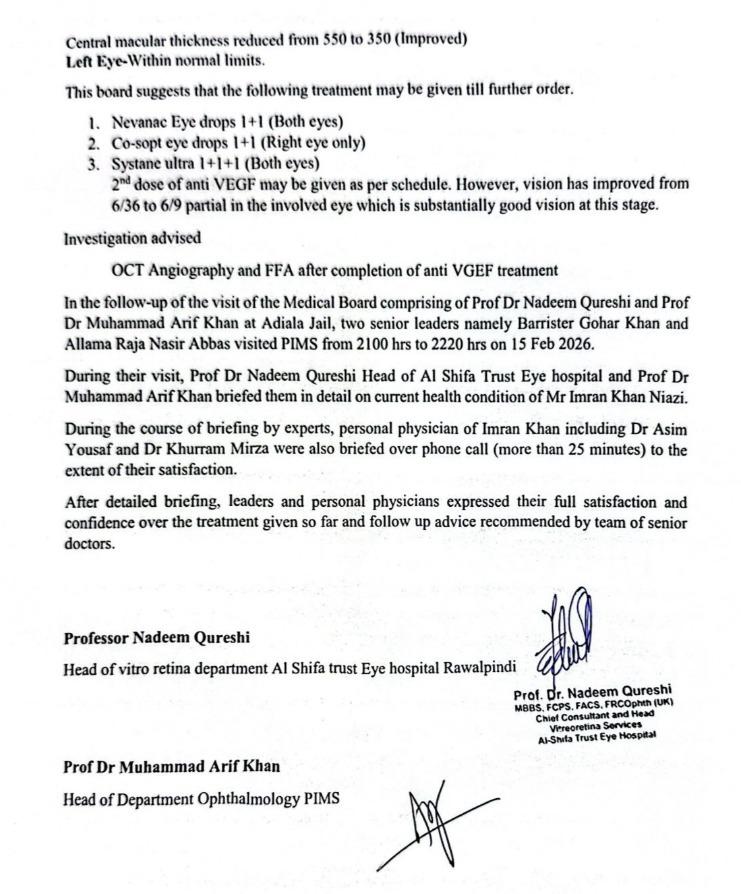
Imran Khan’s reported vision loss inside Adiala Jail has become more than a medical update
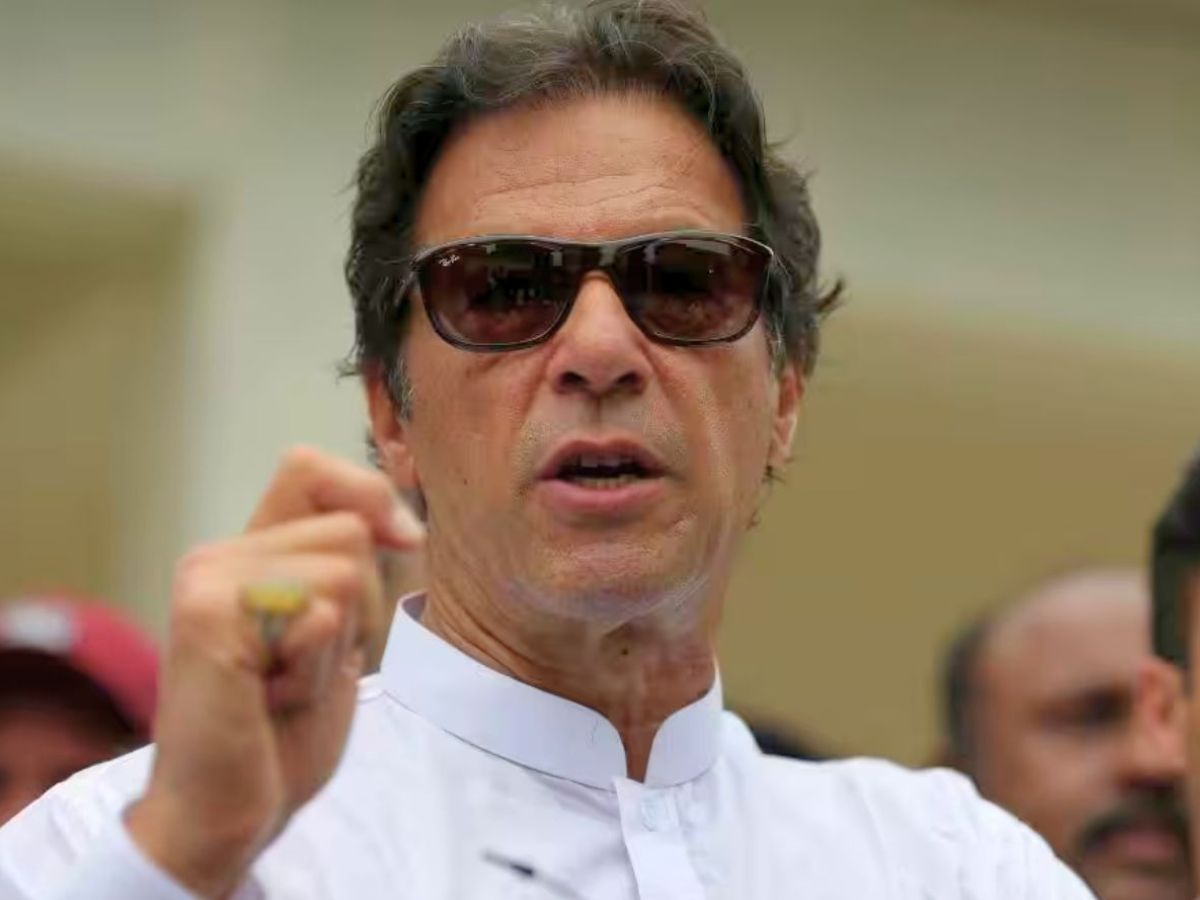
Imran Khan’s reported vision loss inside Adiala Jail (File Photo)
Imran Khan’s reported vision loss inside Adiala Jail has become more than a medical update. For many Pakistanis, both at home and overseas, it feels like a reflection of how power is currently exercised in the country. The news that he has lost nearly 85 percent of sight in his right eye has triggered concern not only about his health, but about the broader political environment under Field Marshal Asim Munir. Critics argue that in today’s Pakistan, opponents do not need to be dramatically silenced. It can be enough to let them slowly weaken.
Khan has said he experienced blurred vision for months. Reuters reported that his legal team claims medical care was delayed, while his party has accused authorities of negligence during his detention. The Associated Press noted that Pakistan’s Supreme Court ordered a medical examination after Khan reported severe vision loss, amid disagreements over whether he received timely treatment. On the surface, the institutions appear to be responding: courts intervene, boards are set up, and procedures are followed. Yet many observers ask whether process alone is meaningful if the end result suggests damage that might have been prevented.
The debate is less about uncovering one explicit order and more about recognizing a broader pattern. Complaints may be formally logged, but they can move slowly. Medical examinations are conducted, yet questions persist about how comprehensive and independent they are. Access to outside specialists must go through official approvals, often creating delays. By the time action is taken, critics argue, the opportunity to avoid lasting harm may already have passed.
PTI’s objections to the court-supervised medical board—calling it unfair and objecting to the exclusion of family members and personal doctors—highlight a deeper concern: who controls the oversight? A medical review carried out within the prison system might satisfy formal requirements, but without outside scrutiny, it can struggle to reassure the public.
The criticism is not that nothing happens. It is that what happens may be too limited and too late.
Khan’s health situation cannot be viewed in isolation from Pakistan’s broader political climate since 2023. International coverage has frequently described Munir as a central figure in the crackdown on Khan and his party following confrontations between PTI supporters and state institutions. Pakistan’s military has long played a powerful role in shaping political outcomes. In such a context, prisons operate within the same power structure as the rest of the state.
When authority is concentrated, even routine administrative matters can take on political meaning.
A United Nations human rights expert has raised concerns about Khan’s reported conditions of confinement, including extended isolation and restricted outside access. Health problems that develop under such circumstances inevitably attract attention. When communication is limited and independent access is restricted, it becomes harder to separate medical issues from the environment in which they unfold.
International concern also challenges the notion that everything is standard procedure. Cases that reach the Supreme Court and draw UN attention rarely feel routine.
After the unrest of May 9, Munir’s public statements emphasized firmness and made clear that there would be no compromise with those accused of destabilizing the state. Critics interpret this stance as signaling a strict, punitive approach rather than reconciliation. In that atmosphere, rights may technically remain in place, but their practical exercise can become constrained.
Munir’s promotion to field marshal, along with his ongoing tenure, has consolidated his authority within Pakistan’s security establishment. Analysts abroad have noted shifts that appear to give the military greater sway, while reducing the ability of civilian bodies to provide effective oversight. In such a framework, accountability rarely collapses overnight. More often, it erodes slowly—shaped by the way power is arranged and exercised day after day.
Responsibility in that environment is not only about direct instructions. It also concerns the climate leadership creates and the safeguards—or lack of them—that exist.
The state has historically been wary of creating martyrs. Sudden and extreme actions can energize supporters and elevate opponents symbolically. A slower strategy—marked by limited access, delays, and carefully managed compliance—draws less immediate outrage. Over time, however, it can steadily erode political strength.
This is why allegations of negligence resonate with many supporters. Critics argue that harm does not always result from outright refusal. Sometimes it arises from minimal responses—actions that technically meet requirements but fall short of fully protecting someone’s health.
There is no public evidence of a direct order interfering with Khan’s treatment. But in centralized systems, accountability extends beyond written directives. It also depends on whether institutions are independent enough to act promptly and decisively, especially in sensitive cases.
When a former prime minister loses most of his vision while in state custody, amid ongoing disputes about medical access and delays, it naturally raises serious concerns. Khan is not an anonymous detainee. He is a former head of government and one of the country’s most visible political figures. His case carries implications beyond his personal health.
At the very least, doctors who are not under prison control should be allowed to examine him freely, and their conclusions should be shared openly with both the courts and his family. People also deserve a straightforward account of what happened—when he first complained, when medical help was requested, how long approvals took, and what treatment he actually received. Clear answers would go a long way in rebuilding trust. Continued international monitoring of detention conditions, as urged by UN observers, also remains important.
Without openness, procedure can start to replace genuine accountability. And when systems are structured more to protect institutions than individuals, there is a real danger that avoidable harm becomes something people quietly accept rather than question.