
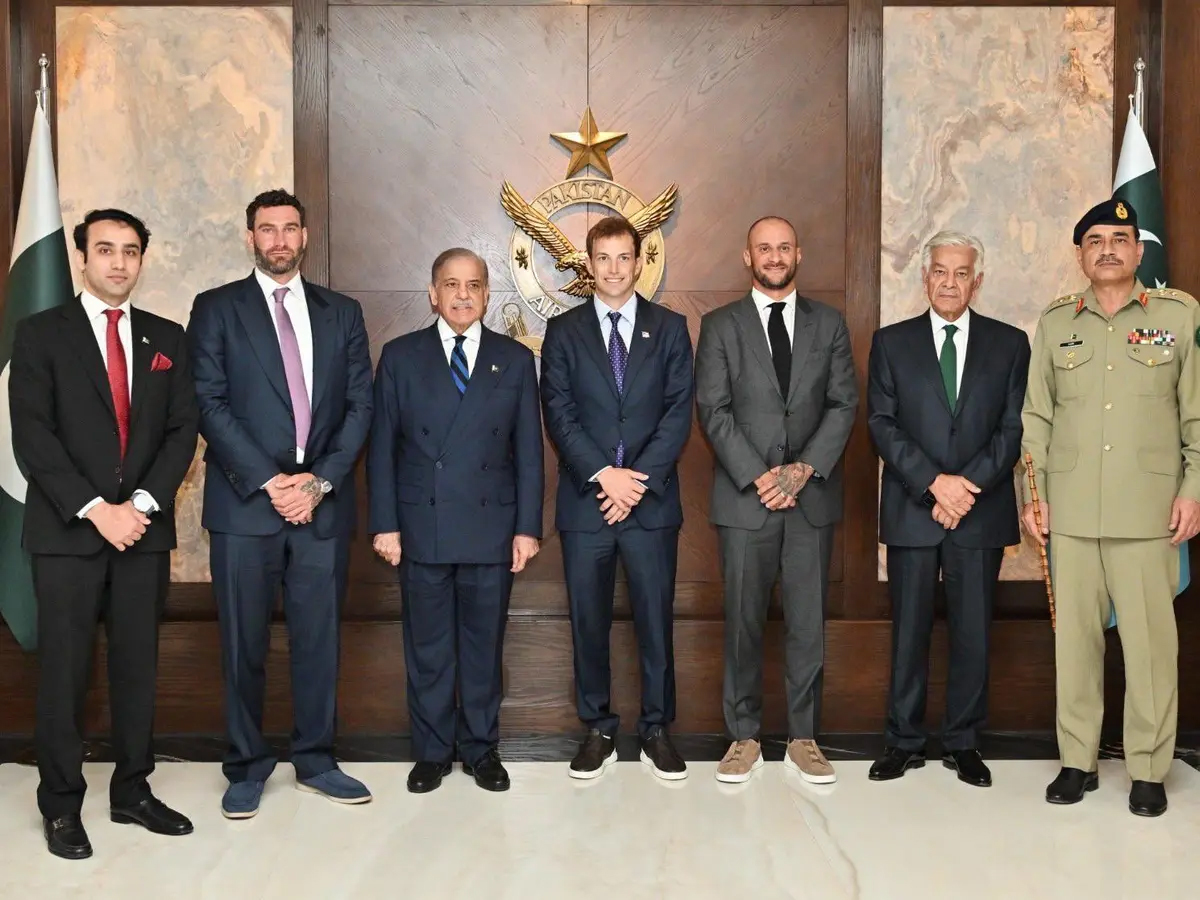
New Delhi: Pakistan’s Finance Ministry signed a memorandum of understanding (MoU) with SC Financial Technologies LLC on 14 January, an affiliate of World Liberty Financial linked to the family of U.S. President Donald Trump, to explore the use of stablecoins for cross-border payments, according to official statements.
The agreement was signed by Finance Minister Muhammad Aurangzeb and World Liberty Financial chief executive Zach Witkoff, and is intended to examine digital finance innovation within Pakistan’s regulatory framework.
Pakistani officials described the MoU as building on earlier engagements with the company and positioned Pakistan as a participant in the global digital finance landscape and a global business partner of Washington. However, U.S. regulatory filings and the legal structure of the agreement indicate that the MoU is non-binding, carries no financial commitment, and does not obligate either Pakistan or the United States to implement stablecoin payments or deploy capital.
U.S. securities filings linked to World Liberty Financial show that the company’s core fundraising and control-building activity has proceeded independently of Pakistan. A Form D filing discloses a private offering of $288.5 million, of which only $2.7 million had been raised at the time of filing, while a separate amended Form D shows a fully subscribed $52.13 million offering, with $50.71 million earmarked for payments to executive officers, directors, and promoters, including Trump-linked entities.
None of the disclosures list any Pakistani government entity, regulator, or state-linked institution as an investor, counterparty, or beneficiary. None of the filings reference Pakistan, the MoU, or any revenue, token purchases, or operational rollout linked to the 14 January agreement.
Separately, a Form 3 filing shows World Liberty Financial becoming a significant insider in ALT5 Sigma Corp, a U.S.-listed company, through common stock and warrants that together amount to effective control on a fully diluted basis.
The disclosure establishes a U.S. capital markets strategy that does not rely on Pakistan for execution.
The MoU is also not a government-to-government agreement and does not involve the U.S. federal government. It has not been ratified by Congress, endorsed by any U.S. department, or incorporated into U.S. policy frameworks, meaning it creates no obligation for any future U.S. administration once the tenure of U.S. President Donald Trump ends.
While Pakistani officials have framed the agreement as evidence of preferred access to Trump and suggested it reflects a shift in Washington’s regional priorities, the structure leaves Pakistan with no financial exposure while allowing the issuer to reference the MoU in future fundraising and promotional material. In actuality, Pakistan does not have to spend money, does not have to buy tokens, and does not have to implement anything.
Taken together, the filings and the MoU show a transaction in which Pakistan incurs no obligation and gains no guaranteed economic or policy outcome, while the Trump family acquires a sovereign-facing reference that can be used for signaling and fundraising, underscoring the gap between official political framing and the agreement’s limited legal and financial substance.




