
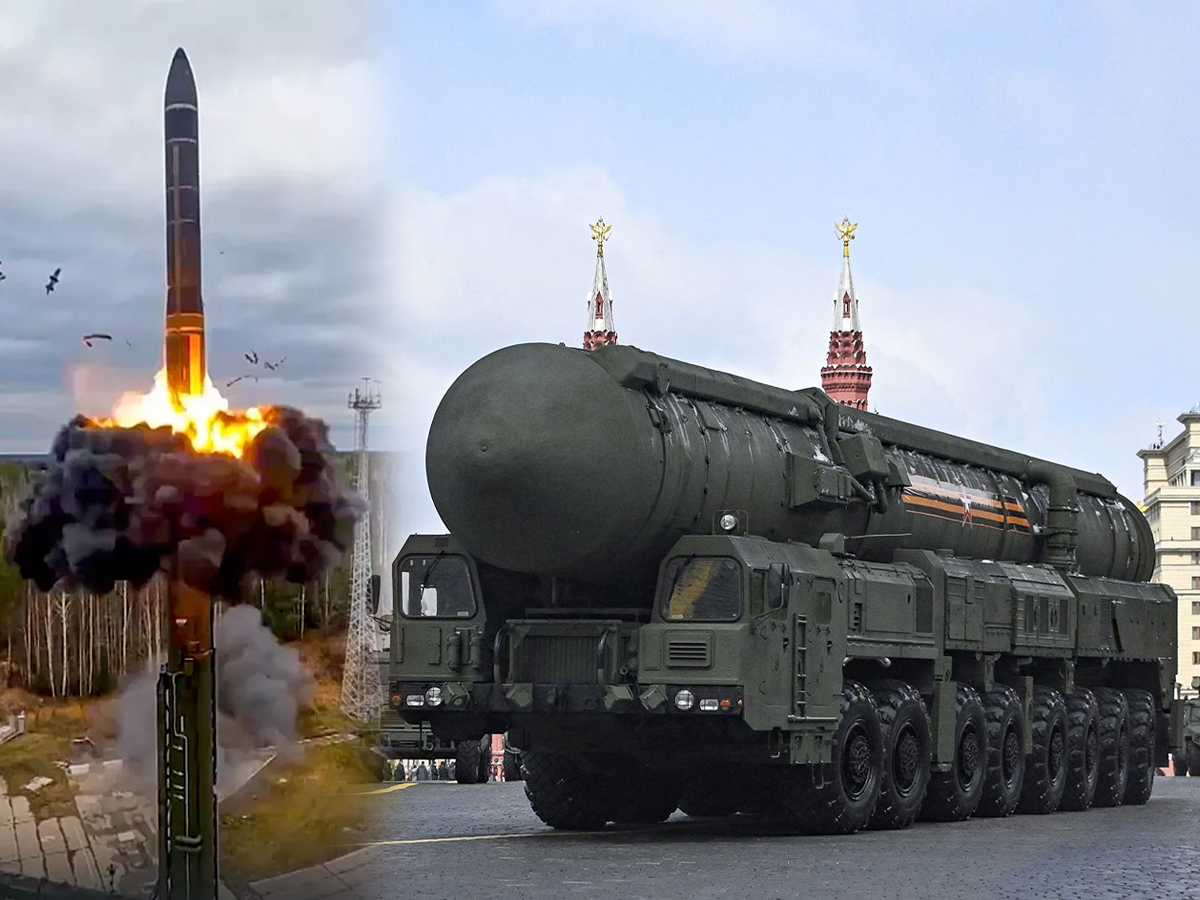
Russia launched one of its most advanced weapons, the hypersonic Oreshnik missile, at Ukraine overnight Thursday in a powerful strike that adds a new twist to the nearly four-year conflict. The attack came amid ongoing diplomatic talks and intense military pressure on Kyiv during freezing winter conditions.
The explosions were reported in multiple cities, and widespread alert warnings from Western allies.
What Is the Oreshnik Ballistic Missile?
The Oreshnik is a new Russian intermediate-range ballistic missile capable of flying at hypersonic speed, more than 10 times the speed of sound, and striking deep into enemy territory. It draws on the design of the Soviet-era RS-26 Rubezh missile, but with modern updates that make it harder to detect and intercept.
The weapon can carry multiple independently targetable warheads and can be equipped with either conventional or nuclear payloads. Its range potentially allows it to reach targets across much of Europe, making it one of Russia’s most potent strategic weapons.
Russian officials have touted the Oreshnik as invulnerable to modern air defence systems, claiming it can outpace and eclipse the interception capabilities of many Western missiles, a statement that underscores Moscow’s effort to project strength.
Oreshnik Missile Range and Speed
The Oreshnik missile is Russia’s newest hypersonic and most advanced intermediate-range ballistic missile (IRBM) and one of the most advanced weapons in its arsenal. Designed to strike targets at extreme speed and long distances, the missile has an estimated range of 3,000 to 5,500 kilometres, which allows it to reach most of Europe if launched from Russian territory.
It travels at hypersonic speeds of over Mach 10, or roughly 12,000–13,000 km per hour, following a high-arc ballistic trajectory that makes detection and interception extremely difficult for modern air-defence systems.
How Many Oreshnik Missiles Does Russia Have and What Is Their Cost?
Russia is believed to have only a limited number of Oreshnik missiles, as the system is still relatively new and not yet mass-produced. Military assessments suggest the stockpile likely runs into a few dozen missiles at most, making each launch rare and strategically significant.
The cost of one Oreshnik missile has not been officially disclosed, but defence analysts estimate it could run into tens of millions of dollars per unit, far higher than conventional cruise or short-range ballistic missiles due to its advanced materials, guidance systems, and hypersonic technology.
Are Oreshnik Missiles Nuclear-Capable?
The Oreshnik hypersonic missile is nuclear-capable. Russian officials have stated that the missile can be fitted with both conventional and nuclear warheads, giving it dual-use capability. This means the same missile system can be deployed for standard battlefield strikes or, if required, for strategic nuclear deterrence.
However, there is no public evidence to suggest that the Oreshnik missiles used in Ukraine carried nuclear payloads; experts widely assess that Russia has so far employed them with conventional warheads only to avoid further escalation.
What Can Oreshnik Missiles Do?
The Oreshnik missile is designed to strike distant, high-value targets with extreme speed and precision. Traveling at hypersonic speeds, it can penetrate advanced air-defense systems and deliver multiple warheads over a wide area, causing severe damage to military infrastructure such as command centers, energy facilities, and logistics hubs.
Beyond its physical impact, the missile also plays a psychological and strategic role, signaling Russia’s technological capabilities and increasing pressure on Ukraine and its Western backers by demonstrating that Moscow is willing to deploy cutting-edge weapons during the conflict.
Overnight Strikes Rock Western Ukraine
According to Ukrainian military sources, several explosions rang out in the western city of Lviv, a major infrastructure and transit hub, late Thursday night.
Ukrainian forces said a ballistic missile was detected flying at extraordinary speed, approximately 13,000 km/h, roughly ten times the speed of sound, along a ballistic trajectory before impacting a critical infrastructure site. Ukrainian Air Command “West” said it would confirm the weapon’s type after analysing recovered components.
Ukraine did not immediately confirm whether the Oreshnik was definitively used, but testing and debris recovery teams have been deployed to assess the aftermath. The Lviv region has seen only occasional direct hits compared with frontline areas, so the strike generated widespread concern among civilians and officials alike.
Russia Claims Retaliation, Ukraine Denies Targeting Putin
The Russian Ministry of Defense said the missile strike was part of a massive overnight offensive that used high-precision, long-range land- and sea-based weapons, including the Oreshnik mobile ground system. Moscow framed the action as a response to an alleged Ukrainian attempt to strike President Vladimir Putin’s residence last month.
However, Ukrainian and Western officials strongly rejected that claim, with U.S. intelligence assessing that Ukraine was not targeting any residence of Putin, making Russia’s justification appear politically charged amid diplomatic negotiations.
International Alert and War Escalation Fears
Russia’s barrage also coincided with broader warnings from the U.S. Embassy in Ukraine, which had indicated a “potentially significant air attack” might occur in the coming days. Western leaders have repeatedly expressed concern that escalating weapon deployments and high-speed ballistic missiles could widen the conflict or provoke unintended clashes near NATO borders.
Hours before the Oreshnik launch, Moscow reiterated that European troops deployed to Ukraine as part of any future peace deal would be considered “legitimate targets.” This hardline language followed recent pledges by France and the United Kingdom to provide troop support if a ceasefire framework includes international peacekeepers — a move strongly opposed by Russia.
A Shift in Missile Warfare
The Oreshnik’s deployment signals a shift in Russia’s missile strategy, with Moscow increasingly relying on long-range hypersonic systems that are more difficult to intercept. Although the weapon saw its first reported combat use in November 2024 during a strike on the city of Dnipro, Thursday’s launch is among the first known uses deep into western Ukraine.
Both sides of the conflict now face heightened urgency as winter operations intensify and diplomatic efforts persist. The international community continues to watch closely, with many fearing this latest missile strike could reshape battlefield calculations in unpredictable ways.




