
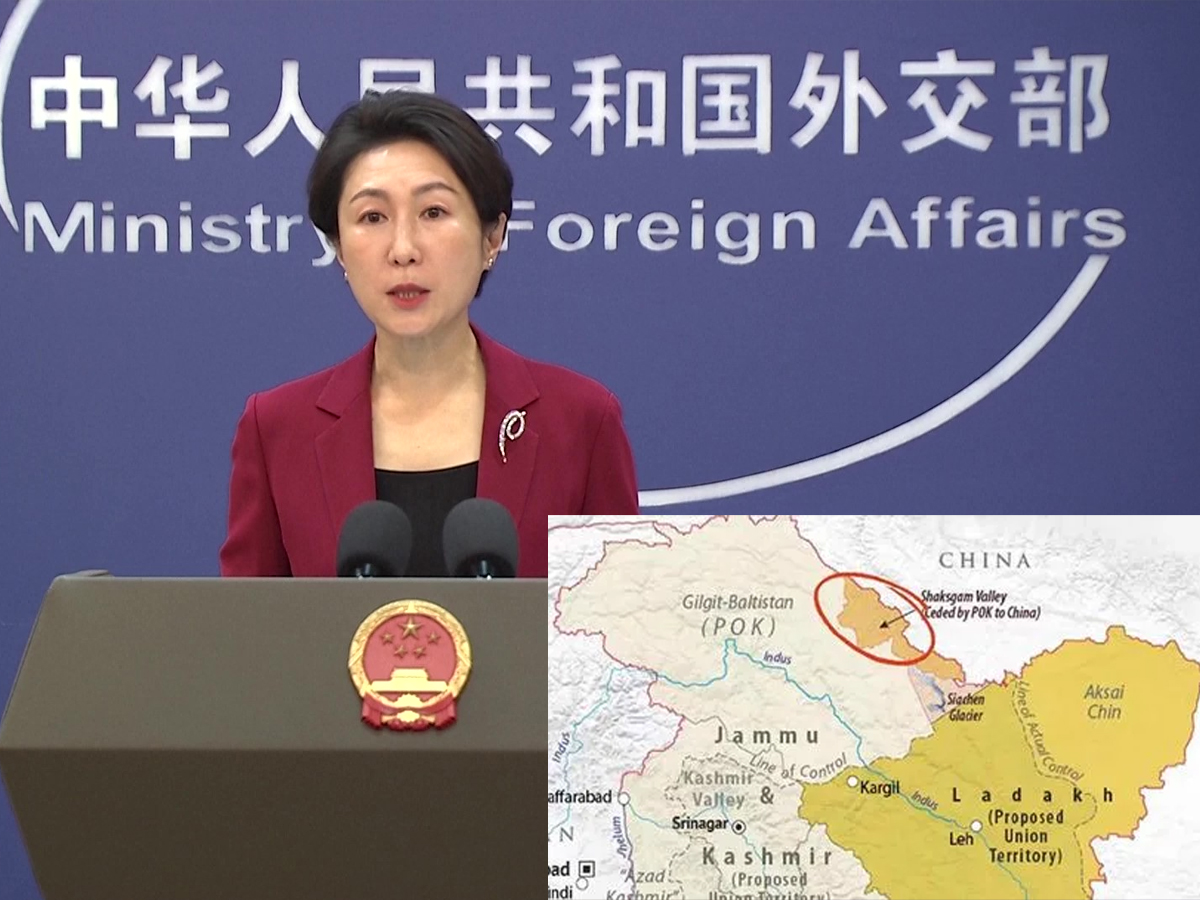
China has once again reignited tensions with India by firmly restating its territorial claim over the Shaksgam Valley in Jammu and Kashmir and defending infrastructure construction in the disputed region. China dismissed India’s objections, insisting that its activities in the area are legitimate and beyond question. The renewed exchange has brought the long-running Shaksgam Valley dispute back into sharp focus.
Let’s understand what the Shaksgam Valley conflict is, China’s stance amid India’s criticism, India’s position, and what the row is really about.
What China Says on the Shaksgam Valley Conflict?
Responding to India’s objections to recent Chinese infrastructure activity, China strongly defended its position. China’s Foreign Ministry spokesperson Mao Ning said, “The territory you mentioned belongs to China.”
She further stated, “It’s fully justified for China to conduct infrastructure construction on its own territory. China and Pakistan, in the 1960s, signed a boundary agreement and delimited the boundary between the two countries, which is the right of China and Pakistan as sovereign countries.”
China has again rejected India’s claim over the Shaksgam Valley in Jammu and Kashmir. Chinese Foreign Ministry spokesperson Mao Ning said the area belongs to China and that infrastructure work there is justified as it is being carried out on Chinese territory. pic.twitter.com/u2yPPYxACz
— BigBreakingWire (@BigBreakingWire) January 13, 2026
China also rejected India’s criticism of the China-Pakistan Economic Corridor (CPEC), maintaining that the project focuses on economic cooperation and development.
Mao added, “The China-Pakistan boundary agreement and CPEC do not affect China’s position on the Kashmir issue, and the position remains unchanged.” She said Beijing believes the Kashmir issue should be resolved peacefully under international frameworks.
What is the Shaksgam Valley Conflict?
Shaksgam Valley, also known as the Trans-Karakoram Tract, lies in the northern part of the larger Jammu and Kashmir region. India considers the area part of its sovereign territory, while China claims it based on a boundary agreement signed with Pakistan in 1963.
Pakistan had ceded around 5,180 square kilometres of this territory to China under that agreement. India has consistently rejected the pact, arguing that Pakistan had no legal authority to transfer land that it was occupying illegally.
What Is India’s Take on the Shaksgam Valley?
India has categorically dismissed China’s claims and reiterated that the Shaksgam Valley is Indian territory. External Affairs Ministry spokesperson Randhir Jaiswal stated, “Shaksgam Valley is Indian territory. We have never recognised the so-called China-Pakistan ‘boundary agreement’ signed in 1963.”
He further said, “We have consistently maintained that the agreement is illegal and invalid.”
India maintains that the entire Union Territories of Jammu and Kashmir and Ladakh are “an integral and inalienable part of India”, and says this position has been conveyed repeatedly to both China and Pakistan.
India also opposes CPEC because several of its routes pass through territory India claims as its own.
Shaksgam Valley in Jammu & Kashmir: What Is the Row All About?
At the heart of the dispute are sovereignty, territorial integrity, and strategic infrastructure. China’s infrastructure push in the Shaksgam Valley and its involvement in CPEC raise serious concerns for India, particularly from a security and geopolitical standpoint.
For China, the region connects to its Xinjiang province and supports broader regional connectivity plans. For India, any construction in the area violates its sovereignty and legitimises Pakistan’s illegal occupation.
The disagreement reflects deeper tensions in India-China relations, especially along disputed borders, and continues to complicate regional diplomacy.




