Comparisons with 1989 are inevitable, but they also illustrate how China’s methods have evolved. Where Tiananmen relied on overwhelming military force, Shanghai’s 2022 November protest was extinguished with algorithms, phone data, and targeted detentions.
Candles on Wulumuqi Road marked a fleeting protest in Shanghai, illustrating China’s advanced surveillance and rapid suppression of dissent (Photo: File)
NEW DELHI: In late November 2022, for a brief moment, Shanghai appeared to loosen the grip that had defined its pandemic years. On Wulumuqi Road normally an unremarkable thoroughfare residents gathered with candles to mourn ten people who died in a fire in far-off Urumqi. Local accounts later described how the victims, trapped behind locked exits during a COVID lockdown, became symbols of a policy that had exhausted the country long before the flames claimed their lives.
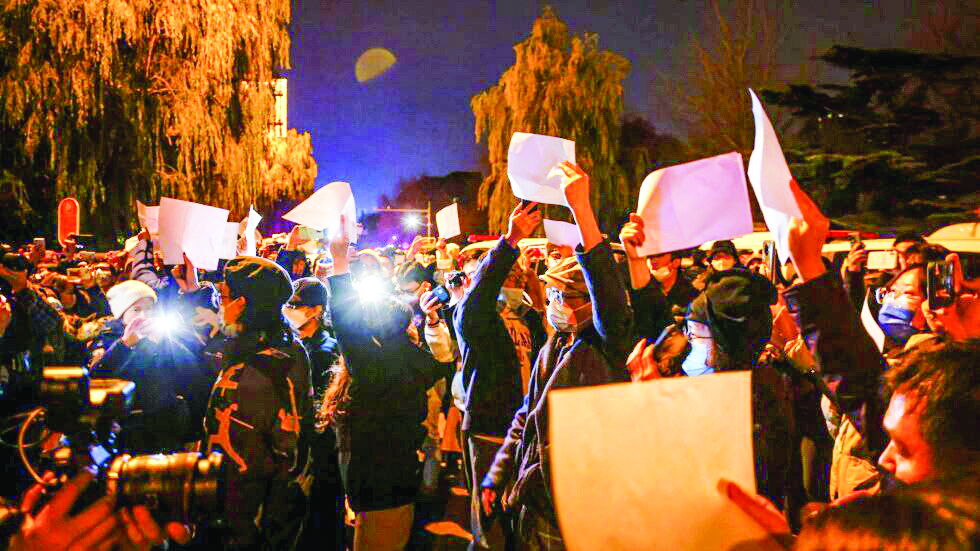
What began as a quiet vigil on 26 November evolved into the most overt public challenge to the Chinese leadership since the Tiananmen demonstrations more than three decades earlier. The crowds swelled, some chanting slogans that would have been unthinkable only weeks before. Yet the opening proved fleeting. By the morning of 28 November, the street was deserted. The sudden silence was not organic it was engineered.
The speed with which authorities restored control demonstrated not only the strength of China's policing apparatus but the degree to which three years of pandemic management had equipped the state with an unusually detailed map of its citizens' movements, networks, and vulnerabilities. The crackdown that followed was not a spontaneous reaction to dissent. It was the culmination of a system refined through data, surveillance, and the routinisation of extraordinary powers.
The turning point came in the early hours of 27 November. As more demonstrators assembled some holding blank A4 sheets as understated rebuttals to censorship plainclothes officers blended into the crowd. Witnesses later described people being pulled into police vans at around 4:30am. Among those seized was Ed Lawrence, a BBC journalist detained and beaten while covering the protest. Beijing later insisted he had "failed to identify himself", a claim rejected by the broadcaster.
By mid-morning, uniformed officers sealed off the area. But throughout that Sunday, smaller gatherings continued to surface across the city, reflecting wider discontent with lockdowns and the arbitrary restrictions they imposed. The state, however, was already shifting the confrontation from the street to the digital sphere.
DISSENT DISAPPEARS FROM THE CHINESE INTERNET
The censorship campaign that followed was comprehensive and efficient. Searches for "Shanghai," "Wulumuqi Road," and "Urumqi fire," which normally generated millions of posts, began returning only a handful. References to "white paper," "A4," and related hashtags vanished across Weibo and WeChat.
Outside China, Twitter (now X) became the only real-time window into what was unfolding. But even there, the state intervened. Researchers monitoring the platform reported hundreds of accounts suddenly posting spam pornography, gambling links, and unrelated advertising using the same protest-related hashtags. The effect was to bury genuine footage under noise, a tactic that prevented the protests from going viral internationally.
By Monday morning, the authorities had all but erased digital traces of the protest. The memorials had been cleared, and the street resumed its familiar subdued rhythm.
A SURVEILLANCE MACHINERY BUILT OVER YEARS
Where previous generations of Chinese protest movements relied on anonymity faces in a crowd the demonstrators of 2022 faced an entirely different environment. China's security apparatus had spent years constructing one of the world's most extensive networks of facial recognition cameras, combined with compulsory health-code apps, QR-based movement tracking, and real-time linkage of mobile phone data to personal identity.
This infrastructure, designed and justified through the zero-COVID period, played a decisive role in identifying attendees. Multiple participants later reported receiving calls or home visits from police within 24 hours of the vigil. One, a protester identified only as Zhang, took elaborate steps to avoid detection: wearing a balaclava, switching jackets, and navigating backstreets. Yet his phone had connected to towers near the demonstration. The next day, police rang to ask about his whereabouts: minutes later, they arrived at his door.
Such accounts illustrate how the state's surveillance capacity has shifted the balance in its favour without resorting to visible force. The system did not need mass detentions in the square. It required only data.
FROM INFORMAL DETENTION TO FORMAL CHARGES
By December, the crackdown moved into the formal legal domain. Authorities began arresting participants under Article 293 of China's Criminal Law picking quarrels and provoking trouble—a charge so elastic that virtually any public act can be made to fit its parameters. Human rights organisations documented at least 32 cases initiated in the weeks that followed.
Those detained included university graduates, publishing editors, and a state media journalist, Yang Liu. Among the most well-known was Cao Zhixin, an editor at a publishing house, who was taken into custody alongside several friends. Videos recorded before their arrests pleaded that if they disappeared, it was because they had attended the vigil.
China's Constitution, on paper, guarantees freedom of assembly. Beijing has also signed, though never ratified, the International Covenant on Civil and Political Rights. In practice, the courts operate within a system where politically sensitive cases rarely produce acquittals. Amnesty International's analysis of comparable cases found 67 of 68 ending in custodial sentences.
For the families of those arrested, the consequences extended beyond the courtroom. Detainees lost jobs, relatives were questioned, social connections evaporated in a climate where proximity to dissent carries reputational risk.
A NEW MODEL OF CONTROL
Comparisons with 1989 are inevitable, but they also illustrate how China's methods have evolved. Where Tiananmen relied on overwhelming military force, Shanghai's protest was extinguished with algorithms, phone data, and targeted detentions. The absence of visible violence made the repression less conspicuous but no less effective.
This model carries implications far outside China's borders. Through its Belt and Road Initiative, Beijing has supplied surveillance infrastructure including camera networks, cloud-based monitoring systems, and facial recognition software to dozens of countries. Several African states have adopted variants of these tools to monitor domestic unrest. Human rights groups warn that the technology exported is often calibrated using data gathered from China's own population, sometimes optimised for use on minority ethnic groups abroad.
The Shanghai crackdown demonstrated how these systems can function when deployed at scale: quick identification, quiet detentions, minimal public spectacle.
THE ERASURE OF MEMORY
Today, Wulumuqi Road shows no sign of the brief rupture that took place in 2022. The protest sites have been repainted, the makeshift memorials removed. Those detained are largely absent from official records, their fate discussed only in private conversations or in reports by international organisations.
Yet the events of that weekend, though suppressed, remain instructive. They revealed both the limits of public dissent in contemporary China, and the speed with which the state can mobilise its technological architecture to restore order. They also highlighted the quiet determination of residents who, despite knowing the risks, stepped forward to express grief and frustration after years of confinement.
China's leadership has since dismantled the zero-COVID system, but the apparatus built to enforce it has not been dismantled. Instead, it has been integrated into a broader framework of security and governance, leaving open the question of how it might be used in the future.
The candles on Wulumuqi Road burned for only a few hours. But the response they triggered revealed a system that has learned not merely to contain dissent, but to erase its traces almost as soon as they appear.
Maj Gen R.P.S. Bhadauria (Retd) is the Additional Director General of the Centre for Land Warfare Studies (CLAWS), New Delhi, and formerly the Director of the Centre for Strategic Studies and Simulation (CS3) at USI, having served in the Indian Army for 36 years.
