
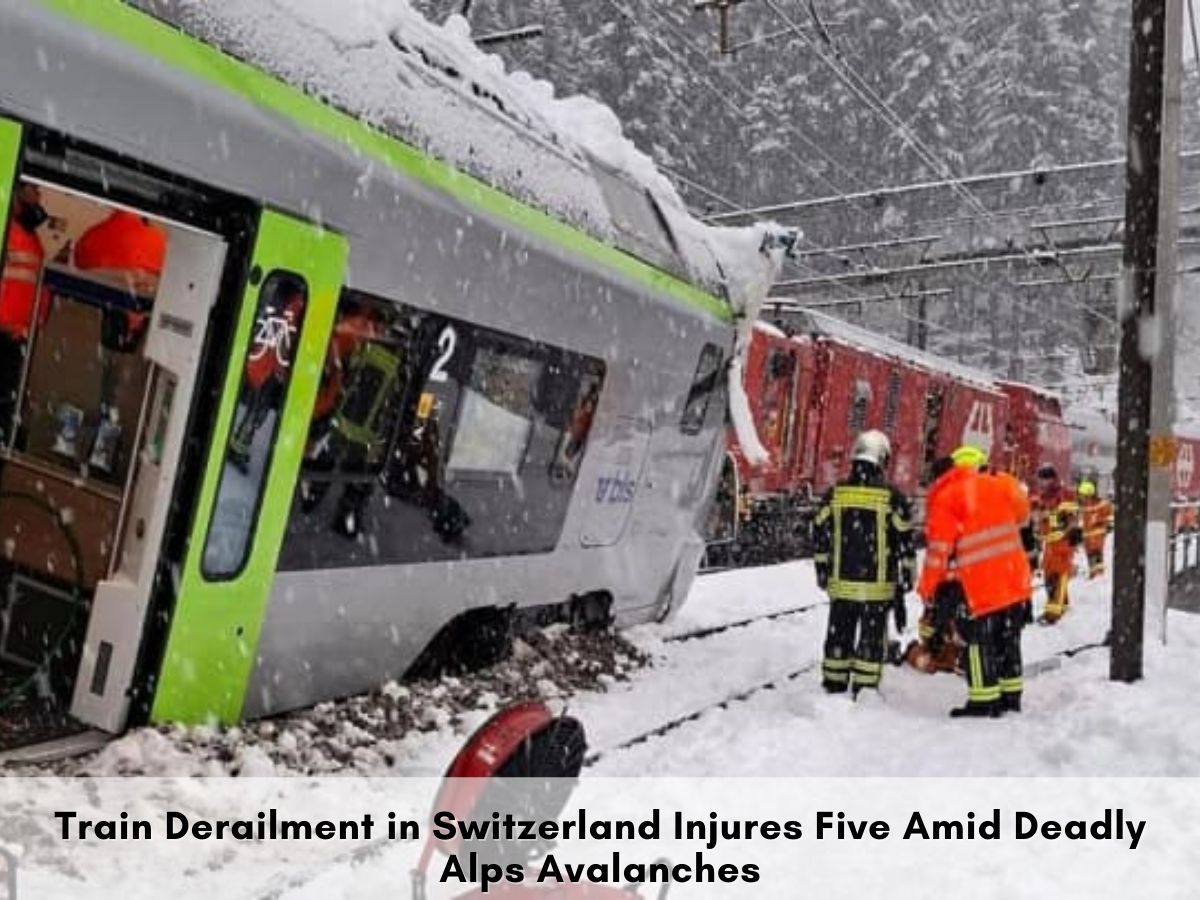
GOPPENSTEIN, Switzerland (February 16) — An avalanche struck a train near the Swiss town of Goppenstein on Monday morning, injuring five people, as authorities confirmed that large portions of the western Alps remain under a category 5 avalanche risk following a weekend that claimed multiple lives in France and Italy.
What happened in avalanche crisis in the Alps?
Swiss police confirmed that Monday’s train derailment occurred when a snow slide hit the railway near Goppenstein, injuring five individuals. The incident follows a series of fatal avalanches involving skiers across the Alpine region. On Friday, three skiers were killed in Val d’Isère, France, including two British nationals who were accompanied by a ski instructor. A French national skiing alone also perished in the same incident. The Albertville prosecutor, Benoît Bachelet, confirmed the instructor tested negative for alcohol and drugs after the event, while another Briton sustained minor injuries. The following day, on Sunday, two additional skiers lost their lives in an avalanche on the Italian side of Mont Blanc near Courmayeur.
What does the category 5 avalanche risk actually mean?
Under the European avalanche warning system, a grade 5 risk is classified as “extraordinary” and rare. It indicates that numerous very large and extremely large natural avalanches can be expected, posing direct threats not just to skiers but to valley roads and settlements below. Authorities have issued warnings advising people to avoid all but open and unthreatened slopes. Due to the significant risk, numerous communities have already been ordered to evacuate and roads surrounding the Mont Blanc massif have been forced to close in order to prevent snow flows from reaching populated areas.
Why are the current snow conditions so unstable and dangerous?
The extreme danger level is the result of a complex combination of meteorological factors. Recent storms, including Storm Nils which passed through last week, deposited between 60cm and 100cm of fresh snow across the region, with an additional 40-50cm predicted in some areas on Monday. High winds have since swept this heavy new snow onto existing slopes, creating thick, windblown snowcaps. These new layers rest on an older, weak snowpack that resulted from lean snow conditions earlier in the season. “It’s a kind of mille-feuille with many hidden, fragile layers,” Luc Nicolino, slopes manager at the resort of La Plagne, told Agence France-Presse. The unstable structure means that even the weight of a single skier can be enough to trigger a massive avalanche. “Under such conditions, the passage of a single skier, or natural overloading from the weight of snow, can be sufficient to trigger an avalanche,” confirmed Federico Catania, a spokesperson for Italy’s Alpine Rescue Corps.
Historical Data
The danger is underscored by recent rescue data, which recorded a deadly period in the Italian mountains during the week ending February 8. Alpine Rescue reported that 13 off-piste skiers, climbers, and hikers died, with avalanches triggered by the unstable snowpack claiming 10 of those lives. Among those caught in the French Alps on Friday was adventure skier Daniel Matthews, who was buried for eight minutes after the couloir he was skiing collapsed beneath him. He was rescued by companions after falling approximately 400 meters. “I made a very bad decision and uneducated decision to ski Skimans [sic] Couloir,” Matthews wrote on Instagram. “I didn’t follow the signs that day that were clearly there! and I paid for it. The only person to blame is myself.”
Frequently Asked Questions
Q: How many people have died in the recent Alps avalanches?
A: At least five skiers were confirmed dead over the weekend in France and Italy, including two Britons in Val d’Isère and two skiers near Mont Blanc. This follows a prior week where 10 people died in avalanches in the Italian mountains alone.
Q: What is a category 5 avalanche risk?
A: It is the highest level on the European avalanche danger scale, described as “extraordinary” and rare. It means numerous very large natural avalanches are expected, posing a danger not only to skiers but also to roads and villages in valleys below.
Q: Why is the snowpack so unstable right now?
A: Older, brittle, and weaker layers from earlier in the season are layered on top of windblown accumulations and heavy new snow, a phenomenon known as the “mille-feuille” effect. Avalanches may result from this structure’s easy collapse.
Q: Is it safe to ski off-piste in the Alps currently?
A: Authorities are strongly advising against it. Under grade 5 conditions, skiers and mountaineers are cautioned to avoid all but open and unthreatened slopes due to the high likelihood of human-triggered avalanches.
Disclaimer: This information is based on inputs from news agency reports. TSG does not independently confirm the information provided by the relevant sources.




