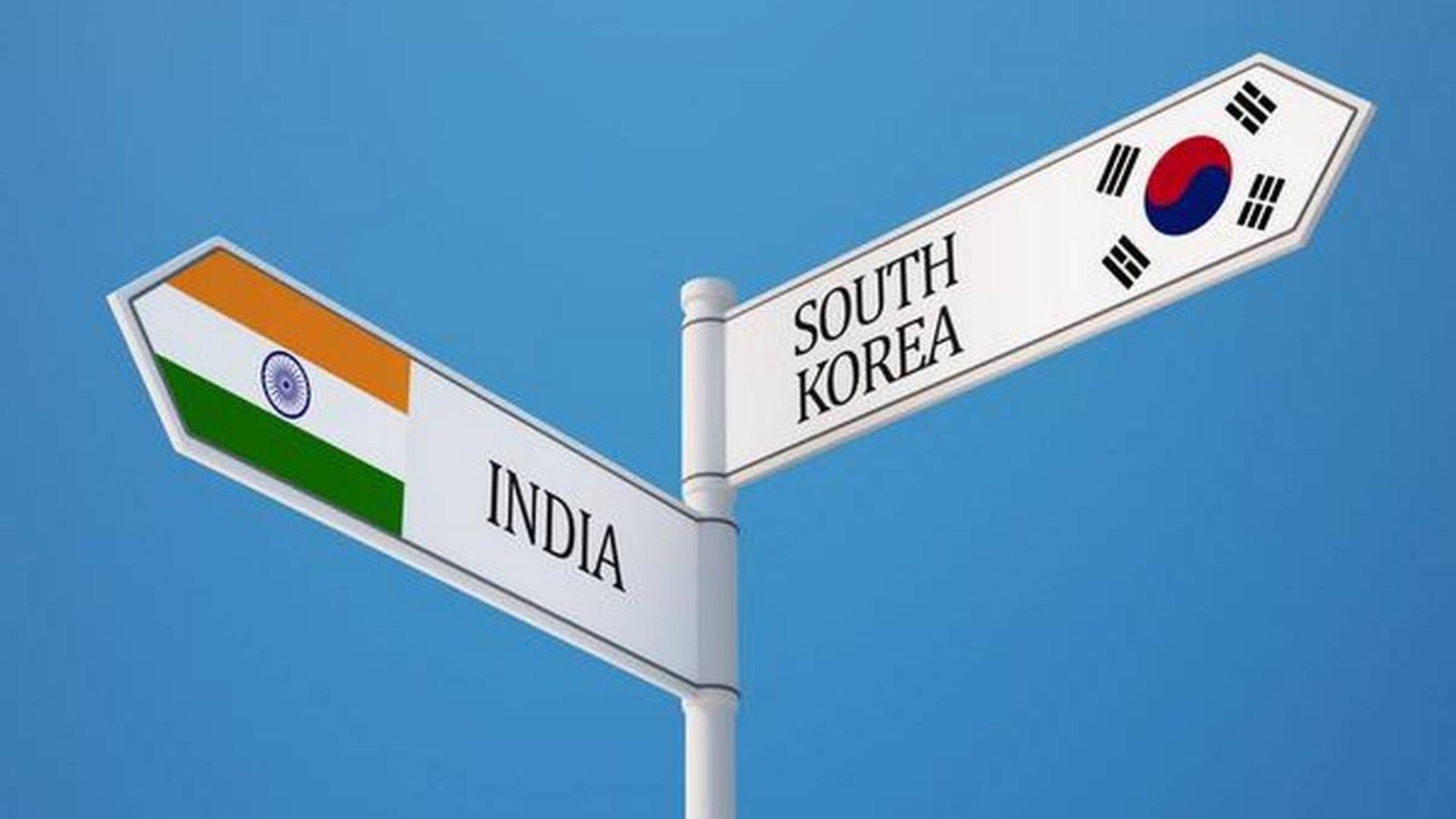
South Korea’s rapid development through authoritarian-led quality focus contrasts with India’s democratic, pluralistic but steady economic rise and modernization.
Seoul: As a Korea Foundation Fellow, landing in South Korea was like stepping into the future, a testament to a nation that has achieved comprehensive modernity and advanced technological integration. The experience, from seamless biometric verification at Incheon International Airport to virtually free-flowing traffic aided by intelligent transportation systems (ITS) and pervasive face-based recognition in public and commercial services, instantly showcased this. Beyond efficient infrastructure, Korea’s prowess extends to cutting-edge mobile and automotive industries, a dominant global shipping and shipbuilding sector, and a rapidly expanding defense industry, with its influence further spanning white goods, revolutionary TV and display technologies, the burgeoning field of entertainment AI, and the global explosion of K-pop, K-drama, and a world-leading cosmetics industry reshaping global trends. This starkly contrasted with narratives of a not-so-distant past, where a Korean senior citizen who came to receive me informed me that in his youth, Korea was much like present-day India. That reality existed even as the 1988 Seoul Olympic Games was held which was far from a sporting celebration, it aimed to be an announcement of a strategic entry onto the global stage, an ambitious endeavor that demanded significant investment, including substantial loans, to transform Korea›s international image. This visceral memory of a nation steeped in poverty and decay underscores the truly monumental leap that defines the «Miracle on the Han River.»
In the immediate aftermath of the Korean War (1950-1953), South Korea was not merely impoverished; it was a land laid waste. Its infrastructure was shattered, its cities reduced to rubble, and its populace teetered on the brink of survival. Sanitation systems were rudimentary or non-existent, and the Han River, far from its current pristine state, served as an open conduit for urban effluent and industrial waste. Economic indicators of the 1950s placed South Korea on par with the world›s poorest nations. It›s difficult to believe that in a span of just a few decades – a lifetime – this profound transformation took place, making its current status as a first-world economic and technological leader a compelling case study in national metamorphosis.’
The Genesis of a Miracle: Authoritarian Roots and Uncompromising Quality
The genesis of this transformation is inextricably linked to the authoritarian rule of General Park Chung-hee, who seized power in a 1961 coup. Park’s regime, following an earlier period of authoritarian tendencies under the nation’s first president, Syngman Rhee, prior to 1960, curtailed political freedoms but implemented an unparalleled, state-directed economic development model. Park’s focus on infrastructure development was foundational, laying the groundwork for the modern nation. Massive investments were channeled into roads, ports, power grids, and, critically, robust public utilities including advanced sewage and water management systems. This pragmatic approach prioritized economic growth above all else, often at the expense of democratic processes.
A key pillar of this strategy was the cultivation of chaebols, the large, family-controlled conglomerates that would become the engines of Korea’s export-oriented economy. The government provided substantial financial support, tax incentives, and policy guidance, while chaebols like Samsung, LG, and Hyundai, in turn, drove industrialization, embraced technological adoption, and spearheaded the nation’s push into global markets. Crucially, this drive for development was coupled with an unwavering commitment to high global standards. Even now, we see that what was presented in any advertisement or brochure – whether for a building, a food product like chips, a restaurant experience, or any consumer good – had to precisely match the actual reality. There was no room for embellishment, misrepresentation, or any form of deception; what was seen, promised, or advertised was unequivocally what one received.
From Dictatorship to Deeply Ingrained Democracy
The path from dictatorship to robust democracy, however, was not without its tumultuous chapters. Park Chung-hee’s assassination in 1979 plunged the nation into a period of political instability, ushering in another military regime under General Chun Doo-hwan. Yet, sustained pressure from a burgeoning civil society, student movements, and a growing middle class, culminating in the widespread pro-democracy movements of 1987, ultimately forced a negotiated transition. It was under President Chun Doo-hwan that the historic “June 29 Declaration” was made, conceding to direct presidential elections. This societal resolve, demonstrating a profound yearning for self-determination, proved that economic prosperity, once achieved, invariably fuels demands for political freedom.
Today, South Korea stands as a testament to the extraordinary potential of national ambition. Its democracy is now deeply ingrained, with peaceful transfers of power through regular elections being the norm. The trajectory from a nation akin to India in its underdevelopment even up to the 1988 Olympics, to the Korea today symbolizes not merely technological advancement but a wholesale societal evolution. Its economic prowess, cultural influence (Hallyu), and cutting-edge technological landscape are a stark, impactful refutation of historical determinants.
India’s Democratic Ascent: A Different Path, Shared Aspirations
As South Korea’s story inspires, India, the world’s largest democracy, charts its own remarkable economic rise. Unlike Korea’s initial authoritarian-led growth, India’s post-independence journey has been steadfastly democratic, balancing economic development with the complexities of pluralistic politics and individual liberties. While early infrastructure development faced various challenges, the idea to robustly connect the country with modern highways gained significant momentum during the tenure of Prime Minister Atal Bihari Vajpayee, whose Golden Quadrilateral project laid the foundation for a truly integrated road network. This was a pivotal moment, contrasting with earlier periods where infrastructure development was sometimes limited, ostensibly to control access to certain regions. Today, the era of modern connectivity – with numerous new airports, dedicated freight corridors, high-speed rail projects, and vastly improved port capacities – is rapidly coming to fruition across India.
What sets them apart is precisely this fundamental political structure and its associated societal nuances. South Korea’s swift, top-down industrialization was facilitated by authoritarian control, enabling rapid decision-making and resource allocation. India, by contrast, navigates a vibrant, sometimes cacophonous, democracy, where development priorities are debated, policies are scrutinized, and reforms often face public and political resistance. This democratic friction, while potentially slowing immediate progress, builds stronger institutional foundations and ensures a broader distribution of the benefits, albeit with ongoing struggles against poverty and inequality.
A key aspect of Korea’s development trajectory lies in its societal adaptability and pragmatic approach to public life. Here, a clear distinction often exists between personal space and professional space. Individuals, even if Christian, have no qualms about offering traditional reverence at ancestral graves or embracing Buddhist practices and wisdom in their daily lives. This ability to largely separate deeply personal beliefs from public discourse and professional conduct has fostered a pragmatic environment conducive to collective goals and high standards of quality in all endeavors, ensuring that what is presented is precisely what is delivered. This adherence to a professional ethos, free from religious or personal biases influencing public-facing work, is a crucial ingredient in building a modern, high-trust society.
A Shared Future: Democracies Delivering on Development
Yet, despite their different starting points and political frameworks, both South Korea (standing in stark contrast to North Korea, a nation characterized by its ongoing state of war and a prevalence of fake goods and cheap imitations, unlike South Korea’s global brands in every sector) and India (which, despite its democratic path, also faces a hostile neighbor in Pakistan, a nation with a notable absence of world-class infrastructure or products, and an unfortunate association with global terrorism) stand as powerful examples of nations that defied conventional wisdom. South Korea demonstrates that even dire circumstances can yield unprecedented economic success, driven by an unyielding commitment to quality and professionalism. India, meanwhile, proves that significant economic growth and widespread development are achievable even within the confines of a complex democratic system.
My time as a Korea Foundation Fellow has been an encounter with the truly unfathomable, a journey of witnessing a nation that defied all expectations to build a future beyond imagination. And in the inspiring tale of Korea, one finds not just a historical anomaly, but a powerful message for countries like India: that economic prosperity, environmental healing, and a pervasive culture of quality and professionalism, even under the sometimes-messy but ultimately resilient banner of democracy, are not just dreams, but attainable realities.
Col (Dr) Divakaran Padma Kumar Pillay, is currently Korea Foundation Visiting Fellow, affiliated to Seoul National University, Seoul, Republic of Korea.