Key votes in Europe, the Middle East and Latin America will reshape alliances and power.
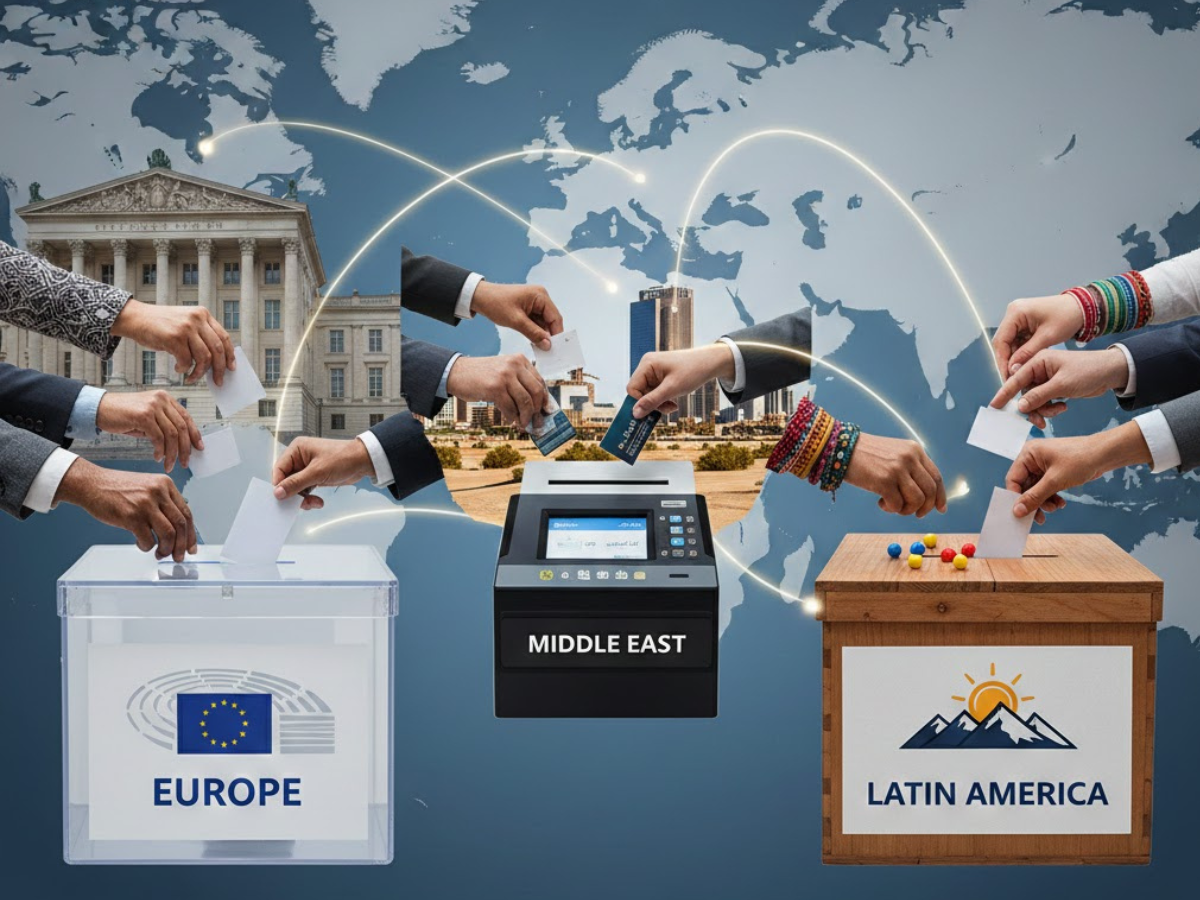
Voters head to the polls in a year of pivotal elections set to influence alliances across Europe, the Middle East and Latin America (Photo: File)
LONDON: Of the 40 worldwide elections in 2026 these are some likely to shape international alliances:
HUNGARY
Strongman Prime Minister Viktor Orban has dominated Hungary's politics for over two decades, prompting the European Parliament to say the system is now one of "electoral autocracy". In the April elections this is about to be challenged. Hungary ditched communism in 1989; Orban's first term began in 1998 but he lost in 2002. Immediately Orban began structuring his and the Fidesz party's re-election; his second premiership began in 2010 and he remains incumbent.
Orban has variously been called populist, extreme and radical right, largely due to his controversial remarks in 2014 "that a democracy does not necessarily have to be liberal. Just because a state is not liberal, it can still be a democracy." These and the following remarks infuriated the European Parliament and thus began an ongoing difference of opinion and values between most European States and Hungary. Hungary supports Christian values and nationalism; Orban will not support the EU's Migration Pact that brings together policies on migration, asylum, integration, and border management. Orban does not endorse pluralism or multi-culturalism.
In 2012 electoral reforms were introduced which decreased the number of seats in the National Assembly from 386 to 199; this came into effect with the 2014 general election. Orban's centralised approach and restrictions on a free-press, plus economic challenges and corruption scandals, followed by disputes over a frozen EU entitlement of funds that are being withheld due to Fidesz not implementing the EU required reforms that were due by the end of 2025. Orban's allies include Prime Minister Fico, President Putin and President Trump. Hungary is largely powered by Russian energy resources and recently US waived sanctions for Rosatom and Russian banks, who have been allowed to participate in the completion of the Paks Nuclear Power Plant in central Hungary.
Recent polls show Fidesz support diminishing and Peter Magyar's moderate right party Tisza's vote base growing. Magyar resigned from Fidesz in 2024 and has risen almost from obscurity somewhat due to dissatisfaction in rural communities with Fidesz. Magyar's campaign is built around a "functioning and humane Hungary," bringing EU money back to Hungary, introducing anti-corruption measures and welcoming everyone in their community. These pledges are designed to be the antithesis of Fidesz, who have been relatively punitive to the LGBT community when they tried to legislate against the Pride Rally last year. Fidesz supporters are against liberal gender and sex education practises common in woke culture.
Magyar paints a gloomy picture of a collapsing state with crumbling infrastructure, a conservative judiciary, over-nationalisation of banking, energy and media industries. According to the Daily News outlet Magyar presents a more pro-Western, cautious-Putin tone; he references figures and milestones rarely invoked by other Hungarian politicians, setting himself apart from Orbán's worldview. Magyar recently promised if successful his first visit will be to Poland, a fellow member of the Visegrad Group, an informal regional cooperation between Poland, the Czech Republic, Slovakia, and Hungary, linked by neighbourhood and similar geopolitical situation but above all by common history, traditions, culture, and values.
Magyar previously expressed a desire for "pragmatic relations" with Russia, however he stressed that the Russia's Foreign Intelligence Service (SVR) recent statement that implies Magyar is loyal to "global elites", indicates Moscow's attempt to directly influence voters in a NATO member state, which under Orban's leadership, has refused to supply weapons to Ukraine. But it would be wrong to underestimate Orban's reactionary smearing of Magyar.
ISRAEL
A crucial and consequential election for the state of Israel and for Trump ally President Netanyahu is due before 27 October 2026. Today Netanyahu's party Likud with some of right-wing coalition partners have 67 seats out of the 120 in the Knesset. Although it is a European style unicameral system with proportional representation, no party has ever won the majority of seats, thus a series of coalitions have governed Israel. Up to 30 parties compete but usually only a combination of about 10 parties achieve the desired 3.25% to sit in the Knesset.
PM Benjamin Netanyahu's popularity goes up and down regularly about every three months; there are those who want him punished for breach of trust, bribery and fraud; on the other hand Bibi has been successful in building the dominant coalition with unlikely parties. Recently right-wingers have coalesced around Netanyahu's Likud but the return of Naftali Bennett with a new party provisionally named Bennett 2026, believe they have the potential change this. Bennett has reopened the call for an investigation into allegations that the Prime Minister's Office was infiltrated by agents of Qatar. Then in mid-December 2025 Handala, an Iranian cyber-backer group claimed to hack former PM Bennett's phone. Bennett says the material, including contacts and chats was obtained via his Telegram and that some of the photographs that have been leaked are Fakes. It is not certain the material actually comes from Bennett's account but the point the hackers are making is that Israel's security is vulnerable.
Four years ago, Mansour Abbas, an Arab dentist made history in Israel with his Israeli Palestinian Ra'am Party; it only lasted just a year but he is ambitious for a coalition in 2026. "The Arab vote will be very important in the election," Abbas has said. As in Jordan and US, Netanyahu threatened to ban the Muslim Brotherhood and this was seen as a warning to Abbas, who has said Ra'am will distance itself from the Muslim Brotherhood following the US move. On 27 December Israel Elects poll positioned the opposition bloc including Bennett at 60 seats, just one seat away from a majority, and a Netanyahu coalition at 50 seats and the Arab parties led by Ra'am & Hadash-Ta'al at 10 seats. So far Ayelet Shaked, previously Home and Justice Minister, has not announced her return to politics; there has been no speculation about such an event but in the past many have not discounted her as a possible Prime Minister. Who she might side with could make her the Kingmaker.
BRAZIL
Brazil, Colombia, Costa Rica, Haiti, and Peru plan to elect presidents in 2026. Argentina, Ecuador, Honduras, Chile and Bolivia have set Latin America on a politically conservative trajectory. Following current events in Venezuela, will US play a part in the elections in the Western Hemisphere?
Brazil's October election will be the last; voting in Brazil is compulsory and Brazilians can vote from abroad; the turnout in 2022 was 79% in the first of two rounds. Lula da Silva, the current energetic 80 year old left-wing President is eligible and as the continuity candidate Lula is the pollster's favourite to run for a fourth term. In 2022 his victory was only by a couple of points, however he is a political survivor and master politician. Lula's administration have been criticised for not effectively dealing with corruption and cybersecurity issues; a possible boost to benefits and subsidies could be a vote winner.
Also on the ballot but on the far-right side is imprisoned Jair Bolsonaro's son Flávio Bolsonaro, a lawyer and the Senator representing Rio de Janeiro. Flávio presents himself as a more moderate version of Jair and out of all the Bolsonaro male contenders he has the support of his father, but so far Flávio has not demonstrated the skills or appeal of his father. Also from the Bolsonarismo stable is the São Paulo Governor Tarcísio de Freitas, a conservative former military officer, a technocrat with market-friendly policies. Tarcísio is a former army captain and a military engineer; it seems his ideology is strategically fluid and pragmatic. He has transformed Sao Paulo's economy and infrastructure with his long term vision. He is market-friendly and his pro-business theme straddles the centre to elements of the far-right, trespassing on Bolsonaro's vote base. However Tarcísio is frequently loyal to Bolsonaro and if speculations are true that Michelle Bolsonaro (third wife of Jair) could be his Vice-Presidential candidate, this pairing could make a real difference.
On the other hand if Lula looks really strong he may postpone his bid until 2030. With China and the US vying for influence in the region, the big question is who will the US support, with the biggest economy in Latin America and the biggest crime rate. Brazilians will have to decide their priority: the economy or their security.
These are consequential elections shaping geopolitics, peace and prosperity across three continents: Hungary in Europe, Israel in the Middle East and Brazil in South America.
