
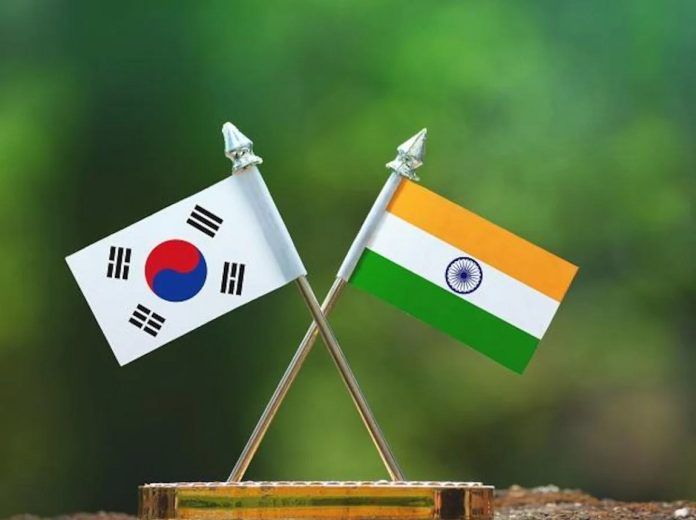
SEOUL: The Indo-Pacific region is undergoing profound geostrategic transformation, reshaping the context within which India and the Republic of Korea (ROK) must re-envision their bilateral partnership. When the two countries elevated their relations to a Strategic Partnership more than a decade ago, regional conditions appeared comparatively stable. The United States retained uncontested strategic primacy in Northeast Asia; the U.S.-ROK alliance functioned as a reliable deterrent against regional security threats, and although North Korea remained hostile, its strategic behavior was largely contained. Domestically, both India and South Korea experienced robust economic growth, demographic stability, and relatively cohesive social environments. Within this context, bilateral cooperation centered primarily on trade expansion, defence industrial collaboration, and diplomatic exchanges an approach that proved largely sufficient at the time.
Today, however, the international and domestic contexts shaping the partnership have shifted markedly. Strategic competition between the United States and China has deepened across technological, military, economic, and ideological spheres, influencing the security and economic choices of both countries in a big way. Washington’s increasingly transactional foreign policy and Beijing’s selective support for multilateralism and open and free trade are reshaping regional strategic and economic agendas. The relative strategic simplicity of the past has given way to a more contested and multilayered regional order. These shifts require New Delhi and Seoul to reassess national security priorities, alliance frameworks, and long-term strategic partnerships.
TRANSFORMATION IN REGIONAL AND DOMESTIC DYNAMICS
Unlike a decade ago, South Korea today faces growing debate over the enduring reliability of the U.S. security commitment. Although the alliance remains central to its defence posture, shifting U.S. domestic priorities, global resource constraints, evolving burden-sharing demands, and tariff-related frictions have encouraged Seoul to pursue greater strategic autonomy. Accordingly, South Korea is working to enhance independent strategic planning capabilities and develop a more self-reliant defence force. At the same time, it remains torn between the necessity of maintaining a strong security alliance with the United States and the economic imperative of sustaining a substantial partnership with China. The complexities of South Korea’s foreign, security, and economic policy choices are increasing by the day.
Simultaneously, South Korea faces profound internal challenges that could undermine its long-term strategic capacity. The country is experiencing one of the world’s most severe demographic declines, with fertility rates far below replacement levels. This contraction is shrinking the pool of military conscripts, complicating force planning amid rising external threats. Economically, export-led growth has slowed, domestic consumption remains subdued, and labor market rigidities persist. Meanwhile, rapid population aging and declining university enrollments threaten the innovation capacity that has long sustained South Korea’s technological edge. Without forward-looking reforms, these pressures may increasingly limit Seoul’s strategic engagement in the Indo-Pacific—including its partnership with India.
For India, the external security environment has likewise become more complex. Intensifying strategic competition with China, expanding Chinese influence in South Asia and the Indian Ocean, and the growing complexity of India’s strategic partnership with the United States underscore the need for diversified strategic relationships. While India has advanced indigenous defence, digital innovation, and maritime capabilities, sustaining strategic autonomy in a polarized Indo-Pacific requires deeper cooperation with like-minded states committed to regional stability and sovereign decision-making.
In this transformed context, an India-ROK partnership limited to transactional cooperation in trade, investment, or defence procurement is no longer sufficient. The next phase must prioritize the development of shared strategic resilience, enabling both countries to navigate regional and domestic volatility while securing their long-term strategic, economic, and political objectives. This necessitates moving beyond fragmented, interest-driven collaboration toward an integrated and institutionalized framework anchored in a broader, forward-looking strategic vision capable of responding to the evolving power dynamics of the Indo-Pacific.
In the defence and security domain, both countries must accord greater strategic priority than at present. Cooperation should move beyond defence industrial projects toward deeper security and defence policy alignment. Strengthening institutionalized strategic dialogue, expanding joint military training and doctrinal exchanges, and enhancing coordination mechanisms will become increasingly important as Seoul and New Delhi pursue greater defence autonomy. Given their shared reliance on secure sea lines of communication and the rising militarization of the Indian Ocean and the South China Sea, maritime cooperation must be urgently prioritized. Current levels of cooperation remain inadequate in light of anticipated regional power competition.
IMPERATIVES FOR STRATEGIC RENEWAL
Though essential, strengthening security ties alone will not suffice. South Korea’s internal structural challenges including demographic decline and weakening innovation capacity require sustained policy attention. India cannot overlook these issues if it seeks a stable and capable partner amid regional uncertainty. New Delhi should develop a strategy to support Korea’s efforts to revitalize its contracting social systems. Collaborative initiatives in the care economy, smart public health infrastructure, higher education and research training could help mitigate the effects of demographic contraction.
Economic cooperation must also move beyond traditional trade, investment, and manufacturing models. Rather than viewing Korean investments in India as isolated production units, both countries should build integrated, innovation-driven production ecosystems in strategic technology sectors to strengthen their global competitiveness. Semiconductors, electric mobility, battery technologies, hydrogen energy, and advanced materials offer promising avenues for co-development. Korean firms contribute engineering expertise and capital, while India provides scale, supply chain resilience, skilled labor, and expanding demand. Joint research platforms and coordinated policy frameworks can reduce supply chain vulnerabilities and enhance technological self-reliance. Both economies must prepare together to meet future challenges with a joint broader strategic vision. The current transactional approach to their economic partnership must come to an end.
The time has come for this partnership to rest on foundations deeper than material interests. India and South Korea must be prepared to support one another in safeguarding their shared democratic values, national sovereignty, a stable Indo-Pacific order, and strategic autonomy amid intensifying great-power competition. As both states navigate pressures from larger regional actors while seeking to maintain independent foreign-policy identities, each requires a reliable and trusted long-term partner. These shared principles rather than transactional considerations should form the durable basis for sustained strategic alignment going forward.
The renewal of the India-ROK partnership is not merely desirable but strategically imperative. As the Indo-Pacific becomes the central geopolitical arena of the twenty-first century, the ability of middle-power democracies to coordinate and cooperate will significantly influence the regional order. Without such renewal, both nations risk diminishing strategic space and weakening geopolitical leverage. Realizing this shared strategic destiny requires vision, commitment, and institutional depth. Incremental or compartmentalized cooperation is no longer adequate. What is needed is a multidimensional, integrated, and future-oriented partnership that aligns defence cooperation, economic co-innovation, social capacity building, and regional diplomacy within a broader, coherent strategic framework.
Dr Lakhvinder Singh is Director of Peace and Security Studies at the Asia Institute in Seoul, South Korea.




