
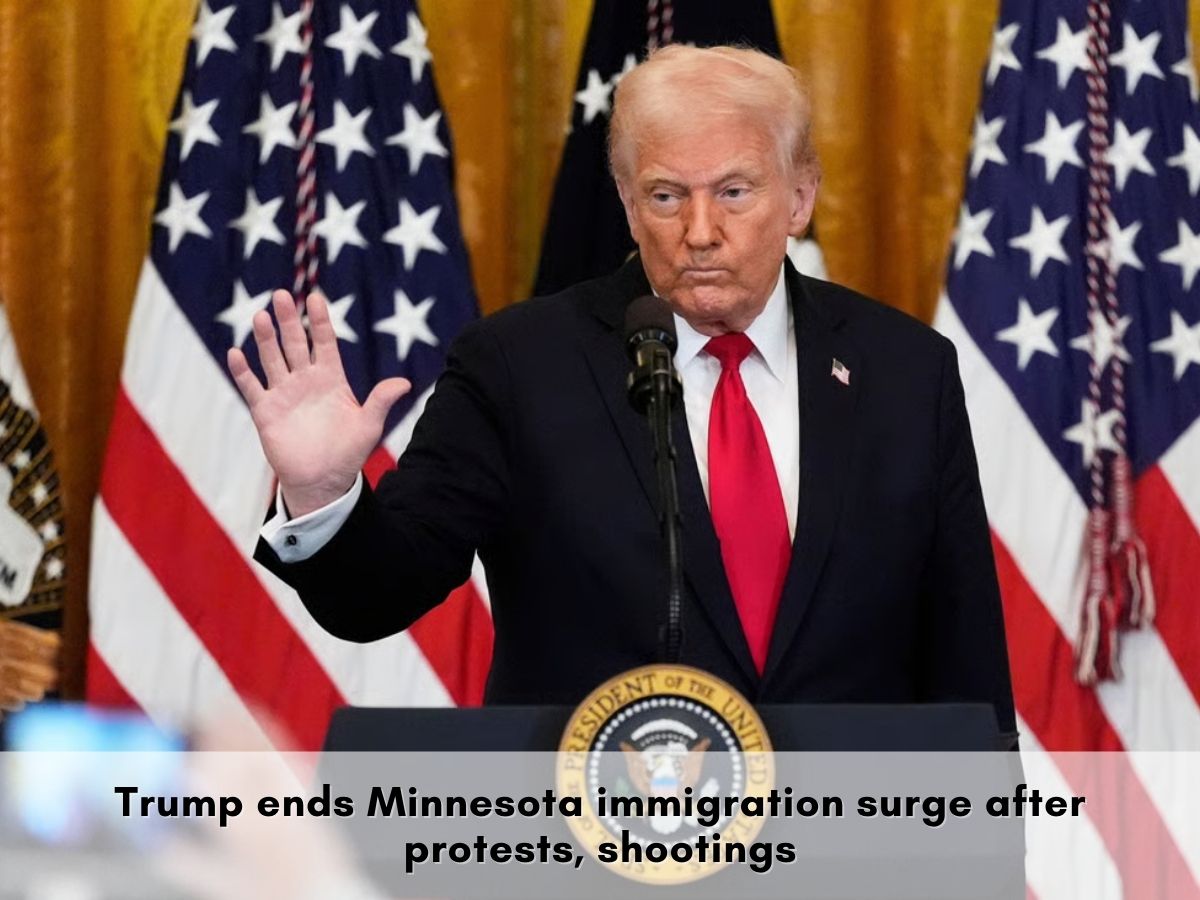
U.S. President Donald Trump has agreed to end Operation Metro Surge, a controversial immigration enforcement operation in Minnesota, after weeks of protest, two fatal officer-involved shootings of American citizens, and mounting bipartisan criticism, White House border czar Tom Homan said Thursday.
The operation, launched in late January, deployed approximately 3,000 armed immigration agents to Minnesota. Trump described it as the largest deportation surge in U.S. history. The deployment occurred over the objections of Gov. Tim Walz (D-MN) and drew thousands of protesters into the streets of Minneapolis and St. Paul.
Who is ending Operation Metro Surge and why?
Homan announced the conclusion of the operation at a news conference outside Minneapolis, saying Trump had concurred with his recommendation to end the surge. “Operation Metro Surge is ending,” Homan said. He cited what he described as “unprecedented levels of coordination” with Minnesota law enforcement as a factor in the decision. Approximately 150 immigration agents were stationed in Minnesota prior to the surge. Homan said many agents deployed from other states would return home in the coming week. A week earlier, Homan announced that roughly 700 of the 3,000 agents would be withdrawn.
Why Is Trump Ending the Minnesota Deportation Surge Now?
The reversal followed weeks of escalating political and legal pressure. Gov. Tim Walz and Minneapolis Mayor Jacob Frey filed a federal lawsuit last month seeking to restrain the operation. Federal judges, including the chief federal judge in Minnesota, issued rulings stating that U.S. Immigration and Customs Enforcement had defied court orders to release wrongly detained migrants. Reuters/Ipsos polling conducted in January showed support for Trump’s immigration agenda falling to its lowest level of his presidency as images of agents in military-style gear circulated nationally.
How did the shootings of two U.S. citizens affect the operation?
On separate days in January, immigration agents fatally shot two U.S. citizens in Minneapolis who had been observing or participating in protests against the operation. The victims were identified as Renee Good and Alex Pretti. Department of Homeland Security Secretary Kristi Noem and other administration officials initially described them as “domestic terrorists.” Sen. Rand Paul (R-KY), chairman of the Senate Homeland Security Committee, criticized that characterization during a hearing Thursday. “People aren’t believing there’s going to be an honest investigation,” Paul said. Attorney General Keith Ellison (D-MN) was in Washington testifying before the same committee when Homan made his announcement.
What are state and local officials saying about the operation’s end?
Walz said in a statement that the damage from the surge would not be quickly undone. “The long road to recovery starts now,” he said. “The impact on our economy, our schools, and people’s lives won’t be reversed overnight. That work starts today.” Frey said the operation had been catastrophic. “They thought they could break us, but a love for our neighbors and a resolve to endure can outlast an occupation,” he said.
How are community members and organizers responding?
Avonna Starck, a school board member and environmental nonprofit director in a Minneapolis suburb, said the announcement did not meet community demands. “They’re not removing all agents, and that was the goal,” she said. “We as a community wanted all of the agents out of Minnesota.” Miguel Hernandez, a Minneapolis community organizer and restaurant owner, said the announcement lacked accountability. “They’re saying it’s over so that people will stop paying attention, but harm was done and the harm continues to be done,” he said. “Our community is going to continue to be destroyed.”
What is ICE’s role in Minnesota after the surge?
Homan said immigration enforcement in Minnesota would return to pre-surge protocols. “ICE will continue to identify, arrest and remove illegal aliens that pose a risk to public safety, like we’ve done for years,” he said, “and our officers will carry out those duties with professionalism, integrity and compassion, like we’ve done for years.” Prior to January, approximately 150 ICE agents were assigned to Minnesota.
FAQs
Q: What was Operation Metro Surge?
A: Operation Metro Surge was a Trump administration immigration enforcement operation that deployed about 3,000 ICE agents to Minnesota beginning in late January 2025. Trump described it as the largest deportation operation in U.S. history.
Q: Why is the operation ending?
A: Border czar Tom Homan said Trump agreed to end the operation after what he called “unprecedented levels of coordination” with Minnesota law enforcement. The decision followed mass protests, two fatal shootings of U.S. citizens by federal agents, lawsuits, court rulings against ICE, and declining public support for Trump’s immigration agenda.
Q: Were any U.S. citizens killed during the operation?
A: Yes. Renee Good and Alex Pretti, both U.S. citizens, were fatally shot by immigration agents on separate days in January while observing or participating in protests. Officials initially labeled them “domestic terrorists,” a characterization Sen. Rand Paul criticized Thursday.
Q: How did Minnesota officials respond to the surge?
A: Gov. Tim Walz and Minneapolis Mayor Jacob Frey condemned the operation, filed a federal lawsuit against the Trump administration, and sought judicial intervention to restrain federal enforcement activity in the state.
Q: Will all federal immigration agents leave Minnesota?
A: No. Homan said many agents deployed from other states will return home in the coming week. Approximately 150 agents were stationed in Minnesota before the surge and are expected to remain.
Disclaimer: This information is based on inputs from news agency reports. TSG does not independently confirm the information provided by the relevant sources.




