
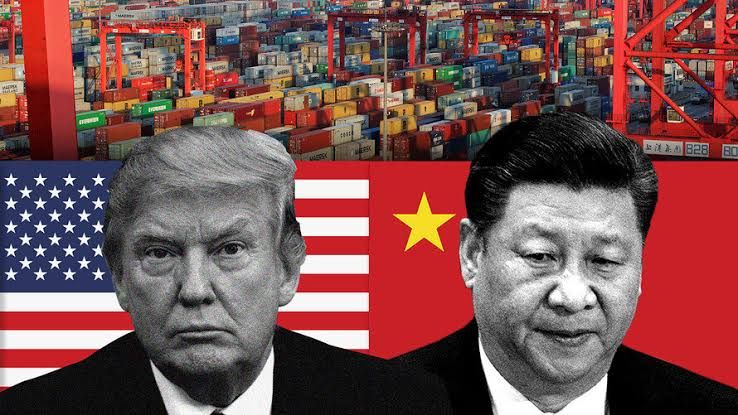
US President Donald Trump is likely to visit China for a state visit sometime soon after the success of the fourth round of US-China trade talks in Spain. A telephonic conversation is also scheduled between Trump and Xi Jinping on September 19.
While there has been much on the table for discussion and much will be in the months to come including Tiktok, Fentanyl, Boeing and Soyabean–the watchers will also be keenly interested to know if the two leaders will discuss the South China Sea dispute and further open doors for participation of other stakeholders like Phillipines, India, Vietnam and Taiwan in the subsequent discussions.
South China Sea is Tense
While the trade talks continued between US and China, the tensions also kept increasing in the South China Sea with the mounting US presence in the region. The US also continues to be negotiating or has already negotiated with other countries’ trade representatives in the region. These nations have strategic interests in the region including Phillipines, Japan, Taiwan, India and some South East Asian countries.
The South China Sea dispute has also repeatedly come up in discussions on the US’ renewed focus on the Asia-Pacific region, within the Indo-Pacific. Secretary of War, Peter Hegseth in a telephonic conversation with China’s Minister of National Defense, Dong Jun on September 9 described Asia-Pacific as a “priority theatre” and said the US will resolutely protect its interests.
Though Hegseth also clarified that the US is not seeking conflict or regime change in PRC, by describing Asia-Pacific as a priority theatre he very loudly expressed what the South China Sea means for the US.
Philippine-U.S. Strategic Cooperation
Leading this strategic impetus in the region is the Philippine-U.S. defense cooperation whose pace remarkably increased after Philippine President Ferdinand Marcos Jr.’s meeting with Trump at White House on July 22.
The U.S. Indo-Pacific Commander Admiral Samuel Paparo and Armed Forces of the Philippines (AFP) Chief of Staff General Romeo Brawner met on August 7 and signed a “8-star memorandum” for military to-military coordination. A week later another meeting happened between Philip pine Army Commander Lt. Gen. Antonio Nafarrete and senior officials from the Joint U.S. Military Assistance Group on August 15. The US is also planning to build a fast boat facility in the Philippines and there has also been an announcement on the deployment of more US missile launchers to the Philippines to strengthen deterrence.
Around this same time in mid-August the US deployed two navy destroyers, USS Higgins and USS Cincinnati in the South China Sea and the former sailed 12 nautical miles of the Shoal which is claimed by China as its waters. The Chinese described the US deployment as illegal and boasted that it warned and drove away the US navy destroyer.
The Philippines has faced at least four significant direct confrontations with Chinese vessels near the disputed Scarborough Shoal in 2025–three with Chinese coast guards and one with a Chinese navy warship. The latest happened on Tuesday when China alleged that a Philippines ship rammed against one of its vessels near the disputed Shoal while the latter denied it and alleged that China used powerful water cannons that destroyed its ships and injured its crew.
Since these crisis situations and confrontations have persisted despite the US, China and Philippines establishing the China-Philippine Communication mechanism on maritime issues in 2023, it’s a high probability that Trump and Xi and their administration will discuss the South China Sea dispute.
Discussions on the Dispute
The confrontations involving Chinese vessels in the South China Sea don’t just involve Philippines and US but multiple other nationality sea vessels as well. In addition the region remains critical as a trade route for many other countries and increasing Chinese aggression has invited other strategic alliances in the region like India and Philippines, and Japan and India.
India and Philippines naval ships conducted their first two-day joint naval drills in the South China Sea in August and they were shad owed by two Chinese navy ships, including a guided missile destroyer, which came about 25 nautical miles (46 kilometers) from one of two participating Philippine navy warships.
A similar confrontation happened when a joint naval patrol of the Philippines, the U.S. and Japan was taking place in the West Philip pine Sea from September 11 to September 13 and three Chinese naval ships shadowed them.
There have been multiple other confrontations between the Chinese and the Taiwanese vessels around the Pratas islands and the Kinmen islands and an increasing number of similar incidents with the Vietnamese.
It’s understandable that increasing Chinese aggression will increase the number of naval alliances in the South China Sea, thereby increasing multiple stakes in the South China Sea dispute discussions. Thus when Trump and Xi Jinping meet in Beijing, all these countries in the region will be watching and so will their naval ships.
Venus Upadhayaya is a MOFA Taiwan 2025 fellow and a Visiting Scholar at NCHU Taichung, Taiwan. Lukas Las is an Assistant Professor of Political and Cultural Geography at the University of Ostrava, Czechia.




