
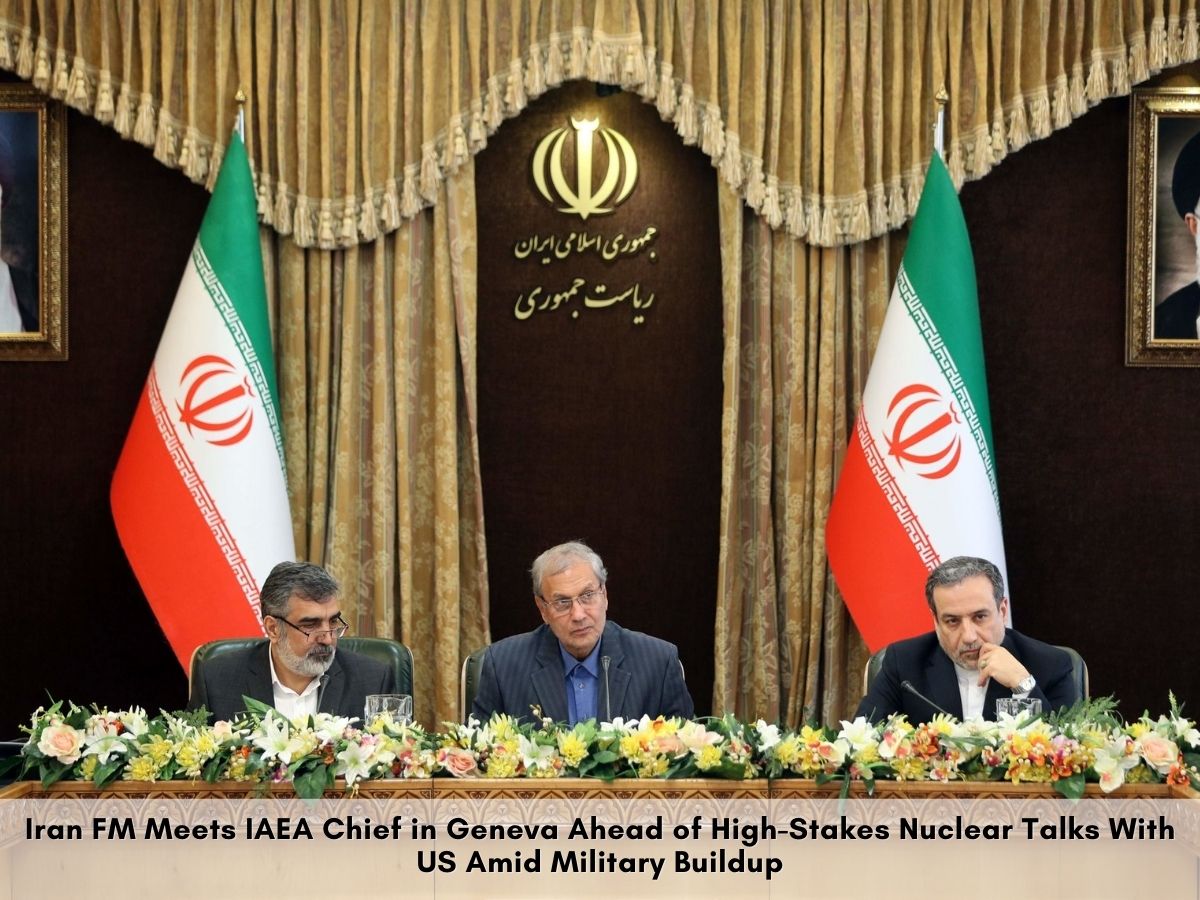
Iran’s foreign minister met with the U.N. nuclear watchdog chief on Monday, hours before indirect talks with Washington aimed at resolving a decades-long nuclear dispute. The meeting comes with few signs of compromise from either side and the threat of U.S. military action looming amid a major American naval buildup in the region.
Who Did Iran’s Foreign Minister Meet in Geneva?
Iran’s Foreign Minister Abbas Araqchi held in-depth technical discussions with International Atomic Energy Agency (IAEA) Director General Rafael Grossi on Monday morning. The meeting focused on cooperation with the IAEA and Tehran’s technical position regarding nuclear talks with the United States.
“I am in Geneva with real ideas to achieve a fair and equitable deal,” Araqchi posted on X. “What is not on the table: submission before threats.”
Grossi confirmed on X that they had completed “in-depth technical discussions in preparation for important negotiations scheduled for tomorrow in Geneva.”
Why Are These Talks Happening Now?
The US and Iran renewed negotiations earlier this month after an eight-month pause following the June 2025 Iran-Israel war. Washington, which joined Israel in air strikes on Iranian nuclear sites in June, has ordered a second aircraft carrier strike group to the Middle East.
Additional US warships and aircraft have already been deployed to the region. The talks aim to tackle the nuclear dispute, with Western states and Israel believing Tehran’s program is aimed at building nuclear arms. Iran denies this.
What Is the Scope of the Negotiations?
Washington has sought to expand talks to non-nuclear issues including Iran’s missile stockpile. Tehran says it is only willing to discuss curbs on its nuclear programme in exchange for sanctions relief and won’t accept zero uranium enrichment.
Its missile capabilities are “off the table.” Deputy Foreign Minister Majid Takht-Ravanchi signalled Iran’s readiness to compromise on its nuclear programme in return for sanctions relief. He told the BBC the ball was “in America’s court to prove that they want to do a deal.”
What Did US and Israeli Officials Say?
US Secretary of State Marco Rubio said reaching a deal with Tehran would be hard. “I think that there’s an opportunity here to diplomatically reach an agreement that addresses the things we’re concerned about,” Rubio said in Hungary on Monday.
“We’ll be very open and welcoming to that. But I don’t want to overstate it either. It’s going to be hard. It’s been very difficult for anyone to do real deals with Iran, because we’re dealing with radical Shia clerics who are making theological decisions, not geopolitical ones.” Israeli Prime Minister Benjamin Netanyahu said any US deal with Iran must include dismantling Iran’s nuclear infrastructure, not just stopping enrichment.
“There shall be no enrichment capability—not stopping the enrichment process, but dismantling the equipment and the infrastructure that allows you to enrich in the first place,” Netanyahu said.
What Is Happening in the Strait of Hormuz?
Iran’s Revolutionary Guards launched a military drill on Monday named “Smart Control of the Strait of Hormuz.” The exercise tests the readiness of naval units to protect the waterway, through which a fifth of global oil flows.
“Intelligently utilizing the geopolitical advantages of the Islamic Republic in the Persian Gulf and the Sea of Oman are among the main objectives of this exercise,” the semi-official Tasnim news agency reported. Iran has repeatedly threatened to close the Strait in retaliation against any attack.
What About the Missing Enriched Uranium?
For months, the IAEA has been requesting that Iran explain the fate of its 440-kilogram (970-pound) highly enriched uranium stockpile in the wake of Israeli-US strikes. The agency wants inspections fully resumed, including at three key sites bombed in June 2025: Natanz, Fordow and Isfahan.
Iran has offered to consider compromises on its stockpile of 60% enriched uranium in return for sanctions relief. Options could include diluting the uranium or allowing international oversight, while stopping short of zero enrichment.
Did Iran Hold Other Military Drills?
Iran’s civil defence organisation held a chemical defence drill in the Pars Special Economic Energy Zone on Monday. The exercise aimed to strengthen preparedness for potential chemical incidents in the southern energy hub.
FAQs
Q: What time are the US-Iran talks happening?
A: The indirect negotiations, mediated by Oman, are scheduled for Tuesday, February 18, in Geneva.
Q: Who is mediating the talks?
A: Omani Foreign Minister Badr al-Bussaidi is mediating, as he did in the previous round held in Muscat on February 6. Switzerland also plays a key role as a neutral venue.
Q: Who leads the US delegation?
A: Special Adviser to President Donald Trump, Steve Witkoff, and his son-in-law Jared Kushner are heading the US team.
Q: What did the February 6 Muscat talks achieve?
A: Iran described the talks as a “good start” with agreement to continue discussions. Both sides reportedly shook hands briefly despite indirect format.
Q: What is Iran’s red line?
A: Iran insists on its “right to enrich uranium” and refuses to discuss its missile programme, which it calls a defensive matter that is “never negotiable.”
Q: What is the US red line?
A: US officials view enrichment inside Iran as a pathway to nuclear weapons and want broader talks including missiles and regional influence.
Q: Could there be military action?
A: President Trump has warned that “bad things” could happen if no deal is reached. The US has positioned two aircraft carriers and additional assets in the region.
Disclaimer: This information is based on inputs from news agency reports. TSG does not independently confirm the information provided by the relevant sources.




