
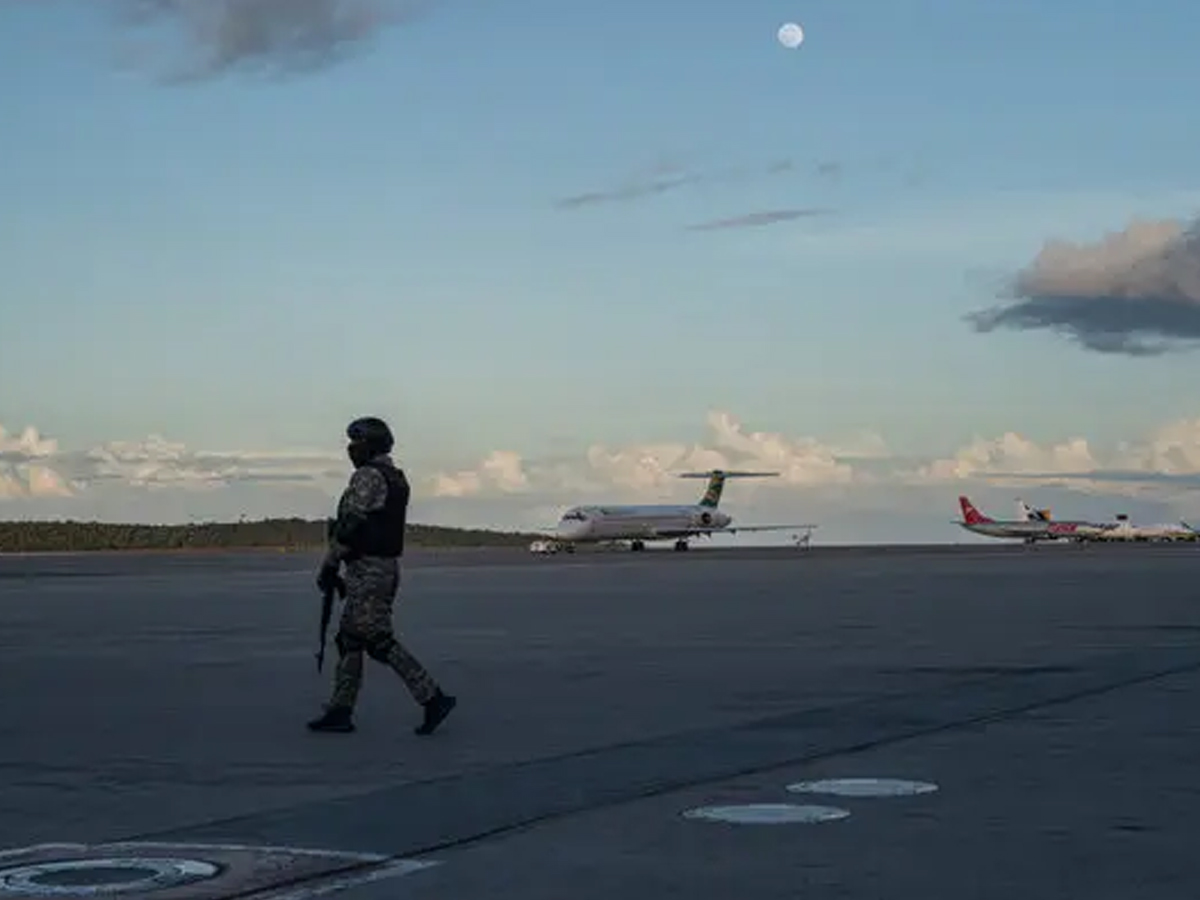
The ongoing conflict in the Middle East has created an increasingly dangerous environment for commercial aviation, forcing airline pilots to navigate crowded skies filled with military activity, drones, and missile interceptions.
Since the United States and Israel launched major strikes on Iran, killing the Islamic Republic’s Supreme Leader Ayatollah Ali Khamenei, tensions across the region have escalated sharply. Iran’s retaliatory attacks on US facilities and allied locations have brought missiles and drones into airspace that is also used by civilian aircraft.
As a result, pilots flying across the Middle East now face an unusual situation where war activity unfolds not far from busy international flight routes. Experts say this environment increases operational stress for crews who are trained for aviation emergencies but not for battlefield-like threats in the sky.
Drone Incursions And Missile Activity Increasing Aviation Risks
The war has turned the skies above several major Middle Eastern hubs into highly monitored and occasionally volatile zones. Hundreds of ballistic missiles and armed drones have crossed regional airspace during the ongoing conflict.
Some of the retaliatory strikes carried out by Iran have targeted facilities close to airports, forcing aviation authorities to temporarily halt operations at key hubs such as Dubai and Abu Dhabi. These disruptions have grounded many flights and limited air traffic across parts of the Gulf.
Only a small number of evacuation and rescue flights have been allowed to operate during some periods of heightened tension. Airlines have also rerouted several international flights to avoid potentially risky corridors.
Pilots and aviation security experts say the situation highlights how modern warfare increasingly overlaps with civilian transportation networks.
Pilots Say They Are Not Trained For Military Threats
Many commercial pilots say the rising presence of drones and missiles in civilian airspace has created new fears within the aviation community.
Tanja Harter, a pilot who has worked in the Middle East and president of the European Cockpit Association, told news agency Reuters, “We are not military pilots. We are not trained to deal with these kinds of threats in the air.”
She said the Middle East conflict is the latest in a series of security challenges the aviation sector has faced over the years, which could lead to fear and anxiety among pilots.
She added that airlines now often run peer support programmes to assist pilots. As a pilot herself, she said she would not want to “share airspace with missiles.”
How Pilots Try To Avoid Missile Threats During Flights
Pilots operating in the Middle East have developed certain safety practices to minimise risk during periods of conflict. Aviation officials say many crews rely on altitude adjustments and route changes when flying in areas where missile threats exist.
‘Fly higher to avoid missiles.’
Pilots trained in the Middle East have grown used to handling emergencies, the head of Lebanon’s civil aviation authority said. A pilot at Middle East Airlines, who has ten years of experience, told Reuters that flights to Beirut have become harder to manage.
Earlier, shoulder-fired anti-aircraft missiles in Lebanon usually had a range of 15,000 feet. To remain safe, pilots would climb higher to stay beyond that distance. Aircraft also often carried extra fuel in case they had to divert to another airport.
Even so, most missile strikes occur far enough away to avoid posing a direct danger. Pilots are also usually too busy during flights to focus on them.
Drone Threats Are Affecting Airports Beyond The Middle East
Security concerns linked to drones are no longer limited to conflict zones. Since Russia invaded Ukraine in 2022, military drones have become widely used weapons, and their presence has started affecting civilian aviation in other regions as well.
Airports in several European cities, including Stockholm and Munich, have reported drone-related disruptions in recent years. Some of these incidents are suspected to have connections to broader geopolitical tensions.
Airline Captain Christian von D’Ahe, who has worked as a commercial pilot for 15 years and head of the Danish Airline Pilots Association, warned about the growing challenge.
“Drones are not easily detected,” Von D’Ahe said. “We can see them in the air, and they’re very small. So sooner or later, something will happen.”
Experts say a drone striking a plane’s engine could cause a serious failure, while a collision with a wing could disrupt the aircraft’s ability to manoeuvre safely.
Why Airports Struggle To Stop Drone Threats?
Airports rely heavily on radar systems to monitor aircraft movements. However, drones often operate without transponders — devices that transmit identification signals to radar systems.
This makes them extremely difficult to track using standard airport equipment.
Most registered aircraft send signals through a transponder, a device that allows radar systems to identify them. Drones do not send such signals, leaving pilots unable to track them. Standard airport radar systems also struggle to detect drones.
Some airports use specialised systems such as radio-frequency sensors, jamming technology, and electronic tools that can force drones off their course. But aviation rules generally prevent airports from shooting drones down, limiting the options available to authorities.
Tim Friebe, an air traffic controller in Germany and vice president of the Air Traffic Controllers European Unions Coordination (ATCEUC), said drones were a “threat that is growing.” He added that airports often have limited options to respond.
“For now, we have reports, pilot reports, or sometimes controllers spot drones. The problem is there’s not much you can do except shut down the airport,” he said.
Commercial pilot Moritz Burger also described a frightening near-miss incident while preparing to land.
“I was looking out of the window, and suddenly, there appeared an object that passed by just below our aircraft. We could see it for maybe one, maximum two seconds,” he told the news agency, adding it shook him and left him no time to take any action.
“When you encounter such a near-miss or some passing object, there is not enough time to react. So it is unrealistic to expect that pilots could fly around such an object. There’s pretty much nothing we can do.”




