
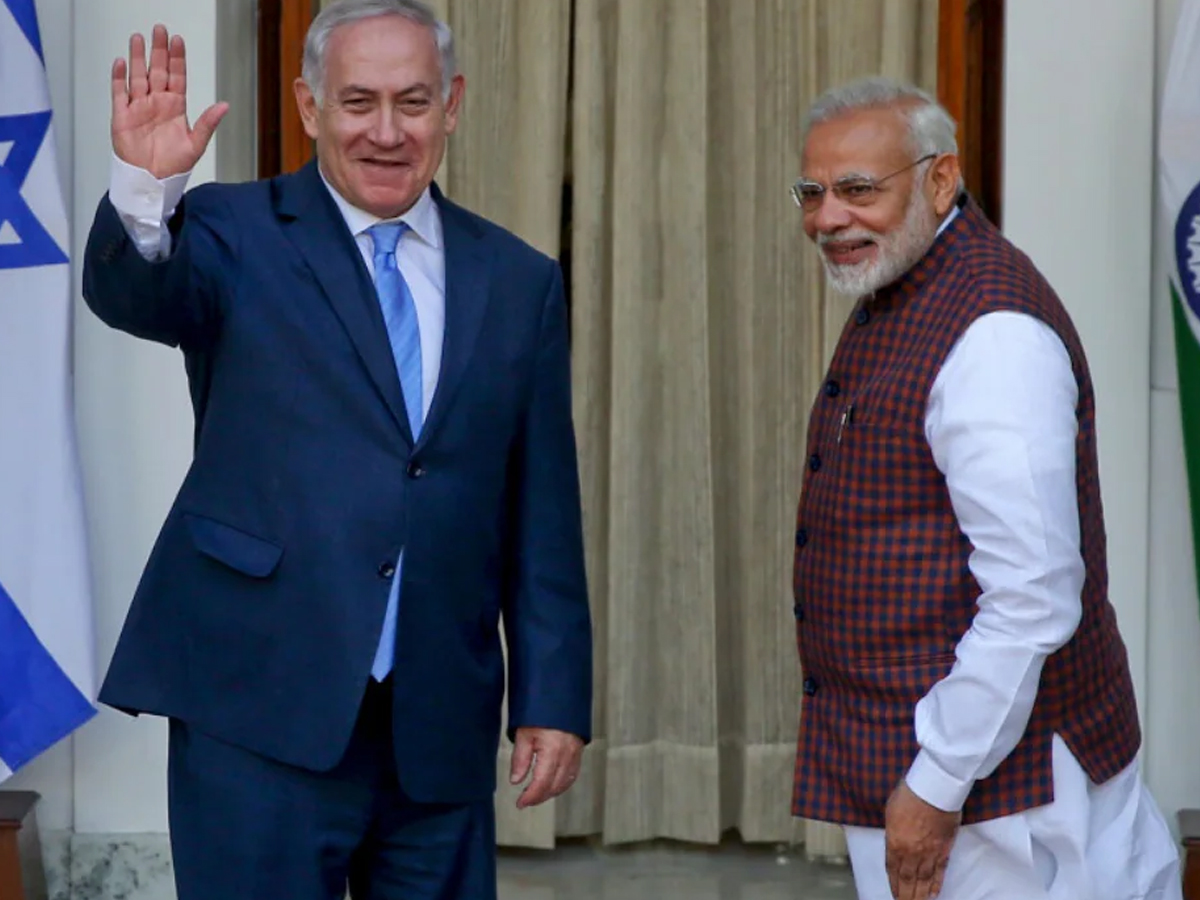
On the eve of Prime Minister Narendra Modi’s state visit to Israel, Israeli Prime Minister Benjamin Netanyahu has put forward an ambitious proposal that could redraw strategic alignments across West Asia and beyond.
Netanyahu revealed plans for what he called a “hexagon of alliances”, a structured coalition of countries with shared security concerns and overlapping strategic interests. The proposal places India at the heart of this emerging framework, alongside Israel, Greece, and Cyprus, with additional participation expected from select Arab, African, and Asian nations.
The announcement, issued by Israel’s foreign office on February 22, comes at a sensitive geopolitical moment, as regional rivalries sharpen and new defence partnerships take shape.
What Is the ‘Hexagon Alliance’ Proposed by Netanyahu?
Explaining the idea during a cabinet meeting, Netanyahu described the initiative as a formal security-oriented grouping designed to connect countries across the Middle East, the Mediterranean, Africa, and Asia.
He positioned the alliance as a response to two destabilising trends in the region: a “radical Shia axis” and an emerging “radical Sunni axis.” He linked the former to Iran and allied groups such as Hamas, Hezbollah, and the Houthis, while associating the latter with extremist organisations operating in parts of West Asia.
Unlike earlier informal arrangements, the proposed hexagon seeks to institutionalise cooperation in areas such as defence coordination, intelligence-sharing, and strategic resilience.
Modi in Israel: Why India Is Central to the Proposed Bloc?
By naming India as a core partner, Netanyahu has underscored New Delhi’s growing strategic weight beyond South Asia. India’s expanding defence ties, diplomatic reach, and economic presence across West Asia and the Mediterranean region make it a natural anchor for such a coalition.
Officials in New Delhi have not publicly commented on the proposal, but India’s Ministry of External Affairs has said that Modi’s discussions in Israel will include regional developments and broader global issues of shared concern.
Modi’s visit on February 25–26 marks his second trip to Israel as Prime Minister and signals continuity in the deepening strategic partnership between the two countries.
How the Hexagon Differs From Existing Groupings?
Netanyahu’s proposal marks a departure from looser multilateral arrangements such as I2U2 and earlier informal understandings involving India, Israel, the UAE, and Greece.
While those platforms focused heavily on economic cooperation, technology, and connectivity, the hexagon framework places security and threat perception at its core. By publicly identifying both partners and adversaries, Israel has elevated what once was quiet coordination into an openly articulated strategic doctrine.
This shift suggests a move toward clearer alliance structures in a region long defined by fluid and often opaque partnerships.
Regional Context: Rising Tensions and New Defence Pacts
The proposal emerges against a backdrop of heightened regional friction. Israel and Iran continue to face off across multiple theatres, while Pakistan and Saudi Arabia signed a Strategic Mutual Defence Agreement in September 2025 — an arrangement some analysts have described as an “Islamic Nato.” Turkey has also hinted at interest in that pact.
These parallel developments highlight a broader trend: West Asia is entering a phase of more explicit alliance-building, driven by security anxieties and shifting power balances.
What This Means for West Asia’s Strategic Balance
By advancing the idea of a hexagon alliance and placing India at its centre, Netanyahu has signalled Israel’s intent to help shape a new security architecture that extends well beyond its immediate neighbourhood.
If the proposal gains traction, it could significantly influence how regional powers cooperate, deter adversaries, and manage shared threats. For India, the idea reflects its evolving role as a pivotal actor in the geopolitics of West Asia and the Mediterranean.
As Modi begins his Israel visit, the proposal adds a new strategic dimension to bilateral talks — one that could resonate far beyond the two-day engagement.




