The US test-fired its Minuteman III doomsday missile from California. Here’s what the nuclear-capable ICBM is, its range, and why the test was conducted.
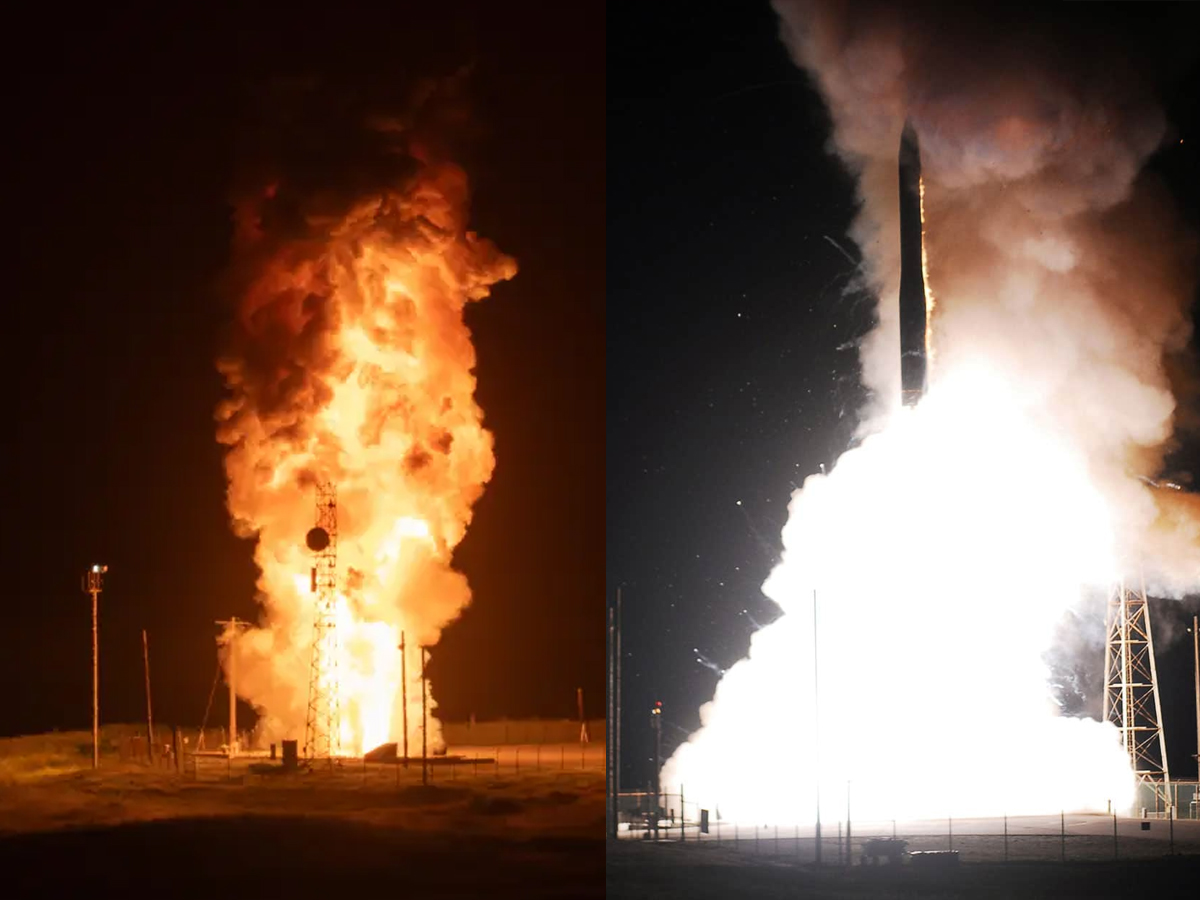
The Minuteman III, officially known as LGM-30G, is the only active land-based intercontinental ballistic missile currently used by the United States. (Photo: Social Media)
The United States recently carried out a test launch of its nuclear-capable intercontinental ballistic missile known as the Minuteman III. The missile was launched late at night from California and travelled thousands of kilometres across the Pacific Ocean before reaching its target near the Marshall Islands.
The launch has attracted global attention because the weapon is part of the US nuclear deterrence system and is often referred to as a “doomsday missile” due to its massive destructive capability.
Officials said the test was routine and planned years in advance. The launch also comes at a time when tensions remain high in the Middle East following recent strikes in Iran and other regional locations.
The Minuteman III, officially known as LGM-30G, is the only active land-based intercontinental ballistic missile currently used by the United States. It forms one part of America’s nuclear triad, which consists of land-based missiles, submarine-launched missiles, and nuclear-capable bombers.
US tests doomsday MINUTEMAN III ballistic missile
— RT (@RT_com) March 5, 2026
'A routine launch scheduled years ago — NOT in response to world events'
ICBM capable of carrying nuclear warheads 20x more powerful than Hiroshima pic.twitter.com/tJu1W8VSns
The missile entered service in 1970 and remains a key part of the US strategic defence system. Around 400 Minuteman III missiles are currently deployed in underground silos across three Air Force bases located in Montana, North Dakota, and Wyoming.
One reason the missile is often called a “doomsday weapon” is its ability to carry extremely powerful nuclear warheads designed for long-range deterrence.
The Minuteman III has a range of more than 13,000 kilometres, allowing it to strike targets almost anywhere in the world.
It can carry up to three independently targetable reentry vehicles, also known as MIRVs. These warheads can separate during flight and strike different targets.
The missile can be equipped with W87 or W78 thermonuclear warheads. Each warhead has an explosive power of around 300 to 475 kilotons. This makes them significantly more powerful than the atomic bomb dropped on Hiroshima during World War II.
Because of its long range and destructive capability, the Minuteman III plays a critical role in the United States’ nuclear deterrence strategy.
The recent launch was part of a scheduled test to check the readiness and reliability of the missile system. The unarmed test missile travelled across the Pacific Ocean after being fired from Vandenberg Space Force Base near Santa Barbara in California.
The missile was launched at around 11 PM local time and later reached a designated test area near the Marshall Islands.
According to military officials, the goal of the launch was to evaluate the performance of the missile system and its components.
“GT 255 allowed us to assess the performance of individual components of the missile system. By continually assessing varying mission profiles, we can enhance the performance of the entire ICBM fleet, ensuring the maximum level of readiness for the land-based leg of the nation’s nuclear triad,” Lt. Col. Karrie Wray, commander of the 576th Flight Test Squadron, said in a press release.
Air Force Global Strike Command also stated that the launch was intended to “verify the effectiveness, readiness, and accuracy” of the weapons system.
Officials emphasised that such tests are conducted regularly and are not linked to any ongoing international conflict.
While the missile test was unrelated to current conflicts, tensions continue to rise in the Middle East. Reports indicate that Kurdish Iranian dissident groups based in northern Iraq are preparing for possible military action across the border into Iran.
Khalil Nadiri, an official with the Kurdistan Freedom Party (PAK), said some of their fighters have moved closer to the Iranian border in Sulaymaniyah province and remain on standby.
The development adds another layer of uncertainty to an already tense regional situation as global powers closely monitor events unfolding in the region.
