Strait of Hormuz Explained: Why this 33-km waterway carries 20% of world's oil, what happens if Iran blocks it, and how India faces dual threat from Hormuz and Red Sea amid US-Israel attacks.
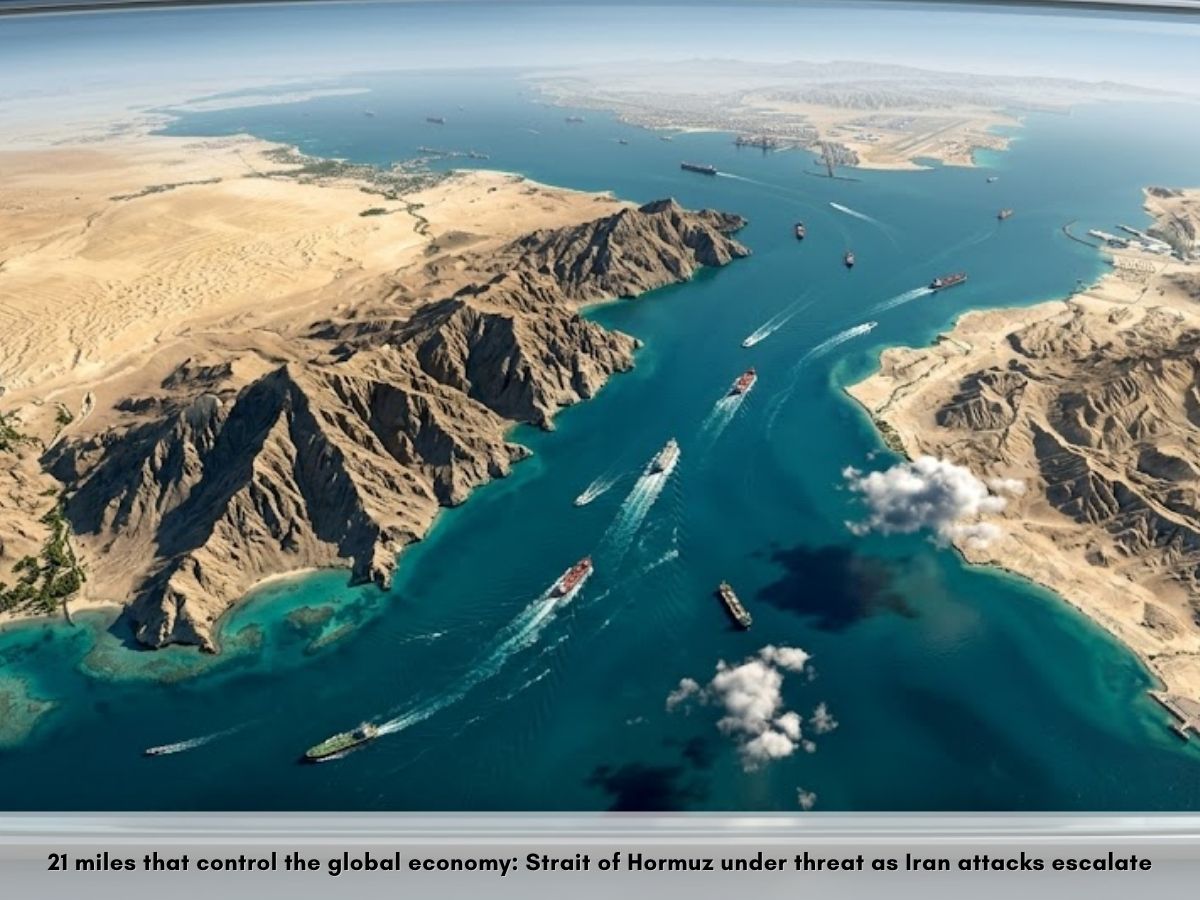
Strait of Hormuz (Image: File)
As US and Israeli strikes on Iran trigger retaliatory missile attacks across the Gulf, a narrow 33-kilometer waterway has become the world's most watched economic flashpoint. The Strait of Hormuz, the only sea passage connecting Persian Gulf oil producers to global markets, now holds the global economy hostage .
The Strait of Hormuz is a narrow sea passage connecting the Persian Gulf to the Gulf of Oman, and beyond that, the Arabian Sea and the Indian Ocean . It forms a critical maritime corridor between:
The shipping lane itself is remarkably slim—two two-mile traffic lanes for incoming and outgoing vessels, separated by a two-mile buffer zone. At its narrowest point, the strait is just 33 kilometers (21 miles) wide, placing every passing ship within easy reach of Iran's coastline .
Every major oil-producing nation in the Persian Gulf must route its exports through this single passage. There is no overland alternative, no bypass canal, no pipeline network that can replace it . The countries dependent on Hormuz include:
| Country | Status |
|---|---|
| Saudi Arabia | World's largest oil exporter |
| Iraq | OPEC's second-largest producer |
| Kuwait | Major OPEC producer |
| UAE | Top 10 global producer |
| Qatar | World's largest LNG exporter |
| Iran | Major OPEC producer |
| Bahrain | Regional producer |
What makes it irreplaceable: Saudi Arabia's East-West Pipeline—a 1,200-kilometer infrastructure built to bypass Hormuz—can carry 5-7 million barrels per day to the Red Sea . The UAE's Abu Dhabi Crude Oil Pipeline adds about 1.5 million barrels per day . Combined, they don't make up half of what normally transits through Hormuz on a given day .
Roughly 20 million barrels of crude oil—or one-fifth of the entire world's daily consumption—pass through the Strait of Hormuz every day, according to the US Energy Information Administration .
Iran's coastline forms the entire northern bank of the Strait of Hormuz . This geographic reality gives Tehran significant military leverage:
The 1980s Iran-Iraq War was dubbed the "Tanker War" after both nations attacked oil vessels in the vicinity. Today's crisis marks the most severe escalation since the 1991 Gulf War .
While oil markets are closed today, any credible threat to the Strait of Hormuz historically sends crude prices soaring . Short-term price impacts typically range from:
India faces an acute vulnerability that few other major economies share. Unlike Europe or even China—which have pipeline networks—India relies almost entirely on seaborne crude .
India's strategic reserves are dangerously thin compared to global standards :
| Reserve Type | Days of Coverage |
|---|---|
| Strategic reserves | 9-10 days |
| Commercial reserves | 74-75 days |
| Total | 83-85 days |
| IEA recommendation | 90 days |
India holds 9.5 million barrels of strategic reserves—enough for just over a week of normal consumption. Even when combined with commercial stocks, India falls short of the International Energy Agency's recommended 90-day buffer .
India confronts two simultaneous chokepoint risks:
If both chokepoints close simultaneously, India's crude imports could grind to a halt within weeks.
Beyond oil, the crisis threatens the lives and livelihoods of approximately 90 lakh (9 million) Indians living and working across Gulf countries .
With Tehran's retaliation expanding to Dubai, Abu Dhabi, and Bahrain:
A. Iran can use naval strikes, anti-ship missiles, or mining to obstruct shipping. But doing so would be considered an act of war, and the United States would probably respond militarily. Iran has previously made threats of closure but has never carried them out.
A. Limited bypass capacity is offered by the UAE's Abu Dhabi Crude Oil Pipeline (1.5 million barrels per day) and Saudi Arabia's East-West Pipeline (5-7 million barrels per day). They manage less than half of the typical Hormuz traffic when combined.
A. Any disruption would cause global crude prices to spike 20-40% in the short term, which would translate directly to higher gasoline, diesel, and aviation fuel prices worldwide within days .
A. India has approximately 83-85 days of total oil reserves (strategic plus commercial), falling short of the 90-day international recommendation. After reserves are exhausted, India would face severe fuel shortages .
Disclaimer: This information is based on inputs from news agency reports. TSG does not independently confirm the information provided by the relevant sources.
