
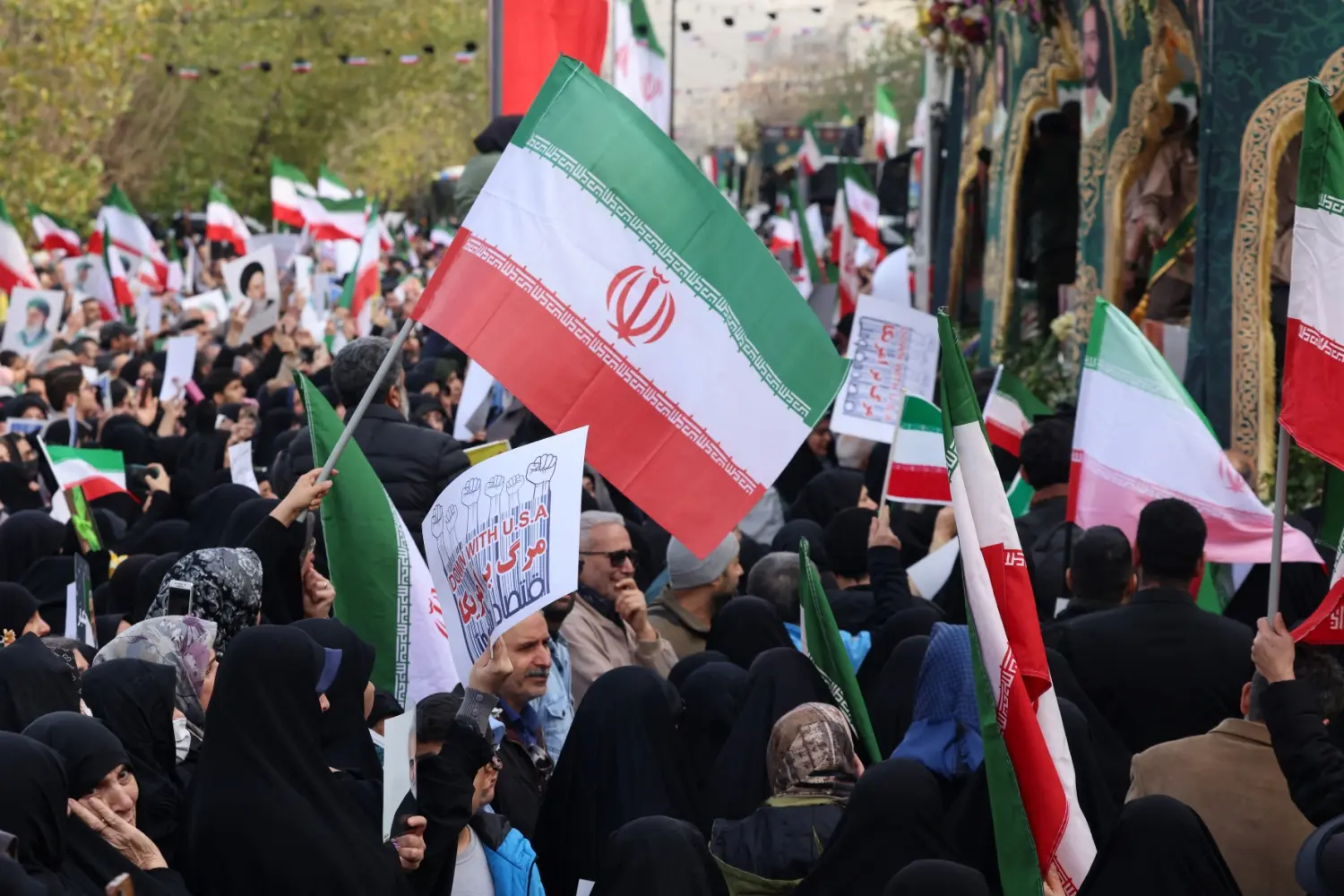
London: Body bags lay piled across Iran, from west to Baluchistan in the east and as far south as the refinery town of Abadan. No region was spared.
An Iranian official told Reuters that more than 2,000 people had been killed during 839 protest incidents nationwide, while insisting that “terrorist protesters were to blame.” Thousands more were arrested. Sources within Iran’s opposition circles claim the true death toll among protesters is far higher, possibly reaching 10,000, which—if verified—would make this the bloodiest crackdown in the Islamic Republic’s history.
Human rights organisations and independent observers, however, place responsibility squarely on Iran’s security forces. Police units, the Islamic Revolutionary Guard Corps (IRGC), and Basij militias were seen using live ammunition, shotgun pellets, tear gas and water cannons against largely peaceful demonstrators. Many victims were shot in the head, with eyes a frequent target.
The unrest followed a summer marked by chronic water shortages and electricity outages. By December, the national currency was in free fall, while runaway inflation pushed food prices up by more than 70 percent year-on-year—outcomes of mismanagement, corruption and sanctions that the revolutionary oligarchy has knowingly courted and, in some cases, exploited for profit.
Significantly, the first protests on 28 December were not led by hijab-discarding young women of the kind who led the “Woman, Life, Freedom” movement in autumn 2022. Instead, this wave of anger erupted among the revolution’s traditional supporters: ageing, religiously conservative bazaar traders whose shops stood empty amid economic collapse. Within days, demonstrations spread to all 31 provinces and snowballed into a mass movement, drawing in not only unemployed youth but also middle-class Iranians who had largely stayed home during previous upheavals.
It is now evident that the Islamic Republic is in profound distress, exposed once again as lacking not only democratic legitimacy but even basic governing competence. The state has effectively fragmented into clusters of military and financial elites enriching themselves without the pretence of serving the public interest. Of the past four major protest waves, three were triggered by the regime’s inability to provide economic security.
Internationally, Iran has become one of the world’s most isolated countries, and for the first time in nearly four decades it faces the realistic prospect of leadership change. Supreme Leader Ayatollah Ali Khamenei, in power since 1989, is 86 years old and visibly frail. The central question is no longer merely who will succeed him, but what kind of political order will emerge afterward.
Khamenei’s 36-year rule has rested on two uncompromising pillars: absolute fidelity to revolutionary ideology and total rejection of political reform. He has long believed that ideological relaxation would replicate the Soviet Union’s collapse under Mikhail Gorbachev, accelerating disintegration rather than preventing it. Normalisation with the United States, in his worldview, was not a route to stability but an existential threat.
This rigidity has left Iran suspended between prolonged decay and sudden rupture. Once Khamenei exits the stage, Iran’s future will be shaped not only by institutions but by a deeply ingrained political culture forged through trauma and mistrust. Modern Iranian history is scarred by invasions, coups and humiliations. In the nineteenth century, the country lost vast territories to Russia and Britain; in 1953, a US and British backed coup overthrew Prime Minister Mohammad Mosaddeq. These experiences cultivated a paranoid style of governance in which rulers perceive conspiracies everywhere and trust no one.
This mindset predates the Islamic Republic. Reza Shah, founder of the Pahlavi dynasty, trusted almost nobody. His son, Mohammad Reza Shah, later claimed that “American betrayal had cost me my throne.” The clerical regime inherited and intensified this suspicion, with Ayatollah Khomeini executing thousands as alleged foreign agents while routinely invoking American and Zionist plots. Paranoia permeated society as well.
In such an environment, loyalty trumps competence, mediocrity rises, and institutions bend to personal rule. Khamenei’s own elevation in 1989, despite limited clerical stature, reflected this negative selection, and the same logic is likely to shape his succession.
Authoritarian transitions rarely follow scripts. Khamenei’s death would be the most obvious catalyst for change, but external shocks—economic collapse, renewed sanctions, fresh military strikes—could accelerate instability. Unexpected internal triggers could do the same. History shows that revolutions are often ignited not by grand strategies but by singular, symbolic events.
Like the late Soviet Union, the Islamic Republic sustains an exhausted ideology through coercion while society quietly disengages. If that ideology collapses, it may not produce democracy but instead nihilism, oligarchy and grievance-fuelled nationalism. A strongman emerging from the Revolutionary Guards or intelligence services could discard Shiite theology while retaining authoritarian habits, promising dignity and order in place of faith.
Another potential path is an Iranian version of China: an authoritarian system that survives by pivoting toward economic growth and global integration. This model has long appealed to regime insiders who recognise that ideology alone cannot feed a population. Yet China’s transformation required visionary leadership and normalised relations with the United States—both consistently blocked by Khamenei. Even if a successor attempted such a shift, Iran’s rentier economy and entrenched corruption would make delivering rapid, broad-based prosperity far more difficult than China’s experience.
The bleakest scenario resembles North Korea. A hard-line clerical succession, possibly involving Khamenei’s 56-year-old son Mojtaba, would preserve ideological purity through intensified repression and isolation. Yet hereditary succession would betray the revolution’s anti-monarchical origins, and few Iranians appear willing to endure an even harsher version of the existing system. Such a regime would likely depend heavily on the Revolutionary Guards and perhaps on acquiring nuclear weapons as an ultimate shield.
Increasingly, Iran already resembles Pakistan—not a country with an army, but an army with a country. The IRGC has evolved into a vast conglomerate encompassing military power, business interests and political authority. It controls strategic industries, oversees the nuclear programme and dominates regional interventions. Khamenei’s personal authority has contained internal rivalries within the Guards; his departure could unleash them.
An IRGC-dominated Iran would likely replace clerical ideology with nationalism. Generals would invoke the nation rather than God, producing either a confrontational strongman—an Iranian analogue to Vladimir Putin—or a more pragmatic authoritarian seeking accommodation with the West, similar to Egypt’s Abdel Fattah el-Sisi. In either case, the nuclear question would loom large, shaped by a lesson many Guards draw from history: regimes without nuclear weapons fall.
There is also a more ambiguous trajectory, loosely comparable to Turkey under Recep Tayyip Erdogan: a populist leader rising through elections, delivering initial reforms, then consolidating power into majoritarian authoritarianism. For Iran, this would require dismantling theocratic veto points and empowering elected institutions. Local councils and municipal structures exist, but political will does not. A populist outsider could emerge, channelling anger against elites and foreign enemies alike. Such a path would not deliver liberal democracy, but it would represent a decisive break from clerical rule.
History counsels humility. In late 1978, experts confidently misread Iran’s future, dismissing the possibility of clerical domination. Today, outlier scenarios are again plausible: a monarchist restoration, ethnic fragmentation, or something entirely unforeseen. Yet Iran’s strong national identity, shared language and long civilisational continuity argue against outright disintegration.
Amid all the models and analogies, one truth stands out. Iranians are not yearning for grand ideologies. They want normal lives—competent governance, economic dignity, and freedom from a state that polices clothing, beliefs and private behaviour. The Islamic Republic has squandered half a century chasing revolutionary and religious fantasies while its neighbours surged ahead. Iran still possesses immense human and natural capital and could yet evolve into a G20-level economy.
Change is coming. The only question is whether it will finally bring renewal, or simply replace one winter with another.
John Dobson is a former British diplomat, who also worked in UK Prime Minister John Major’s office between 1995 and 1998. He is currently a visiting fellow at the University of Plymouth.




