President Macron has announced that 2026 will be the Year of Innovation between France and India. As he visits, several issues are likely to be considered, and some important agreements are expected.
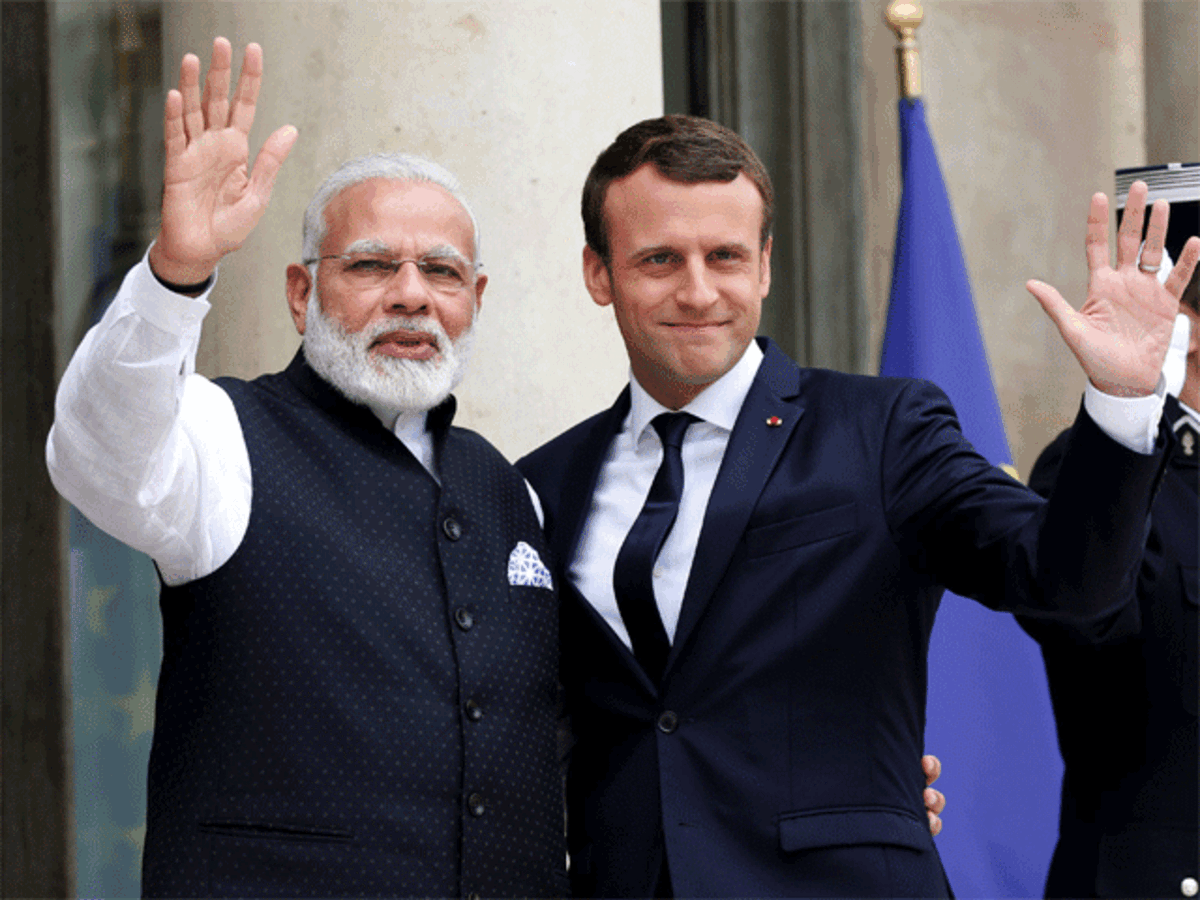
PM Modi with French President Emmanuel Macron (File Photo)
NEW DELHI: Emmanuel Macron will be visiting India for the fourth time on 18 February 2026. He will attend the India AI summit 2026 which will be the first-ever global AI summit hosted in the Global South.
His first visit in March 2018 aligned itself to the founding conference of International Solar Alliance (ISA) and a corresponding 100 MW solar power plant inaugurated by him in Mirzapur, Uttar Pradesh. He visited for the second time to attend the G20 Summit, which was held under India's Presidency. Bilateral talks were held on the sidelines of the summit which focused on the Horizon 2047, a 25-year strategic roadmap explicitly aimed at strengthening India-France bilateral relations. This aimed at marking 50 years of strategic partnership and 100 years of India's independence.
He visited the third time as the Chief Guest for India's 75th Republic Day celebrations in 2024, wherein he announced an additional funding of €3.5 million for university cooperation, particularly in the field of Life Sciences for Health. Macron has further announced that 2026 will be the Year of Innovation between France and India, sketching new contours of this partnership. As he visits this time around, several issues are likely to be considered, and some important agreements are expected.
Beyond economics, the strategic partnership, launched on January 26, 1998, was India's first ever strategic alliance for strengthening ties through closer bilateral cooperation. The overall contours have since expanded immensely in the recent years to include stability in the Indo-Pacific, digital public infrastructure, cyber security, advanced computing, climate action, artificial intelligence and renewable energy. India is a huge market for defence, energy and aeronautics, apart from consumer goods and is energy hungry with a buoyant economic trajectory. In geopolitical construct, India's rightful place in a multipolar world is well defined, especially to Europe, which has realised the risks of over reliance on its traditional trans-Atlantic ally and an exacting China.
Civil nuclear power cooperation is likely to be high on the agenda. France operates 57 nuclear reactors and generates 65% of its power requirement with nuclear power as the very core of its energy strategy. This primarily began as an after effect of the 1973 oil crisis and there have been several collaborations with India in this domain. The Jaitapur project, a collaboration between France's EDF (Électricité de France) and India's Nuclear Power Corporation of India Limited (NPCIL), which is set to be built in Ratnagiri, Maharashtra, under a 2008 civil nuclear cooperation, may figure in the overall agenda. This agreement could feature in the overall gamut with financing mechanism and construction of six 1,650 MW European Pressurised Reactors (EPRs), giving the plant a total installed capacity of 9.6 GWe. Once operational, it could supply clean energy to 70 million Indian homes and prevent 80 million tonnes of CO₂ emissions annually.
In Financial Year 2024-25, the bilateral trade with France stood at about 12.92 billion euros. While the exports to France registered a growth of 11.42% to reach Euros 6.89 billion, petroleum products accounted for Euros 0.99 billion. Imports from France were about Euros 6.03 billion, essentially with aircraft, spacecraft and parts accounting for about Euros 2.11 billion. France is India's fifth largest trading partner in the European Union and is the 11th largest investor in terms of FDI inflows.
More traction in the Indo-Pacific has been achieved by India and France collectively by setting up an Indo-Pacific Triangular Cooperation (IPTDC) Fund as a new initiative in 2023. India and France have been major partners in defence sector since the 1950s. Notable French weapon systems which have been in service transcend all the three services. The land component consists of battle winning AMX-13 light tanks and MILAN anti-tank missiles. Under the Scorpene project, six submarines were constructed for the Indian Navy, with the sixth and final submarine, INS Vaghsheer, commissioned in January 2025.
The air component is a major avenue of collaborations and procurement with Dassault Ouragan (Toofani) and Mystere in the 1950s, Aérospatiale Alouette III and SA 315B Lama, known as Chetak and Cheetah in the late 1960s, SEPECAT Jaguar in the late 1970s, Mirage 2000s in late 1980s and Rafale multirole fighters in the recent years. The entire air power landscape not only consists of procurement but also periodic upgradation, licensed production of some platforms and weapon system integration. Post clearance by the Defence Acquisition Committee, a landmark procurement of 114 Rafale fighter jets for the Indian Air Force, which is worth around Rs 3.25 lakh crores could be signed as a government-to-government agreement with a large tranche of Indian component. Indian Air Force operates 36 Rafales, and the Indian Navy is also poised to procure and induct 26 Rafale M, which is the carrier-borne version of this versatile aircraft.
The existing missile inventories could be expanded with SCALP, Meteor, AASM Hammer, ASRAAM, and MICA NG, with the possibility of manufacturing in India through the already established L&T-MBDA joint venture. There could be a possibility of integrating the AASM Hammer and ASRAAM missile with LCA Tejas as well. In terms of transport aircraft, 16 C-295 aircraft have already been inducted and 40 more are to be built by Tata-Airbus collaboration in Gujarat. The H125 helicopter is in contention for the Army's reconnaissance role, and platforms like the A400M, AS565 MBe Panther, and possibly even the A330 MRTT tanker for replacing the current tanker fleet could feature in discussions.
There is a vast scope of collaborations in Digital Public Infrastructure (DPI) between the two large economies. India's Unified Payment Interface (UPI) was launched in Paris in 2024, facilitating easy payments for Indian tourists. There have been enabling Artificial Intelligence (AI) roundtables between both countries. These forums have greatly emphasized the need for democratized access to AI resources, capacity building, importance of techno-legal frameworks, besides multilingual LLMs, federated AI compute infrastructure, and interoperable access to AI research.
Both countries do have their respective regional interests and unique problems, with potential to create diverging priorities. Balancing these dynamics and aligning interests towards mutual benefit will, however, be the key. Meaningful collaborations in terms of STEM related R&D, minerals, chemicals, clean energy, and joint workforce development could be five sectors of engagement for both nations to jointly harness technologies of the future. This could provide the proverbial "shot in the arm" to the existing security ties. Expanded collaboration could further align both the vectors of security and technology, more so after an enabling Free Trade Agreement with EU earlier this year and growing defence ties for interoperability and joint force projection in the future. The menu has several delectable savouries—the palette and timing will decide the order. Bon appetit!
* Anurag Awasthi is a veteran, and CEO of Escape Velocity Mediaworks. He is a known policy expert and a columnist who writes extensively on critical technologies, security and geopolitics. Views are personal.
