
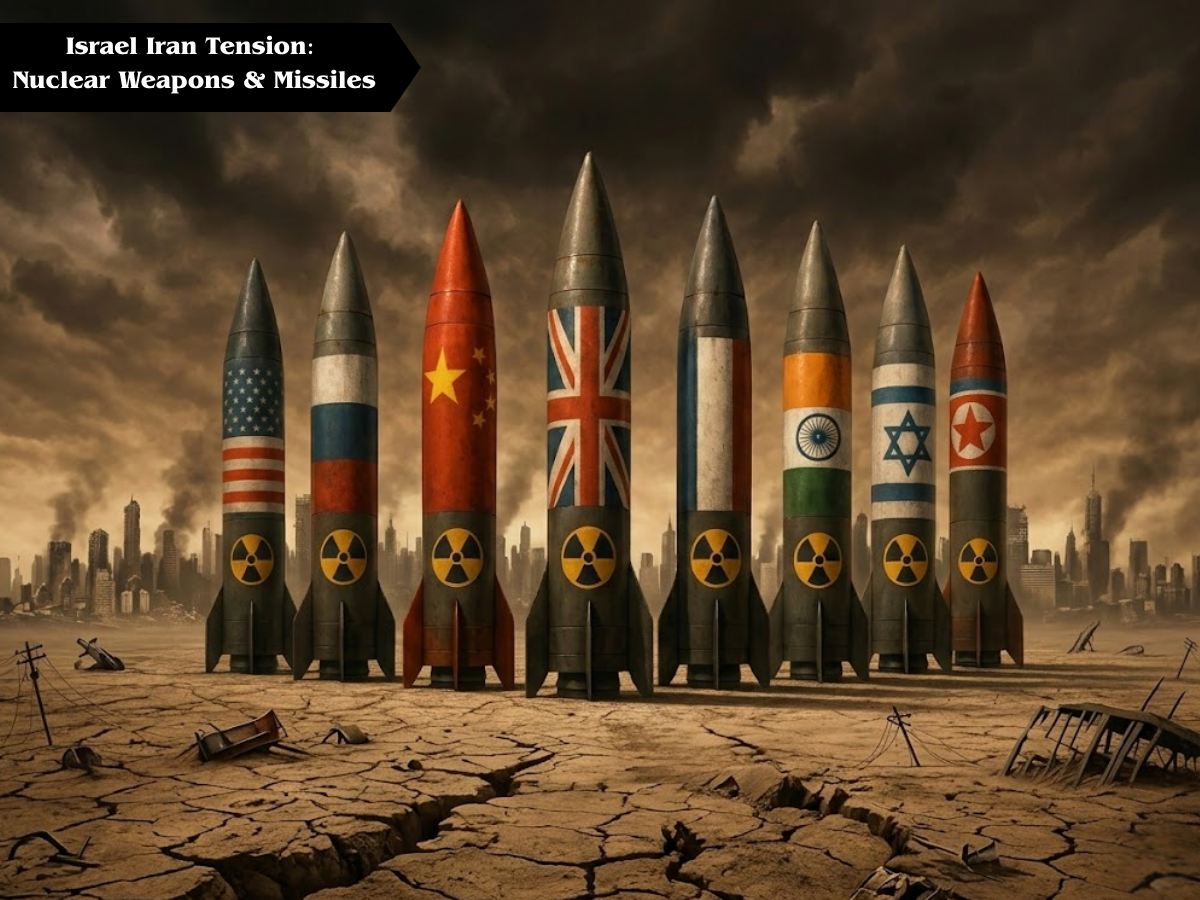
Israel Iran War: Nuclear weapons have always been one of the most effective and controversial weapons of contemporary war. Even though the stockpiles around the globe have drastically reduced since the height of the Cold War they still influence diplomacy, deterrence, and conflict. There are 9 countries which possess the world nuclear warheads and their arsenal affects global politics and calculations of security.
Which Countries Have Nuclear Weapons?
As of early 2025, nine states are confirmed or widely believed to possess nuclear weapons. These are:
|
Country |
Total Inventory |
Military Stockpile |
Status |
|
🇷🇺 Russia |
5,459 |
4,309 |
Modernizing and Largest arsenal |
|
🇺🇸 United States |
5,117 |
3,700 |
Modernizing and Broadest alliance |
|
🇨🇳 China |
600 |
600 |
Rapidly expanding stockpile |
|
🇫🇷 France |
290 |
290 |
Stable and Mostly sea-based |
|
🇬🇧 United Kingdom |
225 |
225 |
Increasing its cap to 260 |
|
🇮🇳 India |
180 |
180 |
Increasing stockpile |
|
🇵🇰 Pakistan |
170 |
170 |
Increasing stockpile |
|
🇮🇱 Israel |
90 |
90 |
Policy of nuclear opacity |
|
🇰🇵 North Korea |
50 |
50 |
Actively testing and expanding |
Together, these nations hold an estimated around 12,200–12,331 nuclear warheads.
Which Countries Hold the Largest Nuclear Arsenals?
Nuclear arsenals are greatly concentrated in the whole world around 87-90% of all warheads are under the control of Russia and that of the United States; both of which have over 5,000 warheads. The U.S is having an estimated warheads of about 5,100-5,177 and Russia having 5,400-5,459. China is ranked third with approximately 600 warheads, France (approximately 290), UK (approximately 225), India (approximately 180), Pakistan (approximately 170), Israel (approximately 90) and North Korea (approximately 50).
What are the Implications of Countries Possessing Nuclear Weapons
The ownership of nuclear weapons has a massive humanitarian and strategic implication. Hundreds of thousands of people will die immediately in the event of a single nuclear explosion and the effects on the environment will be long-term. Nuclear arsenals serve as deterents – discouraging physical assaults by other nuclear nations – but also as an impediment to diplomacy and local disputes, as opponents refine military and political reactions.
What are Tactical Nuclear Weapons?
Tactical nuclear weapons are meant to be used on the battlefield or in the limited areas but not on strategic attacks over a long distance. They may be referred to as low yield yet, they can carry explosive power which is much better than the conventional explosives. These weapons are making the boundaries between the conventional and nuclear war in the sky and increasing the risk levels due to the fact that they can be perceived as more applicable in a crisis.
Which Six States Host Another Country’s Nuclear Weapons
Five European states host U.S. nuclear weapons under NATO nuclear sharing:
- Belgium – Hosts U.S. nuclear weapons under NATO nuclear-sharing arrangements.
- Germany – Hosts U.S. nuclear weapons, contributing to European deterrence strategy.
- Italy – U.S. nuclear warheads are stationed for alliance defense purposes.
- Netherlands – Part of NATO nuclear-sharing program with U.S. oversight.
- Türkiye (Turkey) – Hosts U.S. nuclear weapons as part of NATO defense planning.
- Belarus – In 2023, announced hosting Russian tactical nuclear weapons.
There are also unconfirmed reports that Belarus is hosting Russian tactical nuclear weapons, part of shifting strategic postures among nuclear powers.
Who are the 28 Countries Backing Nuclear Weapons Strategy
Indirectly, almost 28 other nations support nuclear arms by being defense allies, who also seek security assurances by having nuclear-capable allies. This category covers most of the NATO members, as well as other states that enjoy the nuclear deterrence commitments, yet do not have their own arsenals.
- Albania
- Armenia
- Australia
- Belarus
- Belgium
- Bulgaria
- Canada
- Croatia
- Czech Republic
- Denmark
- Estonia
- Finland
- Germany
- Greece
- Hungary
- Iceland
- Italy
- Japan
- Latvia
- Lithuania
- Luxembourg
- Montenegro
- Netherlands
- North Macedonia
- Norway
- Poland
- Portugal
- Romania
- Slovakia
- Slovenia
- South Korea
- Spain
- Sweden
- Türkiye
Israel Iran Tension: What Happened in Iran
The recent military events in Iran have been as a result of the escalating tension in the region and threats of nuclear and missile development. At the beginning of 2026, the troops of the U.S. and Israel launched attacks on a number of Iranian targets, including those around Tehran, and Iran fired at Israel and nearby U.S. bases. The information regarding victims and targeted effects is scanty, yet the war demonstrated the concerns about the growth of the conflict between the nuclear-armed neighbors.
Israel Iran Tension:Why are the US & Israel Attacking Iran?
The United States and Israel have referred to old fears regarding the nuclear enrichment programs of Iran and its ability to launch ballistic rockets. Israeli officials have justified military coercion to ensure that Tehran does not acquire the nuclear delivery system and that the U.S. officials believe that the attacks are geared towards limiting the military of Iran and discouraging the state to unleash more extensive hostility.
Israel Iran Tension: Could Nuclear Strikes Occur Amid US-Israel Attacks
It is not mentioned that U.S. or Israel have or will employ nuclear weapons in the war with Iran. The military have been using conventional forces in the military operations. Nuclear weapons are also strategic deterrents, not instruments of active fighting on the battle field – and employing it would be a drastic move with disastrous effects.
FAQ’s: Nuclear Weapons
How many nuclear warheads exist today?
About 12,200–12,331 global warheads are estimated as of early 2025.
Do nuclear weapons still decline?
Yes, overall inventories are lower than Cold War peaks, but growth is slowing and some nations are modernizing.
Which country has the largest arsenal?
Russia holds the most, closely followed by the United States.
Are nuclear weapons only in those nine countries?
Yes, current public estimates list nine nuclear states.
Can nuclear weapons be used legally?
International law heavily restricts nuclear use, and no formal authorization exists for their use outside wartime self‑defense.




