
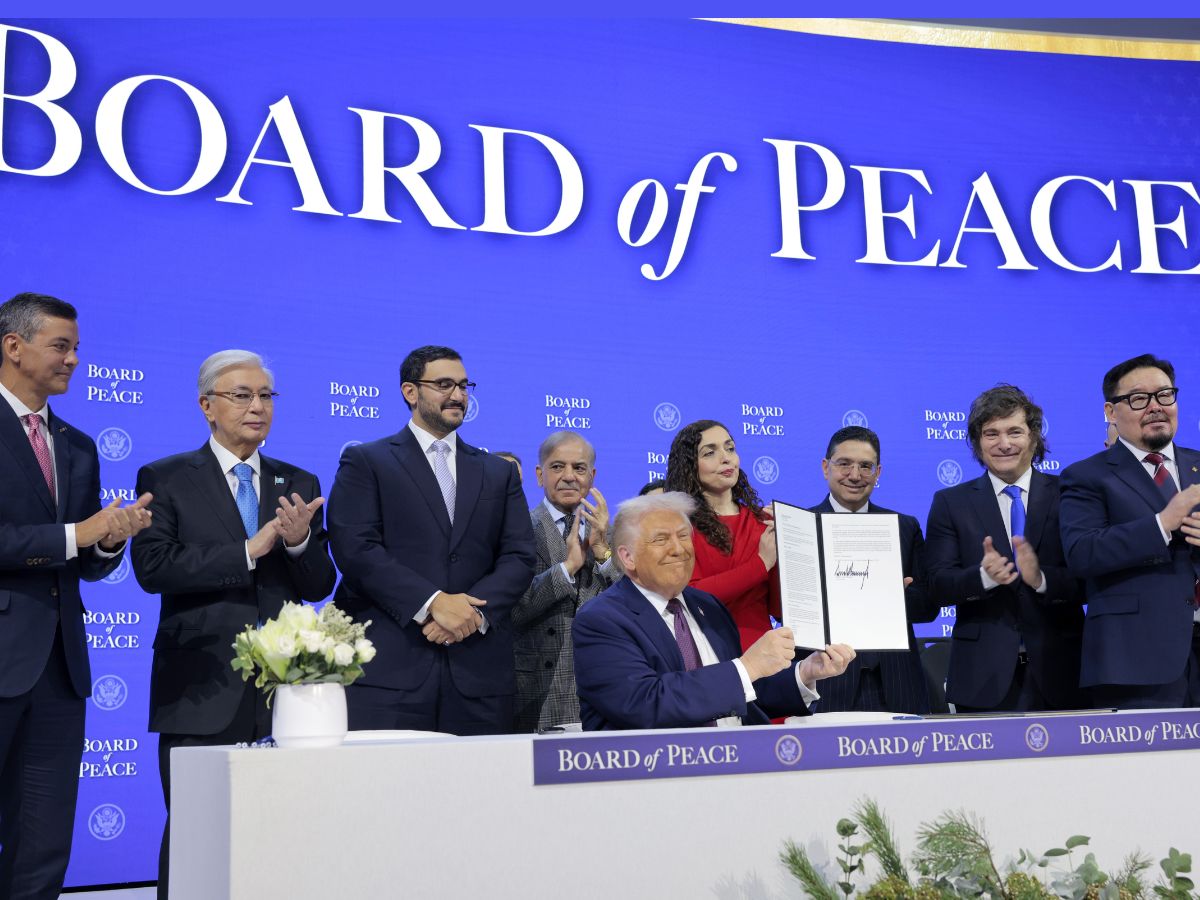
US President Donald Trump unveiled his much-talked-about “Board of Peace” at the World Economic Forum in Davos. The setting promised global attention. The turnout did not. Despite Trump’s claim that the board would bring together the “biggest, most powerful people in the world,” fewer than 20 leaders and representatives showed up.
The room felt restrained. The applause was thin. Many influential leaders had already left Davos or quietly declined the invitation. The absence of major Western democracies raised questions about the board’s credibility and global appeal.
What is the ‘Board of Peace’?
Trump pitched the Board of Peace as a new international body focused on ending conflicts and reshaping global diplomacy. He linked it to his claims of brokering peace in multiple global flashpoints.
The initiative positions itself as a flexible alternative to traditional institutions like the United Nations. Trump insisted the board would still work “in conjunction” with the UN, even as he criticised the organisation as ineffective. The charter allows Trump to remain chair beyond his presidential term, a provision that has drawn scrutiny.
Board of Peace Signing: Who Are Trump ‘Superfans’?
The leaders who attended share a clear political pattern. Many openly admire Trump or align with his worldview. They favour strong executive power, nationalist policies, and scepticism toward multilateral institutions.
Argentina’s President Javier Milei, Hungary’s Prime Minister Viktor Orban, and Indonesia’s President Prabowo Subianto stood out among attendees. Several participants lead countries frequently criticised for democratic erosion or human rights concerns.
Their presence reinforced the perception that the board appeals most to leaders comfortable operating outside the liberal global order.
Only Trump Superfans Come for ‘Board of Peace’ Signing
The guest list revealed more through absence than presence. Few European leaders attended. Major economies stayed away. Many governments chose silence over public rejection to avoid provoking Washington.
One European official privately described the board as at risk of becoming “a gallery of rogues.” Countries critical of Russia’s war in Ukraine were unwilling to associate with a forum expected to include Vladimir Putin.
Trump appeared unfazed. “I like every single one of them, can you believe it!” he said while scanning the room.
Board of Peace: Sparse Turnout at Davos Signing Ceremony
The signing ceremony in Davos drew far fewer leaders than expected. Trump touted the event as historic and ambitious, but fewer than 20 nations attended in person. Many invited countries either sent low-level representatives or skipped the event entirely.
Among those present were some leaders and officials viewed as strong supporters of Trump’s style of leadership. Others — especially from Western Europe and North America stayed away. Observers noted that major powers like France, the United Kingdom, and Germany declined or did not send heads of state.
Trump acknowledged the mixed attendance during remarks in Davos, saying he liked “every single one of them” and calling the group powerful.
Board of Peace: Why Major Powers Stayed Away?
Diplomats cite several reasons for the boycott. Some countries objected to the board’s structure. Others questioned its overlap with existing institutions. Many were uneasy about Trump’s continued leadership role and the inclusion of authoritarian figures.
French President Emmanuel Macron publicly distanced himself from the initiative and faced Trump’s criticism soon after. Others used constitutional or parliamentary requirements as diplomatic cover to stay away.
Board of Peace: Countries That Joined
Despite the limited turnout, a number of states did sign on to the initiative. These came from a range of regions, including the Middle East, Central Asia, and parts of Europe and Africa. Nations such as Saudi Arabia, Qatar, Bahrain, Morocco, Pakistan, Hungary, Indonesia, and Azerbaijan were among those represented at the ceremony.
Pakistan’s participation, in particular, drew attention given regional tensions and global perceptions of peace diplomacy.
Controversies Surrounding the Board of Peace
Trump acknowledged concerns about Russia’s participation, including reports that Vladimir Putin could secure a seat using frozen assets. Trump dismissed objections, saying it was “fine” to “use his own money.”
He also addressed criticism over his long-term role. “It’s in theory for life. But I’m not sure I want that,” Trump said.
Board of Peace Officially Launched: What Comes Next?
The White House declared the signing a success. “The board of peace is now an official international organization,” press secretary Karoline Leavitt said.
The first conference is expected in Washington, with virtual participation likely for many members. Belgium has already denied signing the charter despite being listed by the US.
For now, the Board of Peace begins its journey with loyalty, not legitimacy, as its strongest asset.




