
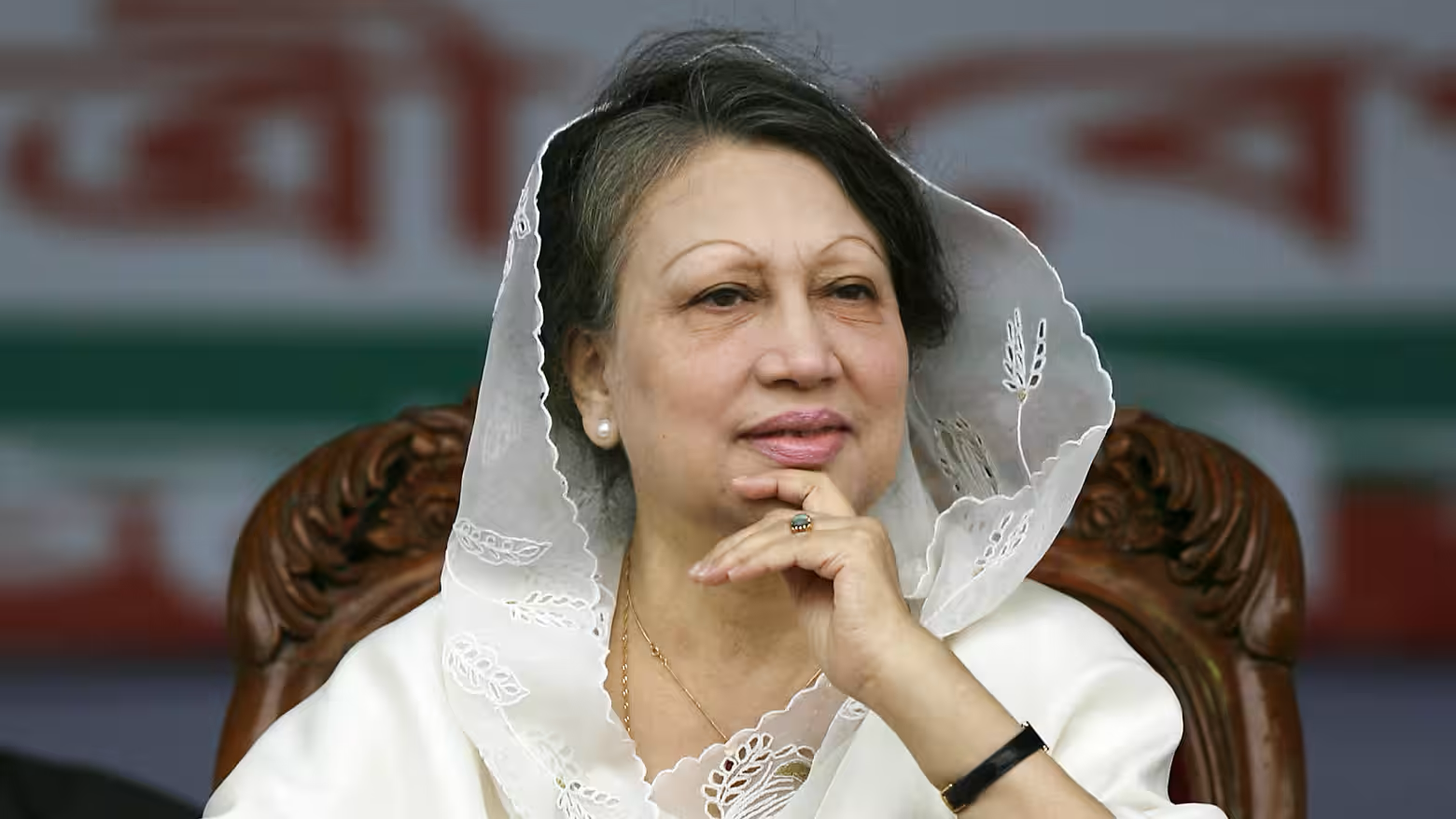
NEW DELHI: Begum Khaleda Zia, Bangladesh’s first woman Prime Minister, breathed her last on December 26, 2025. Known for her often complex and sometimes tense relationship with India, she was born on August 15, 1946, to Taiyaba and Iskandar Ali Majumdar in Dinajpur district in undivided India. Her father ran a business in Jalpaiguri, which was a part of the Bengal Province of British India. Her family moved to East Pakistan only in the 1950s.
It was in 2015 that Begum Zia had her last notable interaction with the Indian leadership. That was when she had come down to the Pan Pacific Sonargaon Hotel in Dhaka to meet Prime Minister Narendra Modi. A meeting that had raised multiple eyebrows even before it happened, with the then Bangladesh Foreign Minister Abul Hassan Mahmood Ali publicly stating that there would be little scope for a meeting between her and PM Modi. The claim, however, was quickly refuted by the then Indian Foreign Secretary Dr S. Jaishankar in no uncertain terms.
Incidentally, Dr Jaishankar, who is now the External Affairs Minister, represented India at Begum Zia’s funeral and met her eldest son and acting Chairman of Bangladesh Nationalist Party (BNP), Tarique Rehman, and handed over a letter of condolence from PM Modi. In his letter, PM Modi fondly recalled his last meeting with Begum Zia and described her as a leader of “rare resolve and conviction”.
With the BNP baton now being passed on to Tarique Rehman, who returned to Bangladesh after 17 long years of self-exile in Christmas last year, and deposed Prime Minister Sheikh Hasina’s Awami League being barred from contesting the upcoming general elections in February, the spotlight lies firmly fixated on BNP-India relations. BNP’s partnership with Jamaat-e-Islami, the internal dynamics of the party, and most importantly Begum Zia’s legacy are being watched closer than ever before.
Often dubbed as anti-Hindu and anti-India, Khaleda Zia, unlike Sheikh Hasina, has never been called a “friend of India” by political pundits. The unquestionable legacy of BNP’s strong ties with Jamaat-e-Islami and Pakistan has a lot to do with this. With the Yunus regime now cosying up to Pakistan, the questions are relevant than ever before.
In a freewheeling conversation with this reporter at her Gulshan office in Dhaka after her meeting with PM Modi, Begum Zia, however, had alleged that there was an orchestrated campaign by the Sheikh Hasina administration to project her as being “anti-India”. Talking about the controversy prior to her meeting with PM Modi, Begum Zia had said: “Did I for once say that I would not meet Modi ji? I had personally congratulated him on his electoral victory. Did you hear a single leader from our Bangladesh Nationalist Party say that I would not meet Modi ji? Modi ji is the leader of the world’s largest democracy. He is here in Bangladesh with an aim to strengthen ties between two countries. The confusion was deliberately created to send out wrong signals and they tried their level best and virtually left no stones unturned to ensure that my meeting with Modi ji did not happen”.
She went on to add: “Let me state the facts straight. Bangladesh Foreign Minister Abul Hassan Mahmood Ali publicly ruled out ‘any possibility’ of my meeting PM Narendra Modi during his stay in Bangladesh. But then New Delhi put out the facts straight. On the eve of Prime Minister’s visit and just hours after the statement from Bangladesh, Indian Foreign Secretary S. Jaishankar said in New Delhi that it was very much on and would happen. How can you justify this? I am thankful to the Indian authorities as this government in Bangladesh tried whatever they could to see to it that the meeting couldn’t happen. They did not want me to have any discussion with Modi ji”.
But then didn’t she also cancel her meeting with then President of India Pranab Mukherjee when he was visiting Bangladesh? Did her alliance partner Jamaat-e-Islami pressurize her from calling off the meeting?
Sharing what she called the “real story,” Begum Zia said: “Yes, it is a fact that I could not meet President Pranab Mukherjee during his state visit to Bangladesh. Jamaat-e-Islami had called a general strike then to protest conviction of its three top leaders for the 1971 war crimes. I had to call off my meeting with the President then as we received inputs that had I gone there to meet him, I would have been attacked. In fact, there could have been a life threat. And if you recall at that very spot near his hotel which I was supposed to cross, there was a petrol bomb explosion”.
But then why would BNP’s alliance partner Jamaat-e-Islami attack her? “Precisely, that is the point. Had anything happened to me, the entire blame would have been pinned on Jamaat. And that is what the game plan was of our opponents which we understood and the meeting was called off. Today I am sharing with you the real story,” she had said.
Begum Zia was unfazed when questioned about her so-called “anti-India, anti-Hindu” stand. Lashing out at her bete-noire Sheikh Hasina she had said: “Why should I be anti-India? There is a concerted propaganda by the ruling government to try and paint me as anti-India and anti-Hindu. India and Bangladesh have had very strong bonding and we recognize full well the contribution India made for our liberation. Prime Minister Modi’s visit is aimed at strengthening Indo-Bangla ties further. It suits them to project me as anti-India. There is a well-oiled propaganda machinery that works relentlessly to project me and BNP as anti-India”.
And what about Jamaat? “Jamaat is our alliance partner and that is it. In the alliance they have to listen to the BNP. Since we are talking about these issues, let me tell you that you would be stunned to know how religious minority population in Bangladesh, Hindus particularly, have suffered in the hands of Awami League. Their houses have been looted, land taken away, and we are projected as anti-Hindu? We are with Hindus and for the welfare of every citizen of the country”.
“There is a reign of terror that has been unleashed in Bangladesh,” she continued. “We are being attacked, our leaders are getting killed, nearly 20,000 leaders are missing and anyone who speaks out against the government is marked and attacked. It is worse than emergency here. And I am labelled as a Pakistani agent if I speak out. My husband Ziaur Rahman was the announcer of the Declaration of Independence. He was a Major when he revolted against Pakistan Army, can we forget that,” she had observed.
THE CURRENT SITUATION
However, the ground situation speaks otherwise. The spate of atrocities against minorities in Bangladesh of late including the bestiality unleashed on Dipu Das, Tarique Rehman’s closeness to the Jamaat-e-Islami, and Jamaat’s growing dominance in Bangladesh’s polity put a question mark on the way forward.
For the upcoming February elections, the Jamaat-e-Islami has stitched together a 10-party alliance bringing together all the Islamist parties of Bangladesh. The most recent addition to this group has been the National Citizens’ Party (NCP), formed by the “student leaders of the regime-change operation”.
US-based think tank International Republican Institute (IRI) recently released its own pre-election survey of poll-bound Bangladesh. The findings suggest 33% support for BNP followed by a close 29% support for Jamaat. If one adds up the two, they already have 62% support base. Add to this the 5% support for Islami Andolan Bangladesh and the 6% share for NCP, then the Islamist parties already have a clear upper hand.
And that is where the real test for Tarique Rehman lies. If he wants to indeed emerge as a democratically elected people’s leader, he needs to rise above his party’s internal arithmetic and pave the way for all-party inclusive elections. Incidentally Begum Zia and Sheikh Hasina had together been instrumental in toppling the military dictatorship of General Hussain Muhammad Ershad and bringing back democracy in the country; democracy, which now appears to be the biggest casualty in Bangladesh.
“Can democracy be achieved if political parties are banned from contesting elections? India has always underscored the need for free, fair, inclusive, and participatory polls in a peaceful atmosphere. If the February 2026 elections are held without the participation of the Awami League, with BNP and the Jamaat-e-Islami as the principal contenders, it can only be described as a friendly fight with a pre-determined outcome,” quips Veena Sikri, former High Commissioner of India to Bangladesh.
Incidentally, Bangladesh’s leading newspaper, Prothom Alo, whose office was recently set on fire by protestors following the death of 32-year-old youth leader Sharif Osman Hadi, also carried out a national survey. It not only projected a ground swell for BNP projecting Tarique Rehman as the Prime Minister but also stated that 69% respondents favoured participation of Awami League in the elections conditionally or unconditionally.
Questions also continue to linger on the National July Charter brought in by the interim government. While its constitutional validity is being questioned, the proposals contained in the Charter also relate to limiting the prime minister’s term and expanding the president’s powers.
With the prospect of a once-banned Jamaat-e-Islami dominated government coming to power in Bangladesh hanging heavy and the party’s strong advocacy for implementing Sharia law, and Pakistan continuing to pull invisible strings to avenge the ignominy of 1971 defeat, India will be monitoring the Bangladesh elections under a microscope.
A lot will depend on Tarique Rehman, who though yet to utter a single word of condemnation against the atrocities being perpetrated on minorities, avoided the language of vendetta and stressed on unity and inclusivity while addressing a mega rally in Dhaka. Whether Tarique, who already met Muhammad Yunus in London in June last year, merely echoes the Yunus regime’s position or engages with New Delhi on the blow-hot blow-cold philosophy of Begum Zia remains to be seen
Sourav Sanyal is a veteran award-winning journalist and
political commentator with extensive experience of reporting about Indo-Bangla relations.




