
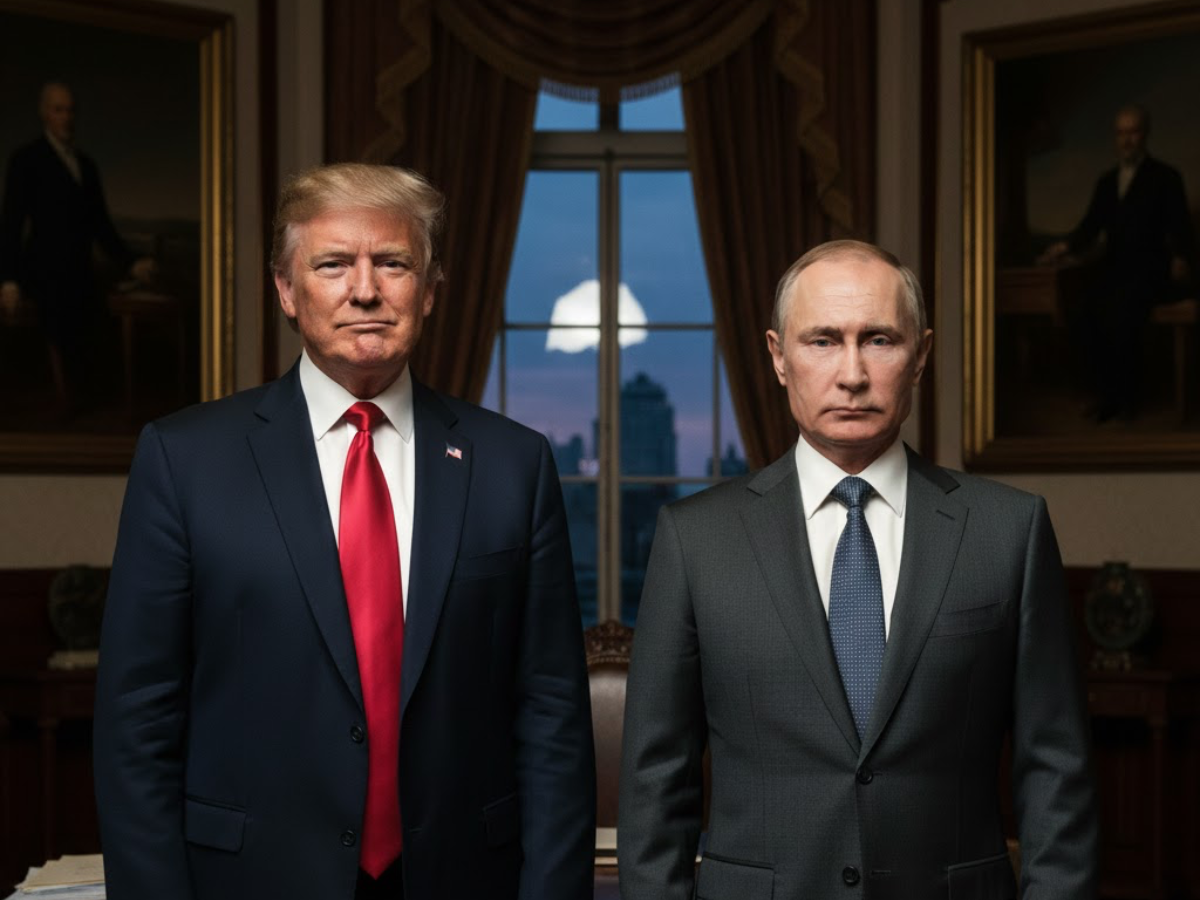
LONDON: Last Tuesday was one of those days when Vladimir Putin probably could not believe his luck. His long-cherished ambition of weakening the Western alliance and undermining the North Atlantic Treaty Organisation (NATO) appeared to be handed to him on a platter—by none other than his erstwhile friend, Donald Trump. The scenario was almost too implausible to imagine, the sort that normally exists only in dreams.
What if the United States were to threaten another NATO country, lay claim to its territory, and then withdraw its defence support for Europe? Surely, that would spell the end of NATO’s strategic objective: to prise apart the Atlantic Alliance.
From the earliest days of the Cold War, Moscow recognised that NATO’s strength lay not merely in American military power or European geography, but in the political bond binding the two. If that bond could be broken, the West would become manageable. If it endured, the Soviet project would remain contained. Every major Cold War crisis in Europe was shaped by this calculation.
When Nikita Khrushchev issued his 1958 ultimatum demanding the withdrawal of Western forces from Berlin, it was not because he believed the city could be seized without resistance; rather, Berlin represented the pressure point at which allied unity might fracture. “To make the West scream, I squeeze on Berlin,” he famously remarked the following year, capturing the logic that would drive Soviet policy for decades.
The construction of the Berlin Wall in 1961, repeated confrontations over access routes, and sustained nuclear brinkmanship were all designed to force Washington and its European allies into open disagreement. Later, under Leonid Brezhnev, the Kremlin refined this approach. The deployment of SS-20 intermediate-range nuclear missiles in the satellite states of central Europe was not merely a military manoeuvre; it was a political gambit. By placing new weapons closer to European capitals, Moscow hoped to frighten publics and governments into opposing any American response, thereby splitting NATO over strategy and risk.
Once again, the effort failed. The West argued, protested, marched, and debated, but ultimately held together. The dual-track decision to deploy American missiles while pursuing arms control demonstrated that, despite tensions, the allies would not allow Moscow the satisfaction of watching them fracture.
That record of unity was no accident. American and European leaders understood precisely what the Soviets were attempting, and however bruising their internal disputes became, they shared a core assumption: NATO’s credibility depended on solidarity. The certainty that an attack on one would be met by all was what preserved peace, and it was this belief—more than any treaty clause or weapons system—that deterred war.
Now, the fissure Putin has long yearned for appears to be opening from within.
The President of the United States has laid claim to the sovereign territory of a NATO ally, Denmark, and threatened the use of force to secure it. The dispute over Greenland—an autonomous territory whose future rests with its inhabitants and Copenhagen—has been transformed into a test of alliance cohesion.
Donald Trump escalated matters further by imposing punitive tariffs on eight allied countries, including Britain, not in response to any hostile act, but for insisting on what ought to be a shared principle: that borders and sovereignty are not bargaining chips.
On Monday, the confrontation took an even darker turn. In a leaked letter to Norway’s Prime Minister, Jonas Gahr Støre, Trump suggested that his failure to secure the Nobel Peace Prize had freed him from any obligation to “think purely of peace”. He asserted that Denmark had no “right of ownership” over Greenland and that America’s “complete and total control” of the island was essential for global security. It was a remarkable communication—a threat framed as grievance, directed not at an adversary but at a fellow NATO member.
The cumulative effect has been to push relations between the United States and Europe into territory that would have been unthinkable only a few years ago. Faced with looming tariffs and persistent threats, the European Union prepared to invoke its “anti-coercion instrument,” proposing €93 billion in levies on US exports. This extraordinary mechanism, never previously deployed, was designed to deter economic bullying by hostile powers. That it might be used against the country that has underwritten Europe’s security for nearly eight decades speaks volumes about the depth of the rupture.
Instead of coordinating policy, allies prepared to damage one another economically. Instead of quiet diplomacy, disputes were conducted through threats and megaphones. For Putin, the spectacle could scarcely be more gratifying.
Although Trump later stepped back from his most aggressive tariffs and threats of force—announcing on Wednesday that a basic framework for future talks had been agreed—the damage may already have been done. Alliances depend not only on formal commitments but on trust. Once shaken, trust is difficult to restore. Who, after this episode, can be entirely confident that the United States would honour its NATO obligation to defend a European ally under pressure?
That question strikes at the heart of deterrence. During the Cold War, Soviet leaders understood that any attack on a NATO member would trigger a war with America—a war they could not win. That certainty kept tanks in their barracks and missiles in their silos. Peace itself rested on the belief that Washington’s word was unshakeable. If that belief erodes, so too does the stability it supports.
Britain’s Prime Minister, Keir Starmer, captured this reality succinctly on Monday when he observed: “Alliances endure because they are built on respect and partnership, not pressure. The use of tariffs against allies is completely wrong.” It was a statement of principle, but also a warning. By exerting pressure on friends—openly, publicly, and boisterously—Trump was not merely pursuing a hard-nosed negotiating tactic; he was undermining the foundations of the Atlantic Alliance.
For Putin, the implications are clear. If the United States is prepared to threaten its own allies over territory and trade, why should Moscow assume it would respond decisively to a crisis on NATO’s eastern flank?
Doubt, once introduced, is corrosive. It invites miscalculation, and in international politics miscalculation often precedes catastrophe. The tragedy is that this moment represents the fulfilment of a long-standing adversary’s ambition without that adversary having to lift a finger. The Soviet Union spent 40 years attempting to divide America and Europe and failed. Its successor state has pursued the same objective with equal determination and little success.
Yet now, through a mix of grievance, bravado, and coercion, the task is being accomplished from within the alliance itself. History suggests that alliances can survive severe strain—but only if their members remember why they exist. NATO was not created to enrich its members or flatter their leaders; it was created to prevent war by making aggression unthinkable.
That purpose demands restraint, mutual respect, and an understanding that strength is multiplied, not diminished, by solidarity. If these lessons are forgotten, the consequences will not be limited to tariffs or diplomatic spats. They will be measured in the balance of peace itself.




