
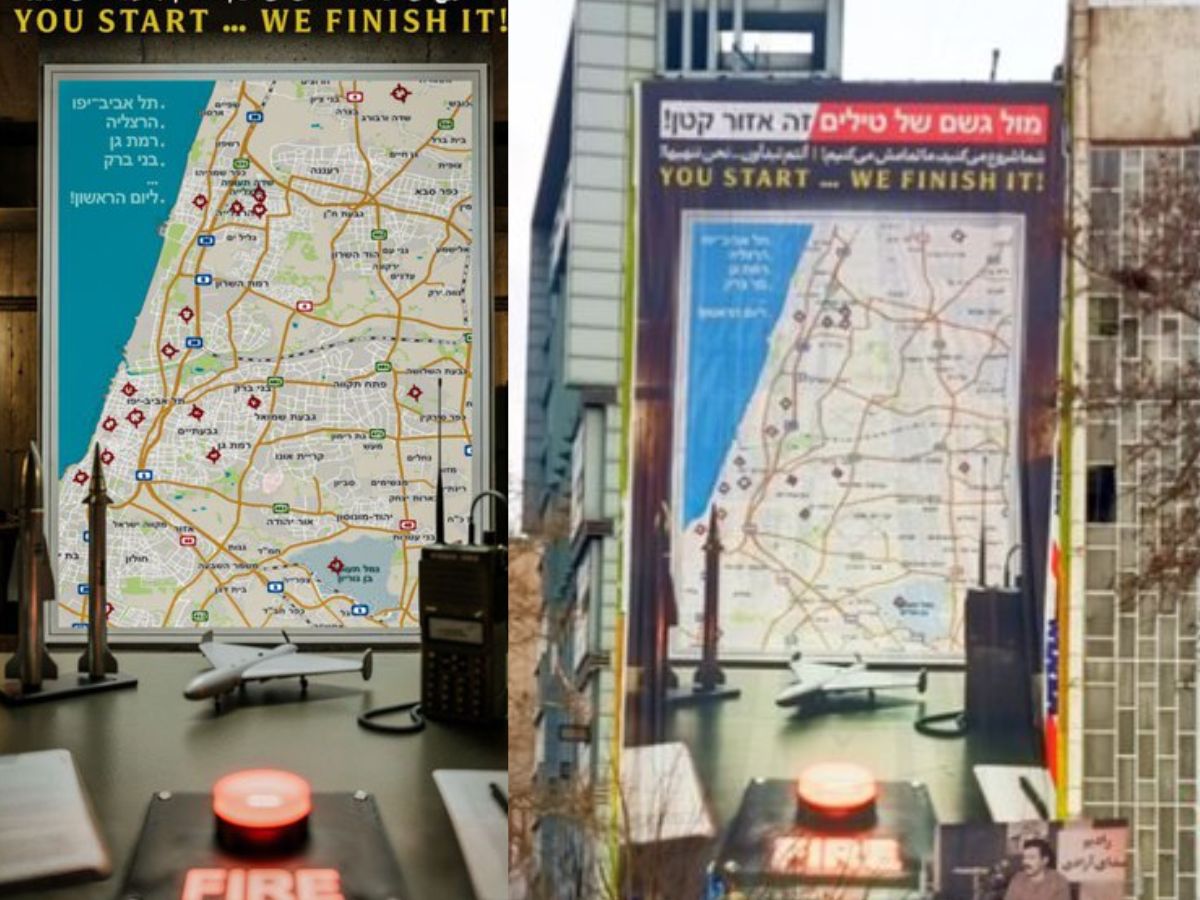
Iran has drawn global attention and heightened regional tensions by unveiling a dramatic missile target map in central Tehran that shows key Israeli locations — including sites in and around Tel Aviv- as potential targets in the event of conflict with Israel or the United States.
The bold public display, bearing the English threat “You start … We finish it,” underscores growing fears of escalation in the volatile Iran-Israel-US standoff and has sparked diplomatic unease and strategic recalculations across the Middle East.
‘You Start It… We Finish It’: Israel Map With Iranian Missile Targets Displayed in Tehran
A large banner displayed in Tehran’s Palestine Square showed a detailed map of central Israel marked with alleged missile targets, alongside the warning: “You start … We finish it.” The display highlighted strategic locations, including Ben-Gurion Airport and key Israeli military installations around Tel Aviv, signalling Iran’s readiness to retaliate if attacked by Israel or the United States.
‘YOU START IT… WE FINISH IT’ — ISRAEL MAP WITH IRANIAN MISSILE TARGETS DISPLAYED IN TEHRAN pic.twitter.com/OUoWnbFAU3
— RT (@RT_com) February 8, 2026
The imagery, featuring ballistic missiles and military symbols, appeared aimed at sending a public deterrence message amid rising regional tensions.
What the Iran Missile Map Shows?
The large banner, erected in Palestine Square in central Tehran, depicts a map of central Israel with several strategic targets highlighted. Among these are Ben-Gurion Airport, the Israel Defence Forces’ Kirya base headquarters in Tel Aviv, and intelligence facilities near Herzliya. Strategically, the map appears designed to signal that Iran’s ballistic missiles could reach densely populated and military areas if conflict erupts.
Interestingly, the map omits Jerusalem entirely, pointing instead to other major urban and military hubs. Alongside the map, the banner features military imagery — ballistic missiles, a jet and a bright red “FIRE” button — amplifying the message of retaliation.
Iran to Attack Israel? What the Tehran Missile Map Threat Means
Iran has publicly displayed what appears to be a missile threat map targeting key Israeli locations, including sites around Tel Aviv such as Ben-Gurion Airport and military bases. The banner, shown in central Tehran’s Palestine Square with the bold English warning “You start … We finish it,” suggests that Tehran wants to signal its readiness to retaliate if Israel or the United States strikes Iranian territory.
The map illustrates several strategic locations in central Israel — a symbolic and provocative act that comes amid ongoing hostilities and broader confrontation between Tehran and Jerusalem, which in recent years has included military exchanges and proxy conflict across the region.
Israeli authorities have not yet directly commented on the specific map threat, but the Israeli Defence Forces (IDF) maintain heightened alertness, and diplomatic efforts are underway to prevent escalation. The imagery and rhetoric underscore how quickly tensions can escalate into public displays of potential strikes — raising concerns about possible miscalculations in a region already marked by long-standing mistrust.
Targets Marked on Iran’s Israel Map: Key Locations Highlighted
The map displayed in Tehran reportedly marked several high-value strategic targets inside central Israel. The highlighted locations included:
- Ben-Gurion International Airport – Israel’s main international aviation hub
- The Kirya Military Headquarters, Tel Aviv – One of the Israeli Defence Forces’ most important command centres
- IDF Intelligence Directorate Base, Glilot – A major intelligence facility near Herzliya
- Strategic military installations around Tel Aviv – including command, logistics, and communications sites
The selection of these targets suggests a focus on military command structures, intelligence capabilities, and critical infrastructure, underscoring the seriousness of the warning message displayed on the banner.
Why Iran Displayed the Threatening Banner?
The display comes amid deteriorating ties between Tehran and both the United States and Israel. Iran has repeatedly asserted that it views military pressure and threats from Washington or Jerusalem as provocations that could trigger retaliation. Recent military warnings in Tehran have echoed this stance, with senior officials saying Iran would not hesitate to respond to any attack with “all-out war” and that American military assets would become targets if threatened.
Iran’s leadership—especially hardline factions—sees bold public displays like this map as a means of signalling resolve and deterring foreign intervention. By visibly outlining “rain of missiles” against Israeli cities, Tehran aims to shift the psychological balance in its favour, showing it can strike deep into Israeli territory if pressed.
How Israel is Responding to the Threat?
Israeli leaders have not immediately responded directly to the specific map, but security planners have been on heightened alert. The Israel Defence Forces (IDF) continue to monitor potential threats and maintain defensive preparedness, especially in the Tel Aviv metropolitan area and other central regions shown on the banner.
Prime Minister Benjamin Netanyahu is scheduled to meet with US President Donald Trump in the coming days, and regional security will be a key focus of those talks. Netanyahu has emphasised that any diplomatic or military discussions with Tehran must address not only nuclear ambitions, but also support for militant groups and direct threats to Israel.
US-Iran Tensions and Military Posturing
The display of the missile map comes against the backdrop of intensifying US military presence in the Middle East. The United States has moved warships, aircraft and other assets toward the region, reportedly as both a deterrent and a sign of readiness should renewed hostilities erupt. President Trump has publicly maintained that while negotiations and a nuclear deal remain an option, Iran cannot be allowed to develop nuclear weapons or threaten regional allies.
US envoys and military commanders recently visited the USS Abraham Lincoln carrier strike group in the Arabian Sea, underscoring Washington’s strategic emphasis on countering Iranian military capabilities. Trump has also issued warnings to Iranian leadership, including Supreme Leader Ayatollah Ali Khamenei, and implemented sanctions aimed at constraining Tehran’s economic and military reach.
Can a Nuclear Deal Defuse the Threat?
Analysts widely believe that a renewed nuclear agreement between the United States and Iran could ease the current tensions, particularly if Tehran agrees to halt uranium enrichment and revive international oversight. Such negotiations would aim to pull Tehran back into compliance frameworks that limit nuclear development while opening diplomatic channels to reduce military brinkmanship.
However, Iran has insisted that its ballistic missile program is non-negotiable, complicating talks. Trump, for his part, has stressed that any diplomatic deal must ensure no uranium enrichment or pursuit of nuclear weapons. With ballistic capability at the heart of Tehran’s deterrence strategy, bridging this gap remains a major diplomatic challenge.
What This Means for the Middle East?
The Tehran missile map’s public display is more than symbolic; it reflects deepening mistrust and the potential for miscalculation. In recent conflicts, Iran and Israel have traded missile and air strikes, with both sides testing defensive and offensive capacities. Experts warn that even signalling alone can heighten tensions and increase the risk of unintended escalation.
Should the conflict expand, neighbouring states and global powers would be forced to navigate a precarious diplomatic landscape, balancing deterrence, alliance commitments and regional stability.




